Category: Work in Canada

  • Hiring in Nova Scotia – PR pathway available! Inland candidates – CLB 5 required

    Hiring in Nova Scotia – PR pathway available! Inland candidates – CLB 5 required

    Jobs in Canada

    We’re Hiring! Labour Positions in a Chicken Farm in Nova Scotia!

    Are you an inland candidate with a valid PGWP/OWP and looking for a stable job opportunity in Canada? We have 10 positions available for Laborers to work on a chicken farm in beautiful Nova Scotia!

    Apply here

  • Start your career in Automotives! Applied for future opportunities with GTR Immigration & GreenTech Resources

    Start your career in Automotives! Applied for future opportunities with GTR Immigration & GreenTech Resources

    Apply now for future opportunities

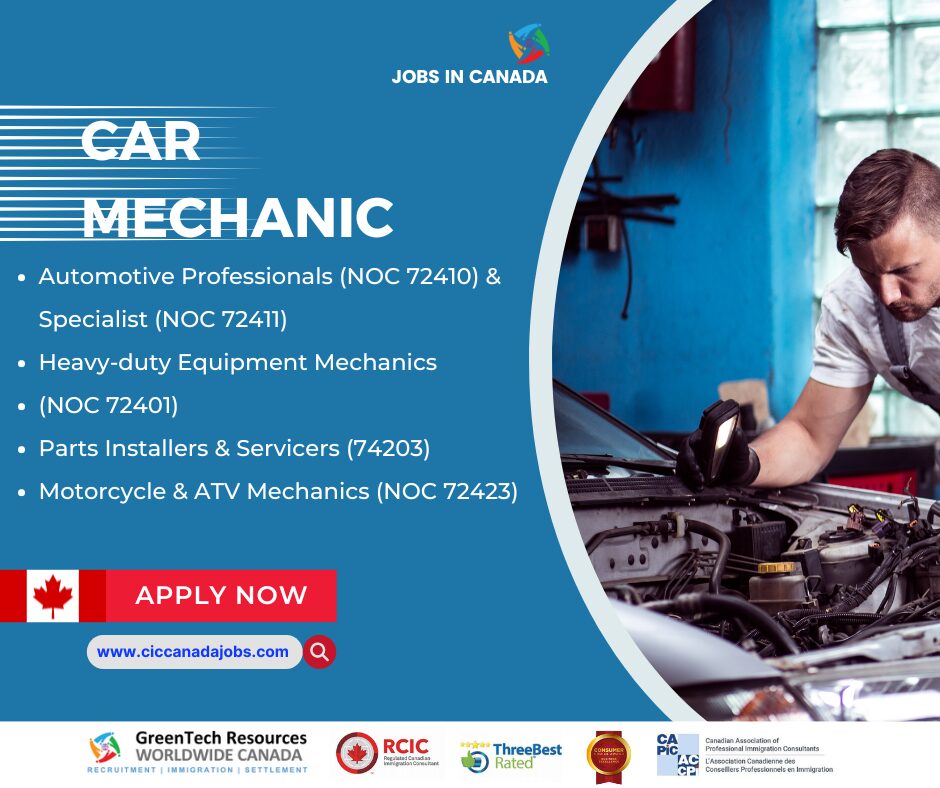
    Job in Demand – Automotive Sector

    Canadian employers are looking for talents across the world. If you are willing to immigrate – work – settle in Canada be on our candidate pipeline. Apply now for future opportunities. We will contact you when matching your profile & employers requirements.

    đźš—Automotive Technician


    Positions:

    • Automotive Service Technician (NOC 72410)
    • Truck and Bus Mechanic (NOC 72410)
    • Mechanical Repairer (NOC 72410)

    Location: Saskatchewan, Canada
    Pay Rate: $18 – $20 per hour


    Apply online

    đźšś Heavy-Duty Equipment Mechanics


    Position: Heavy-Duty Equipment Mechanic (NOC 72401)

    Location: Saskatchewan, Canada
    Pay Rate: $18 – $20 per hour


    Apply online

    đźš— Auto Body Specialists


    Positions:

    • Auto Body Collision Technician (NOC 72411)
    • Refinishing Specialist (NOC 72411)
    • Glass Technician (NOC 72411)
    • Damage Repair Estimator (NOC 72411)

    Location: Saskatchewan, Canada
    Pay Rate: $18 – $20 per hour


    Apply online

    đź”§ Parts Installers & Servicers


    Positions:

    • Automotive Parts Installer (NOC 74203)
    • Heavy Truck Parts Installer (NOC 74203)
    • Equipment Parts Servicer (NOC 74203)

    Location: Saskatchewan, Canada
    Pay Rate: $18 – $20 per hour


    Apply online

    🏍️ Motorcycle & ATV Mechanics


    Positions:

    • Motorcycle Mechanic (NOC 72423)
    • ATV Mechanic (NOC 72423)
    • Related Vehicle Mechanic (NOC 72423)

    Location: Saskatchewan, Canada
    Pay Rate: $18 – $20 per hour


    Apply online

  • Discover Farm Work Opportunities in Canada!

    Discover Farm Work Opportunities in Canada!

    Discover Farm Work Opportunities in Canada!

    Canadian AGRICuture

    Open Call for Farm Workers!

    Canada’s rich and diverse landscapes are not just for show; they’re the bedrock of our vibrant agricultural sector, especially in provinces like Ontario, Atlantic Canada, and British Columbia. Here, farming isn’t just a job—it’s a lifestyle and a crucial industry that feeds nations.

    Our farms are on the lookout for passionate individuals ready to dive into the world of agriculture. Whether you’re highly skilled or stepping into the workforce for the first time, there’s a place for you here. Don’t worry if you’re not fluent in English or lack experience—enthusiasm and willingness to learn are what we value most.
    NOW HIRING

    We are recruiting diverse teams of Farm Workers

    Our doors are open to both men and women interested in working in Mushroom, Potato, Wheat, and Dairy Farms—operations that run throughout the year, ensuring stability and continuous learning opportunities. This is your chance to be part of the essential workforce that powers Canada’s agricultural output.

    If you’re eager to contribute to an industry that makes a real difference and to experience the camaraderie of farm life, we want to hear from you. Submit your resume now! LMIA is ready

    Apply now

    Benefits

    2 year work permit
    Full health insurance

    Requirements

    Mushroom Farm
    Vietnamese women, from 18-35 years old
    Secondary school education is required
    Can communicate in English and Vietnamese
    Dairy Farm
    Vietnamese men and women, from 18-35 years old
    Secondary school education is required
    Can communicate in English and Vietnamese
    Physical strength is required

  • We are hiring! SINP and LMIA jobs

    We are hiring! SINP and LMIA jobs

    WE ARE HIRING

    SINP and LMIA Jobs

    We are looking for experienced qualified candidates globally
    Candidate basic requirements
    • English Language Certificate (CLB 4 – 5)
    • Related experience: 2 – 5 years
    • Certificate could be certified by WES
    • Social Insurance records
    • Bank statements

    Send us your resume

  • Recruitment & Employment: Tips on Getting Hired As a Newcomer

    Recruitment & Employment:
    Tips on Getting Hired As a Newcomer

    There are few things that can help a new immigrant to settle down and get employment in Saskatchewan. You should be proactive and use available resources for recruitment and employment. There are some organizations available for free to assist newcomers about the job market in Saskatchewan and you may join those groups to brush your communication skills as well.

    Sign up with some recruitment agencies online and complete your profile so that they can assess your skills and can connect you with available positions.

    There are 6 main points to keep in your mind:

    Understand Culture

    It’s important to understand that Canada is a country of immigrants, that is the reason Canada has a very open culture and welcomes new immigrants. Major Canadian cities are multicultural and attract more immigrants. Watch some online presentations and videos to get familiar with the culture.

    Resources for new immigrants

    For a newcomer, the Canadian government website is an excellent resource. As it contains all the required details of what a newcomer needs like eligibility criteria, required documents, application, etc. Each province has volunteer organizations that provide initial guidance and support to the newcomers to get a job and provide further assistance to get settled in Canada.

    Create a Resume

    When you’re ready to apply for jobs in Canada, the most important step is to create and update your resume as per Canadian style because that increases your chance to get selected in a company and get a job offer. There are quite a few formats available online which you may use. Job providers look at the resume to qualify candidates so it should have the complete and correct information. Make sure you include your name with contact information, professional summary highlighting skills, work history, and complete experience. You should also include your education and professional experience in your resume.

    Network

    Networking is really important for your career in Canada, it’s not only required for professional growth but also helpful for personal growth when you move to a new country.

    It’s best to reach out to friends and family because they might have some contacts which can help you in Canada. Explore the job market online by using social media applications like CICCanadaJobs, LinkedIn and other job portals like indeed etc.

    Prepare for Interview

    For a newcomer, it might be difficult to crack an interview in the first go but if you’ve done some research online and have an idea about the type of interview questions you may crack the interview in one go. It’s always best to brush up your communication skills along with technical skills. Complete some practice questions and watch some videos depending on the type of interview or job you’re applying for.

    Wages

    Once you’re ready for the interview, another important thing to know is salary expectations. You should research the pay rate for the job(s) you’re applying. It depends on the experience and the skills you have. If you have arrived in Canada through the express entry skilled worker category, the experience, and education assessment will already be completed ahead of arrival. In case you’re not aware of what salary to ask, you may check the job bank portal online as well.

  • 279 more jobs eligible for Saskatchewan immigrant nominee program

    279 more jobs eligible for Saskatchewan immigrant nominee program

    Saskatchewan Immigrant Nominee Program (SNIP) Expansion

    Saskatchewan Expands SINP to Include 279 Intermediate and Lower-Skilled Occupations In a significant development aimed at boosting its workforce and population, Saskatchewan is expanding the Saskatchewan Immigrant Nominee Program (SINP) by adding 279 intermediate and lower-skilled occupations to its list of eligible jobs for permanent residency applications. This expansion is set to positively impact several key economic sectors in the province, including manufacturing, sales and service, agriculture, arts, entertainment, recreation, and transportation.

    Expansion to Boost Saskatchewan’s Economy

    Before this change, the SINP only accepted applications from workers in 34 high-skilled occupations and designated trades. By opening the program to a wider range of skill levels, Saskatchewan aims to address labor shortages and fill gaps across various industries. This move comes at a time when the province is actively seeking to grow its population and economic output.

    The inclusion of intermediate and lower-skilled occupations in the SINP provides new opportunities for workers in essential roles that are often overlooked in other immigration programs. It also makes Saskatchewan a more attractive destination for international workers seeking permanent residency in Canada.

    A New Opportunity for Ukrainian Newcomers

    The expansion of the SINP is particularly beneficial for Ukrainian newcomers who recently arrived in Saskatchewan under the Canada-Ukraine Authorization for Emergency Travel Work Permit. Many Ukrainians have settled in the province, contributing to the local economy in fields like agriculture, transportation, and service sectors. With the inclusion of more job categories, these newcomers now have a greater chance of securing permanent residency through the SINP, further integrating into Saskatchewan’s workforce.

    Driving Population and Job Growth in Saskatchewan

    The Government of Saskatchewan has set ambitious goals for the province’s future, aiming to increase its population to 1.4 million and create 100,000 new jobs by 2030. The expanded SINP plays a crucial role in achieving these targets by attracting international talent across a wider range of skill levels.

    In addition to its economic benefits, the expansion aligns with Saskatchewan’s long-term vision of becoming a more diverse and dynamic province. With the anticipated influx of new workers, the province will be better positioned to meet the demands of its growing economy.

    Meeting Basic English Requirements

    While the expanded SINP opens new doors for many potential applicants, it is important to note that candidates must still meet basic English language requirements. To help newcomers adapt, Saskatchewan offers free English classes, which are particularly beneficial for those seeking to improve their language skills and integrate more smoothly into their communities and workplaces.

    Conclusion

    Saskatchewan’s decision to broaden the scope of the SINP to include 279 intermediate and lower-skilled occupations is a forward-thinking move that addresses the province’s labor needs and supports its economic growth plans. This expansion not only opens doors for international workers but also strengthens Saskatchewan’s position as a welcoming destination for immigrants. With the province’s focus on achieving a population of 1.4 million and creating 100,000 jobs by the end of the decade, the expanded SINP is a key strategy in driving progress toward these goals.

    By providing greater opportunities for permanent residency to workers across a wide range of industries, Saskatchewan is fostering a more inclusive and resilient economy.

  • SINP Tech Talent Pathway

    SINP Tech Talent Pathway

    SINP tech talent pathway: On March 7, 2022, the Government of Saskatchewan announced the new Tech Talent Pathway under the Saskatchewan Immigrant Nominee Program (SINP) to attract highly skilled technology professionals into the province.

    SINP Tech Talent Pathway Overview

    The Saskatchewan Immigrant Nominee Program (SINP) introduced the important points of a new program aimed at recruiting tech experts on March 7, 2022. The Tech Talent Pathway will enable Saskatchewan employers to expedite the permanent residency applications of certain knowledgeable tech workers.

    SINP Tech Talent Pathway Quote

    “As Saskatchewan emerges from the impacts of the global pandemic, our technology sector will be an important driver of economic growth. The new Tech Talent Pathway provides our Saskatchewan employers with a dedicated stream for the attraction of highly skilled talent into our thriving technology sector.”

    Immigration and Career Training Minister Jeremy HarrisonTweet

    “The economy of Saskatchewan relies on our ability to attract and retain highly skilled immigrants who form critical anchors of specialized skills in our communities and workforce. The Tech Talent Pathway offers a competitive advantage to Saskatchewan industries and is unique in Canada. It streamlines the immigration process and acknowledges that we want our immigrants to stay right here in our province to join us in creating innovative solutions for Saskatchewan to export to the world.”

    SaskTech President Dr. Aaron GenestTweet

    The stream will furnish an fast-tracked pathway to permanent residence for tech experts presently working in Saskatchewan as well as foreign places recruits.

    SINP Tech Talent Pathway Conditions

    Who is eligible to practice beneath the new Tech Talent Pathway?

    To be eligible, candidates to the Tech Talent Pathway must:

    Obtain an SINP Job Approval Letter that is employer-specific and for an eligible tech area occupation;

    If working in Saskatchewan, secure a minimal Canadian Language Benchmark (CLB) stage 5; or

    If now not presently working in Saskatchewan, meet any language necessities set through the employer; or

    If applying for Express Entry, tightly closed a CLB stage 7;

    Completed at least one-year of work experience in previous 5 years in the equal occupation as the job offered, or six months working in Saskatchewan;

    Finished post-secondary education associated to the job offered;

    Be eligible for expert licensing in Saskatchewan (if applicable); and

    Intend to reside in the province of Saskatchewan

    SINP Tech Talent Pathway Occupations

    Which tech occupations are viewed beneath Saskatchewan’s new program?

    To qualify underneath SINP’s new program, candidates should have a job provide in one of the following tech occupations:

    NOC    Occupation Titles

    0213    Computer and record structures managers

    2133    Electrical and Electronics engineers

    2147    Computer engineers (except software program engineers and designers)

    2171    Information System analysts and consultants

    2172    Database analysts and information administrators

    2173    Software engineers and designers

    2174    Computer programmers and interactive media developers

    2175    Web designers and developers

    2281    Computer network technicians

    2282    User support technicians

    2283    Information system testing technicians

    Licensing requirements

    If your occupation is regulated in Saskatchewan, you need to be eligible for licensing to qualify for this program. The following occupations require licensing:

    NOC 2147 – Computer Engineers

    NOC 2173 – Software Engineers (but no longer Designers)

    NOC 2133 – Electrical and Electronics Engineers

    To exhibit you are eligible for licensing, you have to furnish a letter from the Association of Professional Engineers and Geoscientists of Saskatchewan (APEGS) that suggests your utility registering as an Engineer-in-Training has been approved, or a letter from APEGS displaying that you have been assigned Confirmatory Exams.

    What is a Saskatchewan Job Approval Letter?

    Job Approval Letters (JAL) can be used via foreign nationals to follow for Saskatchewan nomination.

    In order to employ overseas nationals, Saskatchewan employers should achieve a Certificate of Registration from the Ministry of Labour Relations and Workplace Safety. Saskatchewan employers should then put up software for a Job Approval Letter for every overseas employee they desire to hire.

  • Open Work Permit Update: New Policy For International Students In Canada

    Open Work Permit Update: New Policy For International Students In Canada

    Work permit update

    The Canadian government has recently introduced a new policy for students from abroad affected by Covid 19. It would extend an opportunity to gather work experience that they would need to be eligible for becoming permanent Canadian residents.

    Canada Immigration 2021
    On January 08, 2021, the Government of Canada came up with a new policy that would allow the present international students in Canada with an expiring or expired PGWP (Post Graduate Work Permit) to apply for a new open work permit. This move is a plan to welcome nearly 1,200,000 new permanent residents into Canada by 2023. According to Universities Canada, it would be a positive signal for the International Students.

    According to the Minister of Irrigation, Refugees, and Citizenship – Marco Mendicino, immigrants would enrich Canada in unimaginable ways. The country’s progress cannot be complete without taking into account the contribution of the new residents.

    IRCC Tweet

    Benefits
    The latest immigration target announced by the government is a positive signal to indicate that Canada is more than eager to accommodate skilled talents from all over the world. The graduates of Canadian universities can benefit from immigration if they are looking to stay post completing their studies. According to a leading law firm dealing with immigration, the study permit happens to be the main road for entry into Canada. It allows entering the country and taking up studies of one’s choice, and once that’s finished, the person can apply for a post-graduate work permit. The work permit is a flexible and open permit that allows a person to work at any location of choice in Canada.

    Duration
    The maximum duration of such a work permit is three years. The day a person completes a year of employment in Canada, he/she becomes eligible to be a permanent resident. As per IRCC (Immigration Refugees and Citizenship Canada) and PNP, it can help achieve the Canadian Immigration target.

    New Open Work Permit
    The new open work permit (not to be confused with a study visa or study permit) will be valid for one and a half years. It will enable existing international students to continue staying in Canada and keep looking for job opportunities. It is different from a closed work permit that ties an individual to only a single employer.

    Application Rules
    To apply for a new open work permit, the following conditions must be fulfilled:

    There has to be a PGWP.
    The expiry date of the PGWP has to be January 30, 2020, or after that. Else, the expiry date has to be 120 days or less at the time of application.
    The person has to be in Canada at that time.
    There has to be a valid temporary status. If not, an application should have been submitted already for status restoration.
    Note: The above application process will run from January 27, 2021, to July 27, 2021.

    It has been estimated that the PGWP is exceptionally coveted, and more than half of the international students want to become permanent Canadian residents. The Canada Administration has realized that the corona pandemic has put graduating students at a disadvantage because of a weak labor market resulting in massive layoffs. It is expected that the new policy will help to fill people in critical sectors like technology and health care, as evident from LMIA.

  • National Occupational Classification (NOC) 2021 Redesign

    National Occupational Classification (NOC) 2021 Redesign

    This notice aims to advise all stakeholders and users of the National Occupational Classification (NOC) that there will be a major structural revision in 2021. The new NOC has been scheduled for release early next year.

    NOC 2021 – Canada.ca (esdc.gc.ca)

  • How to Apply for LMIA in 2021 2022?

    How to Apply for LMIA in 2021 2022?

    The changes to the international labor market due to the COVID19 pandemic have also had an impact on Canadian jobs. In 2021, things have greatly changed and the Labor Market Impact Assessment (LMIA) saw several changes too. Formally known as Labor Market Opinion (LMO), LMIA is when a Canadian employer tries to hire a local Canadian for a job and is unable to find the right candidate.

    The employer will issue an LMIA after advertising for the job role within Canada but without any luck. However, an LMIA can only be issued after making all possible efforts and proving that none of the local applicants were qualified enough. Receiving a positive LMIA letter from Social Development Canada is a confirmation that the employer can hire an international candidate.

    The process is simple; the employer applies for the LMIA and waits for approval. Once the employer gets the approval, he or she can send a job offer letter for the right candidate. The candidate can then apply for a work permit. A work permit application must include the job offer letter, a copy of the LMIA and the LMIA number.

    LMIA Canada New Rules 2021 2022

    As mentioned before, there have been a handful of changes across all labor markets in the world, as well as in Canada. As for the LMIA process, all jobs are now divided into two categories:

    1. A high-wage category: where the salary exceeds the median wage in the province.
    2. A low-wage category: where the salary is below the median wage in the province.

    LMIA request application fees have also been increased from $275 to $1000 per worker.

    LMIA Requirements

    Hiring Workers on a High-Wage

    All employers must meet the requirements of the Transition Plan, which is part of the Schedule C form of the LMIA application. This is compulsory when the employer decides to hire a foreign candidate at a high wage. The transition plan typically represents a commitment from the employer indicating that he or she has agreed upon a certain occupation within the province of work.

    Hiring Workers on a Low-Wage

    Unlike the employment of high-wage workers, hiring low-wage workers does not require a transition plan. However, when applying for LMIA, there is a limit to the number of workers an employer can hire at the low-wage rates.

    Hiring with an LMIA

    To meet the shortfall of workers and laborers in Canada, the Temporary Foreign Worker Program (TFWP) allows all employers to hire temporary foreign employees. Once the employer has been issued an LMIA, the duty to direct each worker towards obtaining a work permit falls on the employer alone.

    Giving simple instructions for applying for a work permit for Canada is a good idea. Every worker must include a job offer letter, a copy of the LMIA and the LMIA issue number.

    Hiring without an LMIA

    There is a way of hiring foreign workers without applying for LMIA. The International Mobility Program (IMP) allows employers to hire foreign workers easily. In case the employer wishes to hire without an LMIA, he or she will need:

    • To bear the cost of employer compliance fee,
    • And to submit the offer letter through Employer Portal.

    Processing Times for LMIA

    Due to the impact of COVID19 and global lockdowns, Canada is experiencing a higher number of LMIA applications in 2021. This can result in longer processing times and possible delays but the applications are being processed.

    The list below displays recent processing times per LMIA stream. This is to provide an overview of the estimated timeline of each application:

    Type of Application

    Average Processing Time 2021 – 2022

    Global Talent Stream

    8 business days

    Agricultural Stream

    13 business days

    Seasonal Agricultural Program

    7 business days

    Permanent Residence Stream

    17 business days

    In-Home Caregivers

    13 business days

    High-Wage Stream

    33 business days

    Low-Wage Stream

    29 business days

    What are the Next Steps?

    When an employer gets LMIA approval, a copy of the letter along with Annex A is sent to the foreign worker. The foreign worker will then apply for a work permit under the aforementioned application types. The processing time starts on the day an application has been submitted.

    Give GreenTech a Call!

    For an employer who is simply looking for the right talent to fill a position in his or her business, the LMIA application can often be overwhelming. We at GreenTech Resources have been helping our clients to speed up the process of hiring the right candidate.

    Allow us to fill in your LMIA applications and take care of the hard work while you focus on your business. Our team of highly qualified immigration professionals can help you get your LMIA and Temporary Work Permit Applications right and in no time.