Author: Admin

  • Canada’s Student Cap Raises Concerns, Possible Policy Shift Expected

    Canada’s Student Cap Raises Concerns, Possible Policy Shift Expected

    Canada’s international student cap has become one of the most debated immigration policies of 2024–2025. While the government argues the cap is necessary to ease housing shortages and pressure on public services, universities, students, and industry leaders are raising concerns about its long-term impact. With the cap set to expire at the end of 2025, many are hopeful for a more balanced approach to international education in Canada.

    Canada’s Student Cap: What It Means for International Students

    In early 2024, Canada introduced a temporary cap on new study permits, reducing the number of approved applications by 35%. This lowered the total number of study permits to about 360,000, compared to nearly 560,000 in 2023.

    In 2025, the cap was extended with further restrictions. The federal government set the limit at 437,000 permits, representing another 10% reduction. For the first time, the cap included master’s and doctoral students, groups that were previously exempt.

    To qualify, all applicants must now submit a Provincial or Territorial Attestation Letter (PAL/TAL), ensuring that permits are distributed fairly across Canada.

    Why the International Student Cap Sparks Concern

    1. Financial strain on Canadian universities

    Post-secondary institutions in provinces like Ontario, British Columbia, and Alberta depend heavily on international tuition fees. With fewer international students, universities face reduced revenues, budget deficits, and potential cuts to staff and research programs.

    2. Uneven regional impact

    While some large provinces can absorb the reduction, smaller regions such as Nova Scotia and Prince Edward Island are experiencing sharper declines. This is worrying for local economies that rely on international graduates to fill labor shortages.

    3. Delays and administrative challenges

    The new requirement for attestation letters has caused significant application backlogs. Processing delays have reached 45%, nearly double the government’s target, leaving students uncertain about their future.

    4. Global competitiveness at risk

    Canada’s reputation as a top study destination could suffer. With Australia, the UK, and the U.S. competing for talent, a restrictive cap may drive prospective students elsewhere.

    Could Canada Change Course?

    The student cap is scheduled to expire in December 2025, creating an opportunity for policymakers to design a long-term framework. Experts and stakeholders are urging the government to:

    • Allocate study permits based on institutional quality and regional labor needs.
    • Target non-compliant private colleges rather than penalizing the entire education system.
    • Provide stable policies that support Canada’s $31 billion international education sector.

    Broader Immigration and Housing Policy Trends

    • The cap on students is part of a wider effort to control immigration levels and ease Canada’s housing crisis. In 2025, Canada also lowered permanent and temporary resident targets. Rental prices have already begun to fall, showing signs of stabilization after years of rapid increases.
    • One controversial move was a 31% reduction in study permits issued to Indian students, raising concerns in Canada’s largest source country for international enrollment.

    The Future of International Education in Canada

    • While the student cap has provided short-term relief for the housing market, it risks weakening Canada’s global competitiveness in higher education. Unless the government adopts a smarter, targeted strategy, universities, local economies, and international students could face lasting consequences.

    As the 2025 expiration date approaches, Canada has an opportunity to strike the right balance between managing immigration pressures and keeping its doors open to the world’s top talent
  • Canada Immigration Updates – New Language Test Approved for PR

    Canada Immigration Updates – New Language Test Approved for PR

    Immigration, Refugees and Citizenship Canada (IRCC) has officially announced that the Test of English as a Foreign Language (TOEFL) Essentials is now an approved language proficiency test for candidates applying through Canada’s permanent economic immigration programs. This update provides more flexibility for skilled workers and international applicants planning to immigrate to Canada.

    What Is TOEFL Essentials?

    The TOEFL Essentials test, administered by Educational Testing Service (ETS), is a modern, streamlined version of the widely recognized TOEFL iBT exam. It measures all four key language skills—reading, writing, listening, and speaking—within a shorter testing time (1.5-hour exam) and at a more affordable cost. TOEFL Essentials is designed to reflect real-life communication skills while maintaining academic rigor.

    Why This Matters for Canadian Immigration Applicants

    Until now, approved English language tests for Express Entry and other economic immigration pathways included the IELTS General Training, CELPIP-General, and TOEFL iBT Test. With the addition of TOEFL Essentials, applicants now have an additional option to prove their English proficiency.

    This policy change is especially beneficial for candidates who:

    • Prefer a flexible, online test format.
    • Seek a more cost-effective English test option.
    • Want to demonstrate practical and academic English proficiency in one exam.

    Programs Accepting TOEFL Essentials

    The TOEFL Essentials test will be accepted for:

    • Express Entry (Federal Skilled Worker, Canadian Experience Class, Federal Skilled Trades)
    • Provincial Nominee Programs (PNPs) aligned with Express Entry
    • Atlantic Immigration Program (AIP): A pathway for skilled workers and graduates in Canada’s Atlantic provinces.

    Minimum Scores and CLB Equivalency

    As with other approved English tests, TOEFL Essentials results will be converted into Canadian Language Benchmarks (CLB). Applicants must meet the specific CLB levels required by their immigration program. IRCC will publish detailed score conversion charts to help applicants understand their eligibility.

    What This Means for Future PR Candidates

    This update reflects IRCC’s commitment to making the immigration process more accessible, fair, and inclusive for skilled workers worldwide. By adding TOEFL Essentials, Canada provides newcomers with more testing choices, reduced barriers, and a smoother pathway toward permanent residency.

  • New Express Entry Draw Targets Healthcare Workers- Invites 2,500 Candidates

    New Express Entry Draw Targets Healthcare Workers- Invites 2,500 Candidates

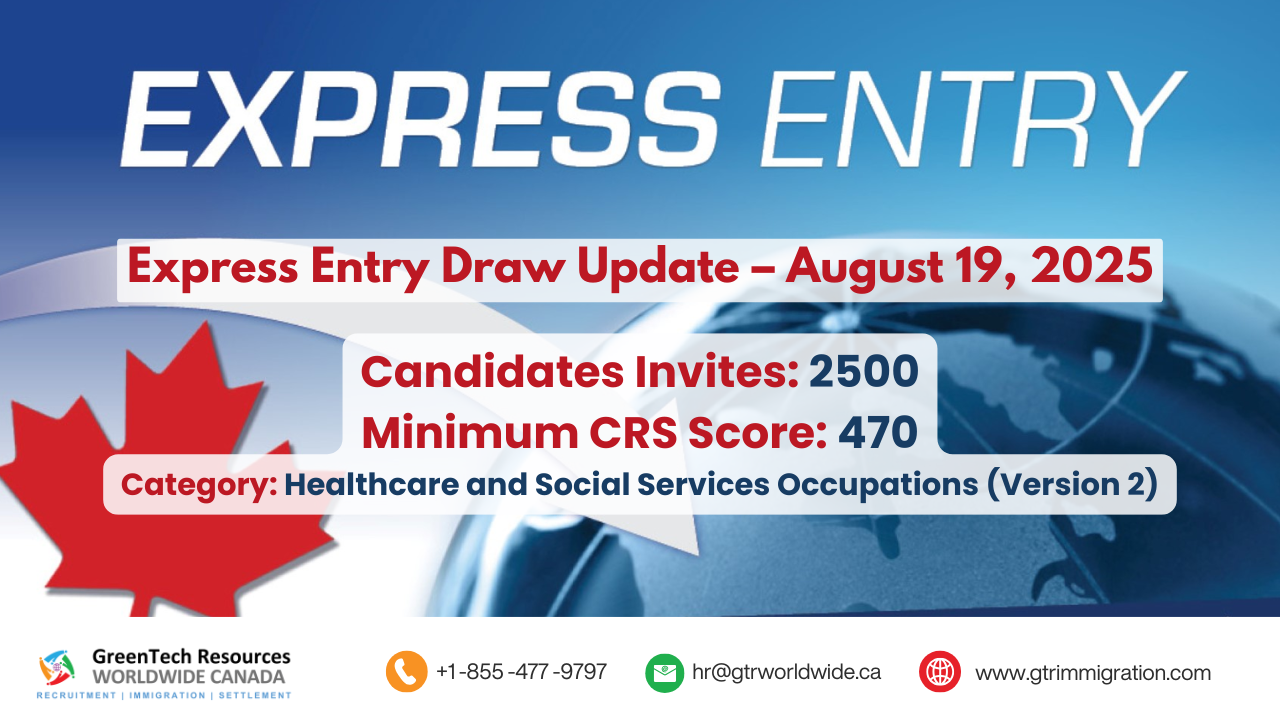
    On August 19, 2025, Immigration, Refugees and Citizenship Canada (IRCC) executed a targeted Express Entry draw specifically for the Healthcare and Social Services occupation category, inviting 2,500 candidates who met a Comprehensive Ranking System (CRS) score of 470 or higher. This significant draw marks the second-largest healthcare-focused round of the year.

    Key Draw Highlights

    • Draw Date: August 19, 2025
    • Category: Healthcare and Social Services Occupations (Version 2)
    • Invitations Issued: 2,500 ITAs
    • Minimum CRS Score: 470
    • Tie-Breaking Rule: Candidates who submitted their profiles before April 23, 2025 at 20:08:53 UTC received priority in the case of score ties

    Why This Matters

    Canada’s healthcare and social services sectors are experiencing urgent labor shortages. By conducting category-based draws like this, IRCC can effectively recruit professionals in high-priority roles—ranging from registered nurses and pharmacists to social workers and therapists.

    A CRS cut-off of 470 is relatively accessible compared to previous general draws, empowering more hopeful candidates—especially those with strong healthcare/social services credentials—to secure Canada PR.

    Historical Context: How This Draw Compares

    DateDraw TypeITAs IssuedCRS Cut-off
    July 22, 2025Healthcare & Social Services (V2)4,000475
    June 4, 2025Healthcare & Social Services (V2)500504
    May 2, 2025Healthcare & Social Services (V2)500510
    August 19, 2025Healthcare & Social Services (V2)2,500470

    This August draw, while second in scale to the July 22 round (4,000 ITAs at 475 CRS), stands out for its notably lower CRS threshold—making it especially competitive and encouraging for many applicants.

    What This Means for You

    • Greater Opportunity: Healthcare and social services professionals with CRS scores around or above 470 are prime candidates for ITAs.
    • Strategic Profile Updates: Candidates should ensure their Express Entry profiles highlight relevant National Occupational Classification (NOC) codes and emphasize six months (or equivalent) of continuous work experience in eligible roles.
    • Tie-Break Priority: Early profile submission continues to matter. Profiles submitted before the tie-breaking timestamp may have better chances in tight cut-offs.

    Tips to Improve Your CRS Score

    If your CRS score is close to the cut-off, here are strategies to boost your profile:

    1. Retake a language test (IELTS/CELPIP or TEF) to score higher in English or French.
    2. Claim spousal points — if your partner can complete a language test or add educational/work credentials.
    3. Pursue a Canadian job offer in a healthcare or social service role (adds 50–200 CRS points).
    4. Apply for Provincial Nominee Programs (PNPs) — a nomination adds 600 CRS points, guaranteeing an ITA.
    5. Update work experience — ensure your NOC codes match the eligible occupations listed by IRCC.

    The August 19, 2025 Express Entry draw highlights how Canada is making immigration pathways more accessible for healthcare and social service professionals. With a cut-off score of just 470, many skilled candidates who were previously on the margin now have an excellent chance of securing permanent residency.

    For applicants in these sectors, staying proactive by updating your Express Entry profile and exploring CRS-boosting strategies can be the key to success in upcoming draws.

  • Canada Express Entry Draw – August 19, 2025- 192 ITAs Issued with CRS 800

    Canada Express Entry Draw – August 19, 2025- 192 ITAs Issued with CRS 800

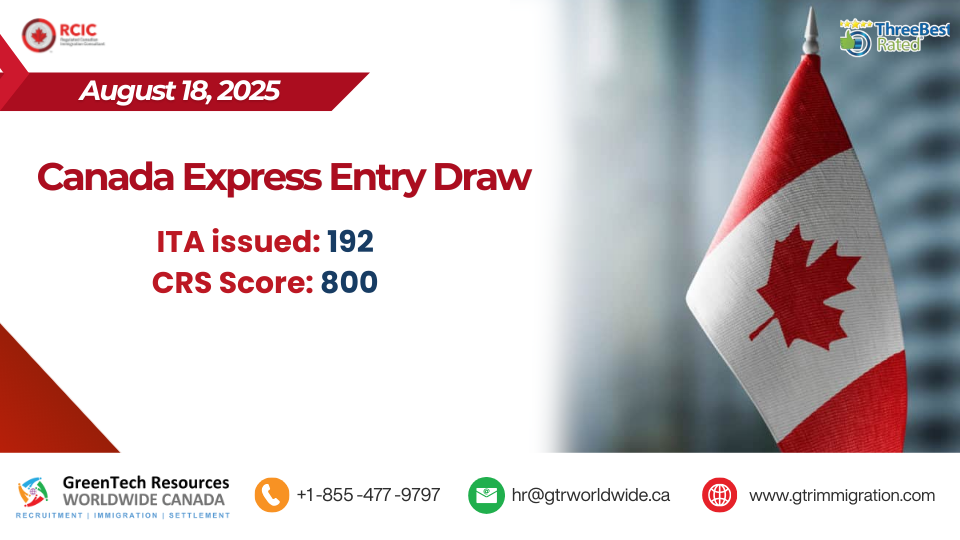
    On August 19, 2025, Immigration, Refugees and Citizenship Canada (IRCC) held the latest Express Entry draw, issuing 192 Invitations to Apply (ITAs) for permanent residency. This was a Provincial Nominee Program (PNP)-specific draw with a minimum Comprehensive Ranking System (CRS) score of 800, making it one of the most competitive rounds this year.

    For many skilled workers aiming to build their future in Canada, this draw highlights both the opportunities and challenges within the Express Entry system.

    About the August 18, 2025 Draw

    Here are the key details from the latest round of invitations:

    • Date of draw: August 19, 2025
    • Program targeted: Provincial Nominee Program (PNP)
    • Number of ITAs issued: 192
    • Minimum CRS score required: 800
    • Tie-breaking rule: February 11, 2025, at 19:17:09 UTC

    The high CRS cut-off reflects the competitive nature of PNP draws. Since candidates with a provincial nomination automatically receive an additional 600 CRS points, only those with already strong profiles were able to secure an invitation.

    Express Entry Draw Trends in 2025

    This draw was the fourth Express Entry round in August 2025 and the second PNP-focused draw of the month. Here’s a quick look at recent rounds:

    • August 6, 2025: 225 PNP candidates invited, minimum CRS 739
    • August 7, 2025: 1,000 Canadian Experience Class (CEC) candidates invited, CRS 534
    • August 8, 2025: 2,500 French-language proficiency candidates invited, CRS 481
    • August 18, 2025: 192 PNP candidates invited, CRS 800

    So far in 2025, IRCC has issued over 53,000 ITAs, covering PNP, CEC, and category-based draws targeting French speakers, healthcare workers, and educators.

    This year, the CRS cut-offs for PNP draws have consistently been among the highest, with the August 19 draw ranking second only to the February 4 draw, which required a CRS of 802.

    Why This Draw Matters

    The August 18 draw sends important signals to immigration hopefuls:

    • Competition remains high – A CRS of 800 shows the advantage of securing a provincial nomination.
    • PNP is a strong pathway – Candidates who earn a nomination from provinces like Ontario, British Columbia, or Alberta drastically improve their chances of receiving an ITA.
    • IRCC is balancing priorities – By holding different types of draws (PNP, CEC, French, occupation-specific), Canada is ensuring diverse talent enters the country.

    What Applicants Can Do to Improve Their Chances

    If your CRS score is not yet competitive, here are some strategies to increase it:

    • Pursue a Provincial Nomination: Each province has its own streams aligned with local labour market needs.
    • Boost your language score: Higher IELTS, CELPIP, or TEF results can significantly increase CRS points.
    • Enhance education credentials: Completing additional studies or getting foreign education recognized helps.
    • Leverage spousal points: A partner’s education, work experience, or language test results may add valuable points.
    • Stay updated: Regular draws happen every few weeks, so timing and preparation are crucial.

    About Express Entry

    The Express Entry system is Canada’s primary immigration pathway for skilled workers. It manages applications for three economic programs:

    1. Federal Skilled Worker Program (FSWP)
    2. Federal Skilled Trades Program (FSTP)
    3. Canadian Experience Class (CEC)

    Candidates enter the Express Entry pool and are ranked using the CRS based on age, education, language ability, and work experience. During each draw, IRCC issues ITAs to top-ranking candidates. Those with a provincial nomination receive a 600-point boost, almost guaranteeing an invitation.

    The August 19, 2025 Express Entry draw once again highlighted the significance of the Provincial Nominee Program in Canada’s immigration strategy. With only 192 ITAs issued and a CRS cut-off of 800, competition is fierce, but opportunities remain strong for skilled workers who align with Canada’s labour needs.

    If you are considering immigration to Canada, now is the time to explore provincial streams, improve your CRS score, and stay prepared for upcoming draws. With careful planning, your path to permanent residency could be just around the corner.

  • Canada to Require Mandatory Biometrics for Citizenship Applications by 2026–2027

    Canada to Require Mandatory Biometrics for Citizenship Applications by 2026–2027

    Canada is advancing its citizenship process. In 2026–2027, authorities plan to introduce a mandatory biometric requirement for citizenship grant applications—part of a broader modernization strategy.

    What Is Changing: The New Biometric Citizenship Requirement

    • IRCC proposes new regulations amending the Citizenship Regulations to systematically collect and use biometric information (fingerprints, facial recognition data, etc.) for citizenship processing.
    • The authority for this change stems from legislative powers granted in June 2023 via the Budget Implementation Act, No. 1
    • The impetus is to modernize workflows and enhance integrity across the Citizenship Program

    Why Canada Is Implementing Mandatory Biometrics

    • Stronger identity verification: Biometrics ensure applicants are who they claim to be, reducing fraud.
    • Program integrity: Enhances the reliability of background and criminality screening.
    • Processing efficiency: Automation enabled by biometric data helps speed up low-risk decision-making—impacting up to 93% of applications at the intake stage
    • Ultimately, the goal is to bolster client service, security, and efficiency.

    Timeline: Consultation, Pre-Publication, and Final Regulation

    • This long-term initiative was listed in IRCC’s Forward Regulatory Plan for 2025–2027, with inclusion dating from July 16, 2025
    • Pre-publication of the regulatory amendments is expected in the Canada Gazette, Part I, in 2026.
    • Final publication and regulatory enactment are targeted for 2027, with stakeholder feedback collected during pre-publication.

    Impacts and What Applicants Need to Know

    • Applicants across all relevant categories should anticipate submitting biometrics as part of their citizenship application process starting post-2027.
    • Minimal impact on businesses or trade, as IRCC indicates the change is client-focused and internal
    • Applicant preparation tip: Keep documents ready to comply with biometric requirements (higher likelihood of needing to submit fingerprints or facial data).

    Privacy, Security, and Data Handling Considerations

    • IRCC assures privacy protection through strict regulatory frameworks. Fingerprints will be purged from RCMP records once an applicant becomes a citizen
    • The department’s stance includes secure storage, usage compliant with the Privacy Act, and alignment with Charter rights
    • The sailing toward biometric modernization includes procurement to upgrade biometric collection technology—reflecting the overall investment in system integrity.

    By 2027, all citizenship applicants will likely need to undergo biometric enrollment—a move driven by modernization, efficiency, and security.
    Stakeholders—applicants, legal advisors, and consultancy firms—should monitor IRCC announcements, prepare for upcoming consultations, and update application guidance accordingly.

  • IRCC Announces New Medical Exam Requirements for Express Entry Permanent Residence

    IRCC Announces New Medical Exam Requirements for Express Entry Permanent Residence

    Immigration, Refugees and Citizenship Canada (IRCC) has announced that upfront medical examinations will once again be mandatory for all Express Entry permanent residence (PR) applications starting August 21, 2025.

    This change ends the deferred medical exam policy in place since October 2023, where applicants could submit their PR applications without completing the Immigration Medical Examination (IME) in advance.

    New Express Entry Medical Exam Rules

    • Effective Date: August 21, 2025
    • Who is Affected: All applicants under the Express Entry system, including accompanying and non-accompanying dependents.
    • Main Change: Medical exams must be completed before submitting your PR application.
    • Purpose: Improve processing speed, ensure early health admissibility assessment.

    Who Must Complete the Immigration Medical Examination (IME)?

    Under the new requirement, the following must complete an IME upfront:

    1. Principal Applicants applying under Federal Skilled Worker Program (FSWP), Federal Skilled Trades Program (FSTP), and Canadian Experience Class (CEC) via Express Entry.
    2. All accompanying family members (spouse, common-law partner, dependent children).
    3. Non-accompanying family members (must still undergo IME to assess overall admissibility).

    Exceptions – Who May Be Exempt from a New Medical Exam

    You may not need a new IME if:

    • You are already in Canada and completed an IME in the last 5 years for a work permit, study permit, or previous PR application.
    • Your prior medical results are still valid and IRCC can access them.

    In these cases, you can upload your IME number (UMI) instead of a new report. If IRCC finds your old IME unusable or expired, they will ask you to take a new exam.

    What Does the Upfront Medical Exam Involve?

    The IME must be done only by an IRCC-approved panel physician.

    Typical steps include:

    • Physical examination (weight, height, blood pressure, vision, etc.)
    • Blood tests and urine analysis
    • Chest X-ray (often for tuberculosis screening)
    • Review of your medical history and any existing conditions

    Validity: IME results are valid for 12 months. If your PR application is not finalized within this time, a new exam may be required.

    Required Documents for Your Medical Exam

    Before attending your appointment, prepare:

    • Valid passport or government-issued ID
    • Eyeglasses or contact lenses (if applicable)
    • Any previous medical reports and prescriptions
    • List of current medications
    • Four recent photos (only if the clinic doesn’t use eMedical)
    • IRCC’s Medical Report Form (IMM 1017E) if applicable

    Cost of the Immigration Medical Examination

    The cost of an IME varies by country and clinic, but generally ranges from USD $100–500. This covers:

    • Panel physician’s consultation
    • Laboratory testing
    • Radiology fees (for X-rays)
    • Specialist referrals if needed

    What If No Panel Physician Is Available in Your Area?

    If there is no IRCC-approved panel physician nearby, you can:

    1. Write a Letter of Explanation detailing your situation.
    2. Submit it with your PR application through IRCC’s online web form.
      IRCC will assess your case individually and provide next steps.

    Why IRCC Is Bringing Back the Upfront Medical Exam

    • 2023–2025 policy: Deferred medical exams allowed applicants to complete the IME later in the process to avoid result expiry.
    • 2025 change: IRCC states that upfront exams will speed up processing times, reduce backlogs, and allow medical admissibility checks earlier in the review process.

    Tips for a Smooth Express Entry Medical Exam Process

    1. Book Early – Appointments can fill quickly, especially in high-demand cities.
    2. Bring All Required Documents – Missing paperwork may delay your results.
    3. Check Validity Period – Ensure your IME won’t expire before IRCC finalizes your case.
    4. Use an Approved Panel Physician – Exams from non-approved doctors will not be accepted.

    From August 21, 2025, anyone applying for permanent residence under Express Entry must complete and submit an Immigration Medical Examination upfront. By preparing early and using an IRCC-approved panel physician, applicants can avoid delays and improve their chances of a smooth application process.

  • Canada Eyes Addition of Three New Job Categories to Express Entry in 2026

    Canada Eyes Addition of Three New Job Categories to Express Entry in 2026

    Canada is proposing three new Express Entry categories for 2026—Leadership, Research & Innovation, and National Security & Defence—to attract top talent and bolster national interests.

    In preparation for Express Entry in 2026, Immigration, Refugees and Citizenship Canada (IRCC) is exploring new occupational categories to reflect Canada’s evolving priorities. In addition to the traditional sector-based categories, discussions now include a Leadership category, a Research & Innovation category, and potentially a National Security & Defence category to reinforce national resilience.
    IRCC continues to refine its framework based on public and stakeholder input.

    The Three Proposed Categories

    a) Leadership

    This category would prioritize senior managers and strategic leaders, aiming to draw individuals who can significantly contribute to Canada’s business leadership, economic direction, and global competitiveness.

    b) Research & Innovation

    Focused on attracting scientists, researchers, and innovators, this category aligns with Canada’s ambition to scale innovation-driven growth and strengthen its knowledge economy.

    c) National Security & Defence

    While not confirmed by IRCC, the inclusion of this theme may be informed by broader geopolitical and security considerations—such as NORAD modernization and defence-driven research programs.
    Although not yet officially proposed, Canada’s recent investments in defence preparedness and research underscore its growing relevance.

    Continuity with Existing Categories

    IRCC plans to maintain core categories such as French-language proficiency, healthcare, STEM, trades, agriculture/agri-food, and education. These are being reviewed to address persistent labour shortages and integrate feedback from consultations.

    Strategic Rationale & Context

    • Balancing Immediate and Long-Term Needs: Existing categories target urgent labour gaps, while new ones aim to secure Canada’s future through leadership, innovation, and security.
    • Public & Stakeholder Engagement: IRCC’s approach leverages broad public consultation to ensure policy alignment with economic trends and societal priorities.
    • National Security Considerations: High-level technological strategies and partnerships, such as NORAD modernization and defence innovation networks, highlight the strategic significance of security capabilities.

    The proposed addition of Leadership, Research & Innovation, and potentially National Security & Defence categories to Express Entry in 2026 signals Canada’s forward-looking strategy—fostering high-impact talent, innovation, and resilience.

    Next Steps for Applicants:

    • Follow IRCC for formal updates on category inclusion.
    • Tailor your Express Entry profile to highlight relevant leadership, research, or security-related experience.

    Monitor Canada’s defence and innovation policy developments for possible implications on immigration pathways.

  • Immigration Processing Times August 2025 – IRCC’s Latest Update

    Immigration Processing Times August 2025 – IRCC’s Latest Update

    The latest IRCC processing times were updated as of August 6, 2025, crucial for anyone planning to apply now.

    August 2025 Processing Times by Category

    Based on ICC Immigration’s report (August 7, 2025):

    A. Citizenship

    • Grant of Citizenship: ~10 months (no change)
    • Proof of Citizenship: ~5 months (stable)
    • Renunciation of Citizenship: ~5 months (down by 2 months)

    B. Permanent Resident (PR) Cards

    • New PR Card: ~40 days (faster by 5 days)
    • PR Card Renewal: ~28 days (slower by 7 days)

    C. Family Sponsorship

    • Spousal (Outside Canada, Non-Quebec): ~13 months
    • Spousal (Inside Canada): ~36–40 months
    • Parents/Grandparents (Non-Quebec): ~36 months
    • Parents/Grandparents (Quebec): ~48 months

    D. Economic Class Immigration

    • Express Entry – CEC: ~5 months
    • Express Entry – FSWP: ~7 months
    • Express Entry PNP: ~8 months
    • Non-Express Entry PNP: ~20 months
    • Start-Up Visa: ~52 months
    • Self-Employed Program: ~60 months

    E. Temporary Visas (Visitor, Study, Work)

    • Visitor Visas (Outside Canada): India ~31 days, Philippines ~30 days, Pakistan ~43 days, USA ~20 days
    • Super Visa: India ~99 days, USA ~102 days
    • Study Permits: India ~3 weeks, USA ~8 weeks
    • Work Permits (Outside Canada): India ~6 weeks, Nigeria ~8 weeks
    • Work Permits (Inside Canada): ~181 days

    4. Key Trends & Insights

    • Start-Up Visa & Self-Employed streams show significantly longer processing times, stretching over 4–5 years.
    • Family sponsorships, especially inside Canada and in Quebec, face some of the longest delays.
    • Visitor visas and study permits are relatively fast, offering promising timelines if documentation is complete.
    • Express Entry remains the most efficient pathway, with moderate processing durations.

    How to Improve Your Chances

    • Always submit a complete and accurate application (check IRCC’s checklist).
    • Track updates regularly—IRCC revises timelines weekly (for PR cards) or monthly (for citizenship and sponsorship).
    • Take additional steps if applying in Quebec, due to its dual provincial–federal jurisdiction that contributes to longer delays.
    • Consider alternatives if your chosen stream shows extended timelines (e.g., look into Express Entry vs non-Express Entry PNP).

    August 2025 processing times paint a mixed picture: most categories remain steady, but long delays persist in family and self-employment streams. Staying informed, choosing the right pathway, and submitting complete applications are essential for smoother visa processing.

  • Alberta Prioritizes Construction Jobs in Latest Immigration Draw

    Alberta Prioritizes Construction Jobs in Latest Immigration Draw

    In a July 2025 Alberta PNP draw, the Alberta Advantage Immigration Program (AAIP) targeted construction worker occupations through its Express Entry–aligned Priority Sector stream. A total of 39 Invitations to Apply (ITAs) were issued, with a minimum CRS cut‑off of just 66.

    This draw is part of Alberta’s strategy to prioritize key sectors—Construction, Agriculture, Aviation, and Healthcare—under its enhanced streams aimed at supporting economic growth and labor market needs

    Why This Matters to Construction Workers

    Construction professionals—including carpenters, masons, heavy‑equipment operators, and project supervisors—can significantly benefit from this draw. The low CRS threshold and sector-specific invitations present an accessible path for candidates who may not meet federal Express Entry minimums but are in high demand within Alberta.

    Draw Results at a Glance

    DateStreamOccupation FocusInvitations IssuedCRS Cut‑off
    July 2025Alberta Express Entry – Priority SectorsConstruction3966

    Eligibility & Stream Overview

    To qualify for an invitation under the Express Entry–aligned construction stream:

    1. You must have an active Express Entry profile, listing a primary occupation in an eligible NOC construction role.
    2. A job offer in Alberta from a local employer in that eligible occupation is strongly encouraged.
    3. You must have a CRS score of at least 66 (though most successful candidates may score higher to be competitive)

    Alberta also operates the Alberta Opportunity Stream (AOS) for candidates already working in the province, but Priority Sector draws through Express Entry remain a faster route for many construction professionals.

    Industry Context & Backdrop

    With Canada facing a national shortage of construction workers—short by an estimated 64,000 jobs—Alberta’s targeted invitation approach is part of a broader labour market response. Additionally, a federal pilot project is underway granting legal status to undocumented construction workers, further emphasizing the sector’s critical labour demand.

    This latest draw demonstrates Alberta’s commitment to attracting skilled construction talent through lower CRS thresholds and sector‑targeted pathways. If you’re a construction professional with Express Entry eligibility and a relevant Alberta job offer, this could be a timely opportunity to move your permanent residency process forward.

    Stay updated with Alberta PNP draw announcements and assess your eligibility using Alberta’s official score calculator. For personalized guidance, consider consulting a licensed Canadian immigration advisor.

  • BC’s West Kootenay Unveils Employers for Rural PR Pathway under RCIP

    BC’s West Kootenay Unveils Employers for Rural PR Pathway under RCIP

    The West Kootenay region in southeastern B.C. has officially published its list of designated employers under the Rural Community Immigration Pilot (RCIP), offering foreign workers a direct pathway to permanent residence in select rural communities including Nelson, Castlegar, Trail, Kaslo, Nakusp, Creston, and others

    Why the Designated Employer List Matters

    Only job offers from these officially designated employers—in five priority sectors—qualify candidates for a community recommendation under the RCIP. Employers must be approved, offer eligible positions, and support newcomer settlement to maintain their status

    Priority Sectors & Eligible Occupations

    West Kootenay RCIP supports employment in these five key sectors:

    • Health
    • Education, law, social & community services
    • Sales & service
    • Trades, transport & equipment operators
    • Manufacturing & utilities

    Eligible occupations include 19 NOC codes such as:

    • Carpenters, cooks, early childhood educators, health care aides
    • Transport truck drivers (≥ 75% duties within the West Kootenay region)
    • Heavy-duty equipment mechanics, material handlers, painters, social/community service workers, office support staff, and more, each with CLB language level requirements of 4–6 .

    Sample List of Designated Employers by Sector

    According to the official listing last updated July 23, 2025, designated employers include:

    Health sector:

    • Ancron Medical Services (Nelson)
    • CareCorp (Mountain Lake Village, Nelson)
    • Castleview Care Centre (Castlegar)
    • Misha Zibin Society (Grand Forks)
    • Trail Association for Community Living

    Education & Community Services:

    • Blueberry Creek Community School (Castlegar)
    • Brent Kennedy Learning Centre (South Slocan)
    • Community Connections Support Services (Trail/Nelson)
    • Four Winds Daycare, Golden Bears Children’s Centre (Rossland), Kootenay Family Place, Songbird Early Learning Centre (Nelson), Silly Monkeys Childcare (Castlegar), and more

    Sales, Retail, Food & Accommodation:

    • Boston Pizza (Castlegar), Kootenay Tamil Kitchen (Nelson, Creston), Ashley Furniture (Trail), Ainsworth Hot Springs Resort, The Adventure Hotel, Kootenay Co‑op Grocery, El Taco, Ferraro Foods, Mainstreet Diner, and others across Nelson, Trail, Castlegar, Creston, Grand Forks, Slocan, Rossland

    Trades, Transport & Equipment Operators:

    • A3 Plumbing (Nelson), Ace Couriers (Castlegar/Grand Forks), Martech Electrical Systems (Castlegar), Paradise Painters (Nelson), The Sutherland Group (Salmo), Valor Painting (Nelson), and more

    Manufacturing & Utilities:

    • Kalesnikoff Lumber (Thrums), Kalesnikoff Mass Timber (Castlegar), Spearhead (Nelson), Nelson Naturals, KC Recycling (Trail), Treasure Life Flour Mills (Creston), Popov Leather and others

    Eligibility & How the RCIP Works

    To be eligible for permanent residence via the West Kootenay RCIP:

    1. You must receive a full‑time, permanent job offer from one of the designated employers listed above.
    2. The job must belong to a priority sector and eligible occupation.
    3. You must meet other RCIP criteria:
      • Minimum 1,560 hours of work experience in the past 3 years (or be a local graduate without experience)
      • Required language proficiency (CLB levels 4–6 depending on occupation)
      • Equivalent education credentials and proof of settlement funds if not already in Canada

    Applicants not yet living in West Kootenay must relocate permanently if recommended by the community.

    Application Timeline & Community Limit

    • Employer designation applications launched in June 2025, followed by community recommendation applications in early July, with the RCIP portal now accepting applications as of July 21, 2025
    • Each designated employer can recommend max 3 candidates/year if they have 1–65 employees, or up to 6 candidates if 66+ staff

    With its first official list of designated employers now live, the West Kootenay RCIP offers foreign professionals and workers across key sectors a promising route to permanent residence in rural B.C. If you hold a job offer from one of these employers in an eligible occupation, consider applying through this employer‑driven pilot.

    Stay updated via the official West Kootenay RCIP site for new employer listings and detailed application instructions. And remember: never contact designated employers directly unless you’re replying to a public job ad.