Author: Admin

  • BCPNP Invites 714 High-Earning Candidates for Provincial Nomination

    BCPNP Invites 714 High-Earning Candidates for Provincial Nomination

    BCPNP invites 714 high‑earning candidates on Sept 24 — in‑depth look at the provincial nomination draw, thresholds and practical impact

    Major update and why it matters
    On September 24, 2026, British Columbia’s Provincial Nominee Program (BCPNP) held its 25th selection round of the year and issued 714 invitations to apply for provincial nomination for permanent residence. The draw targeted high‑earning and high‑score registrants: 426 invitations went to skilled workers with job offers of at least CDN$105,000 per year (equivalent to CDN$52/hour for TEER 0–3 jobs), and 288 invitations went to candidates with registration scores of 131 points or higher. Invited candidates have 30 days to submit a complete nomination application. The round underscores B.C.’s focus on candidates who can deliver immediate economic impact through high wages or competitive profiles.

    Where this draw sits in B.C.’s 2026 plan
    This was B.C.’s 25th draw in 2026 and the eighth aligned with the “innovate” objective. Of the innovate‑aligned rounds this year, the Sept. 24 draw issued the most invitations so far. Through 2026 the BCPNP has issued at least 6,128 invitations across all worker and entrepreneur streams; specifically, 3,974 invitations this year were based on wage/salary + job offer and registration score. B.C.’s 2026 allocation of nomination spaces stands at 6,254.

    How candidates were selected in this round
    Two main paths produced invitations:
    – Wage/salary + job offer (TEER 0–3): offered wage of at least CDN$52/hour and CDN$105,000/year — 426 invitations.
    – Registration score: minimum 131 points — 288 invitations.
    The round was labeled under the “innovate” objective, and B.C. does not publish the specific occupations or sectors for innovate invitations.

    Skills Immigration (SI) and the registration pool
    To be considered under Skills Immigration, foreign nationals must register an EOI profile with the BCPNP. Each profile gets a score and is placed into the relevant pool(s). B.C. runs periodic draws and invites the most competitive candidates who meet the round criteria.

    As of September 1, the SI registration pool had 8,013 profiles. The largest bands were 100–109 (1,559), 90–99 (1,444), and 110–119 (1,273). There were 193 registrants with scores of 130–139, 22 with 140–149, and 8 with 150+. That score distribution helps explain why a 131‑point cut‑off yielded 288 invitations.

    What the invitations and thresholds indicate about B.C.’s priorities
    The focus on high wages and high scores shows B.C. is prioritizing applicants likely to have immediate economic effect. The CDN$105,000/year (or CDN$52/hour for TEER 0–3) wage floor targets senior professionals and high‑paid technical roles. The 131‑point score threshold lets the province select well‑rounded registrants under the SI scoring model. Labeling the round “innovate” signals a priority on candidates who can support innovation or sectoral growth, even though B.C. does not disclose specific occupations for these invitations.

    Federal BOWP change and PNP nominees
    A temporary federal measure effective June 9, 2026 lets nominees applying for PR through a base PNP stream apply for a bridging open work permit (BOWP) faster, without first receiving an Acknowledgement of Receipt (AOR) for their PR application. For nominees already in Canada, this can shorten the time to obtain bridging work authorization while their PR application is processed.

    Who is most directly affected
    – Invited registrants: 714 candidates must submit a complete nomination application within 30 days or forfeit the invitation.
    – Skilled workers with high‑paying job offers: those with TEER 0–3 offers at or above the CDN$105,000 threshold were directly targeted.
    – High‑score EOI registrants: candidates at or above 131 points had a clear pathway to invitation in this draw.
    – Applicants in Canada: nominated candidates filing for PR may be able to apply for a BOWP earlier under the June 9, 2026 measure.
    – Employers and recruiters: organizations hiring for senior or high‑paid TEER 0–3 roles should note the province’s wage‑focused selections.

    Practical impact for applicants and employers
    – Time sensitivity: invited candidates have 30 days to file a complete provincial nomination application. Prepare employment evidence, wage confirmations, and personal documents immediately after an invitation.
    – Wage thresholds matter: employers and candidates should ensure offer letters and compensation meet the CDN$105,000/year (or CDN$52/hour) threshold where applicable.
    – Registration score competitiveness: a 131‑point cut‑off shows low‑130s can be competitive; candidates should review profile elements that affect scoring (education, experience, language, job details).
    – Bridge to work authorization: nominees in Canada may access a BOWP faster under the June 9, 2026 temporary federal measure.
    – Capacity limits: with 6,254 nomination spaces for 2026 and at least 6,128 invitations issued so far, the province is close to its allocation—monitor remaining capacity and ongoing draws.

    Numbers and dates to keep front of mind
    – Date of draw: September 24, 2026 (25th selection round).
    – Total invitations: 714 (426 via wage/salary + job offer; 288 via registration score ≥131).
    – Wage threshold (TEER 0–3): minimum CDN$52/hour and CDN$105,000/year.
    – Time to apply after invitation: 30 days to submit a complete nomination application.
    – Temporary federal measure effective: June 9, 2026 — allows earlier BOWP applications for base PNP nominees without first receiving an AOR.
    – BCPNP allocation for 2026: 6,254 nomination spaces.
    – BCPNP invitations in 2026 (wage/salary + registration score): 3,974; total invitations across all streams in 2026: at least 6,128.
    – SI registration pool (as of Sept. 1): 8,013 profiles, with score band breakdowns noted above.

    Possible future selection factors
    B.C. may use other factors for high‑economic‑impact invitations, including:
    – Education (level, field, location)
    – Provincial professional designation
    – Length and skill level of work experience
    – Language proficiency
    – Occupation
    – Wage and/or skill level of the job offer
    – Intention to live and work in a specific region
    – Strategic priorities tied to provincial labour market needs or projects

    What applicants should pay attention to now
    – If you received an invitation: submit a complete nomination application within 30 days and ensure job offer documentation and wage evidence meet the invitation’s criteria.
    – If you have a job offer in B.C.: confirm your TEER level and wage meet thresholds used in recent draws; consider employer support to strengthen your SI profile.
    – If you are a high‑score registrant: stay ready to act quickly if invited—documentation readiness is essential.
    – If you expect to be nominated and are in Canada: review the June 9, 2026 federal measure on the BOWP.
    – Employers: prepare clear, compliant job offers that document wage, hours, and duties; higher wages tied to TEER 0–3 roles have been favored in recent draws.

    Final observations
    The Sept. 24 BCPNP draw shows B.C.’s current approach: a mix of targeted wage‑based selections and selective score‑based rounds under the innovate objective. For high‑earning professionals and competitive SI registrants, there are concrete pathways to provincial nomination—but success requires speed, complete documentation, and alignment with the province’s selection criteria. With limited nomination spaces and many competitive registrants, readiness and attention to evolving selection factors remain essential.

    🚀 Start Your Canada Immigration, Jobs & Settlement Journey Today

    #BCPNP #ProvincialNominee #CanadaImmigration #PNPdraw #WorkPermit #BOWP #BCJobs #SkilledImmigration

  • Born in Canada East 1850? Citizenship by descent possible

    Born in Canada East 1850? Citizenship by descent possible

    Citizenship by Descent: Can a Pre‑Confederation Ancestor (born 1850) Anchor Your Canadian Claim?

    If you have an ancestor born in “Canada East” in 1850, you might assume their birth falls outside Canadian citizenship law because Confederation was in 1867. Under the Citizenship Act, however, the key factor for a citizenship‑by‑descent claim is where an ancestor was born, not the exact year. That distinction can reopen a route to proof of citizenship for people who can trace an unbroken line to ancestors born on what is now Canadian territory — but documentary evidence is usually the main hurdle.

    How the law treats place versus time
    The Act focuses on place and legal status (for example, whether someone was born in Canada or had a particular status on a given date) rather than specifying an earliest birth year such as 1867. Constitutional history — including how the Constitution Act, 1867 treats the old Province of Canada — and historical case law have been used to argue that births in colonial jurisdictions that continued into present provinces (for example, Canada East → Québec) can be treated as births “in Canada” for citizenship purposes.

    That interpretation is persuasive to many practitioners, but it has not yet been settled by a court. If your claim depends on a pre‑Confederation birth, expert review is advisable.

    The “death‑bridge” mechanism
    A common worry is that modern Canadian citizenship did not exist until 1947, so ancestors who died earlier could not have held it. The Act contains a provision (subsection 3(1.3)) that asks a hypothetical question when a parent died before January 1, 1947: would that parent have become a citizen if the 1946 Act had been in force immediately before their death? In practice, this lets decision‑makers assess the parent’s eligibility at the date of death rather than treating 1947 as a hard cutoff. The subsection does not set an earliest date, so a death long before 1947 is not, by itself, an automatic barrier — though success still depends on the specific facts and documentary evidence.

    Practical obstacles: records and long chains
    Even where the law may allow a pre‑Confederation anchor, two practical problems usually matter most:

    – Old records can be scarce. Civil registration began unevenly across Canada. In Québec, many 19th‑century births are found in parish or baptismal registers rather than provincial civil records.
    – Longer lineage chains increase the evidentiary burden. Every generation must be documented with birth, marriage and death records as far as possible; each added link raises the chance of a gap.

    Because of these realities, claims based on later, better‑documented ancestors are often easier to prove.

    What to do next
    If a pre‑Confederation ancestor might support your claim, focus on these steps:

    – Map the lineage and list the documents needed for each generation (birth/baptism, marriage, death, immigration records).
    – Search parish and church registers where civil registration is absent, especially for Québec and other areas with late civil registration.
    – Identify any deaths before January 1, 1947 and be prepared to analyze those generations under the subsection that applies to pre‑1947 deaths.
    – Recognize the legal theory supporting pre‑Confederation anchors is a strong interpretation but not yet a definitive court ruling. If your case depends on it, consider early legal review.

    When to seek specialized legal help
    A lawyer experienced in citizenship by descent can assess whether the territorial and historical facts support a “place over date” reading of the Act, advise on the death‑bridge analysis, and design a records strategy to locate baptismal, parish, marriage and other documents. They can also help manage the risk that a tribunal or court could take a different view in future litigation.

    Final practical checklist
    – Confirm the ancestral place of birth corresponds to present Canadian territory (e.g., Canada East → Québec).
    – Locate primary source records: baptismal acts, parish registers, civil registrations where available.
    – Document every generation between the ancestor and you with birth, marriage and death records where possible.
    – Flag any deaths before January 1, 1947 and prepare the death‑bridge analysis.
    – Consider early consultation with an experienced citizenship‑by‑descent lawyer.

    🚀 Start Your Canada Immigration, Jobs & Settlement Journey Today

    #citizenshipbydescent #canadianimmigration #preconfederation #genealogy #proofofcitizenship #canadaeast #immigrationlaw #citizenshipclaims

  • New Brunswick issues 678 immigration invitations to priority workers

    New Brunswick issues 678 immigration invitations to priority workers

    New Brunswick Immigration: 678 Invitations Issued Through NBPNP and AIP (Aug–Sep 2026)

    Overview
    Between August 10 and September 18, 2026, New Brunswick held a series of provincial selections and Atlantic Immigration Program (AIP) rounds that together issued 678 invitations. Invitations were issued across three NBPNP streams (Skilled Worker, Express Entry, Strategic Initiative) and three AIP draws. Targeted occupations included Construction; Education, social and community services; Manufacturing; Professional and IT; Sales and services; Transportation; and Other trades.

    Draw details
    NBPNP — Skilled Worker Stream
    – 197 invitations issued (draws held Sept 15–18, 2026).
    – Pathways: New Brunswick Graduates and New Brunswick Experience.
    – Cut-off: Sept 13, 2026 at 11:59 p.m. AST.
    – New Brunswick Graduates: international graduates of eligible in-province programs who qualify for a post‑graduation work permit and who are working full time (or have accepted a full‑time offer) with an eligible employer.
    – New Brunswick Experience: applicants already living and working in the province with at least six months of full‑time experience with the eligible employer.

    NBPNP — Express Entry Stream
    – 102 invitations issued (Sept 17, 2026).
    – Pathway: Employment in New Brunswick (Express Entry candidates who have lived in NB at least 12 months and worked full time in a TEER 0–3 position for a NB employer).
    – Cut-off: Sept 13, 2026 at 11:59 p.m. AST.

    NBPNP — Strategic Initiative Stream
    – 251 invitations issued (Sept 11, 2026).
    – Pathways: Francophone Workers in New Brunswick and New Brunswick Francophone Priorities (results now reported together).
    – Cut-off: Sept 8, 2026 at 11:59 p.m. AST.

    AIP selections
    – Total AIP invitations: 128 across three rounds (Aug 10, Aug 20, Sept 10).
    – Sept 10 round: 60 invitations (cut-off Sept 9, 2026 at 11:59 p.m. AST).
    – Aug 10 + Aug 20 rounds: combined 68 invitations (cut-offs Aug 9 and Aug 19, 2026 at 11:59 p.m. AST).
    – AIP is an employer‑led PR pathway for candidates with offers from designated employers in the Atlantic provinces; the offer must be provincially endorsed and candidates must meet federal requirements.

    How nomination, endorsement and federal steps interact
    – NBPNP invitees respond with a complete provincial nomination application; once nominated, they apply to the federal government for permanent residence (PR).
    – AIP invitees seek provincial endorsement; after endorsement they apply for PR and may be eligible for an employer‑specific work permit.
    – Provincial nominees can apply for a bridging open work permit (BOWP) after submitting their federal PR application. A federal temporary measure effective June 9, 2026 allows some base PNP applicants to qualify for a BOWP before receiving an Acknowledgement of Receipt (AOR), which can reduce gaps in work authorization.

    Who should pay attention
    – International graduates of eligible New Brunswick study programs with post‑graduation work permit eligibility and full‑time provincial employment (or offers).
    – Workers already employed full time in NB for an eligible employer (six months+).
    – Express Entry candidates who have lived and worked full time in NB for 12+ months in TEER 0–3 roles.
    – French‑speaking candidates with NB connections or job offers (Francophone pathways).
    – Foreign nationals with offers from designated Atlantic employers (AIP).
    – New Brunswick employers recruiting in the listed sectors.

    Practical implications
    – Confirm pathway eligibility (residence/work duration, employer eligibility, study program PGWP eligibility).
    – Observe cut-off dates cited for each draw when assessing past or future eligibility.
    – Respond to provincial invitations first; nomination/endorsement is required before federal PR steps.
    – Understand post‑endorsement work permit options (AIP employer‑specific work permit; BOWP for nominees) and how the June 9, 2026 temporary measure may apply.
    – Employers should verify they meet NBPNP eligible‑employer or AIP designated‑employer requirements.

    Key numbers and reporting change
    – Total invitations: 678 (550 NBPNP + 128 AIP).
    – NBPNP breakdown: Skilled Worker 197; Express Entry 102; Strategic Initiative 251.
    – AIP breakdown: 60 (Sept 10) and 68 (Aug rounds combined).
    – Reporting change: New Brunswick now reports multi‑pathway draw totals and targeted occupations together, rather than separating by pathway.

    Next steps to monitor
    – New NBPNP and AIP communications from Immigration New Brunswick (draws, targeted occupations, eligibility updates).
    – Provincial invitation response windows and documentation requirements.
    – How IRCC applies the June 9, 2026 temporary measure for BOWPs in practice.
    – Employer readiness to support nomination or endorsement applications.

    Final note
    These August–September 2026 rounds show active provincial recruitment across trades, services, manufacturing and professional/IT sectors. Being in‑province—whether as a recent graduate or an active employee—remains an important route to NBPNP selection. Careful attention to pathway criteria, cut‑off dates and the interplay between provincial and federal steps will be crucial for turning an invitation into a successful nomination and timely federal application.

    🚀 Start Your Canada Immigration, Jobs & Settlement Journey Today

    Need help with Express Entry, PNP, LMIA, Work Permit, Study Permit, Visitor Visa, Family Sponsorship, Canada Jobs, Recruitment, or Settlement guidance? Book a paid consultant: https://gtrworldwide.zohobookings.com/#/greentechresourcesworldwidecanadawebsite

    📱 WhatsApp / Call: +1 647 619 7975 / +1 639 560 3180
    🌐 Website: www.gtrimmigration.com
    💼 Canada Job Site: www.ciccanadajobs.com
    📊 Job Analytics & Labour Market Insights: www.jobmaze.ca
    🔗 LinkedIn: www.linkedin.com/in/manojcanada
    📘 Facebook: https://www.facebook.com/gtrimmigrationcanada
    ▶️ YouTube: https://www.youtube.com/@GTRImmigration
    📸 Instagram: https://www.instagram.com/gtr_immigration

    #NewBrunswickImmigration #NBPNP #AtlanticImmigrationProgram #CanadaWorkPermit #ProvincialNominee #FrancophoneWorkers #ImmigrationNews

  • Manitoba PNP Issues 474 LAAs, Invites 417 STEM Workers

    Manitoba PNP Issues 474 LAAs, Invites 417 STEM Workers

    Manitoba PNP draw #280 (Sept 24, 2026): 474 LAAs prioritize natural sciences, engineering, IT and francophone candidates

    On Sept. 24, 2026, the Manitoba Provincial Nominee Program (MPNP) issued 474 Letters of Advice to Apply (LAAs) in draw #280. The round invited 417 workers in natural sciences, engineering, architecture and information technology; one family physician (NOC 31102); 16 francophone candidates; and 40 strategically recruited applicants. Invited candidates have 60 days to submit a complete provincial nomination application. Successful nominees can request an MPNP work permit support letter to apply to the federal government for a work permit and may be eligible for a bridging open work permit (BOWP) after filing a permanent residence application. A temporary policy effective June 9, 2026 can speed BOWP access for base PNP applicants.

    What the numbers show
    – Total LAAs: 474.
    – Occupation-specific invitations (natural sciences, engineering, architecture, IT): 417.
    – Healthcare (NOC 31102 – family physician): 1.
    – Francophone selection: 16.
    – Strategically recruited candidates: 40.
    – Express Entry linkage: 148 invited candidates had a valid Express Entry profile number and job seeker validation code.
    – Cumulative 2026 LAAs: 6,883 across 19 rounds as of Sept. 24.
    – Cutoff score for the occupation-specific sub-stream in this draw: 760.

    Selection pathways and breakdown
    – Skilled Worker in Manitoba: 434 of the 474 LAAs. These were issued under three selection categories:
    – Occupation-specific selection for employment in natural and applied sciences or related occupations (417 LAAs; BOC 2 — Major Groups 20, 21, 22).
    – Employment in a healthcare NOC (1 LAA — NOC 31102).
    – Francophone selection (16 LAAs), requiring candidates to indicate French as their communication language and show valid French test results.
    – Skilled Worker Stream — in Manitoba and overseas: 40 LAAs for candidates invited through strategic recruitment initiatives or the now-expired Temporary Public Policy (TPP). Breakdown: Regional Communities 15; Ethnocultural Communities 9; Employer Services 9; Francophone Community 6; TPP 1.

    Why some eligible profiles were not invited
    MPNP notes common exclusion issues:
    – Missing, invalid, or expired language test identification numbers/results at draw date.
    – Declared participation in a strategic recruitment initiative without a valid invitation number recorded in the EOI.

    Immediate steps for invited candidates
    – Submit a complete provincial nomination application within 60 days of the LAA (from Sept. 24, 2026).
    – If nominated, request the MPNP work permit support letter to apply for a federal work permit.
    – After submitting a PR application, check BOWP eligibility and the temporary policy that may speed access for base PNP applicants.
    – Verify all identifiers and documents in your EOI: language test ID and results, recruitment invitation number (if applicable), and Express Entry profile number/job seeker validation code.

    Advice for those still waiting or excluded
    – Confirm your approved language test ID is recorded correctly and that results are valid on draw dates.
    – Enter any strategic recruitment invitation numbers in your EOI.
    – Keep Express Entry identifiers current if you want EE-linked consideration.
    – For the Manitoba Workforce Transition Bridge: up to 2,700 at-risk workers with a provincial support letter and an active EOI as of Dec. 31, 2025 may be eligible for open work permits — check whether you meet those conditions.

    Signals for employers and settlement planners
    – Manitoba is clearly prioritizing occupations in natural sciences, engineering and IT. Employers should ensure employee profiles are complete and accurate.
    – Francophone recruitment remains active; confirm language test validity and correct EOI declarations for French communication.
    – Small administrative errors (missing IDs, expired tests, absent invitation numbers) frequently determine who is drawn — profile maintenance matters.

    Key facts to keep on your radar
    – Draw date: Sept. 24, 2026 (MPNP draw #280).
    – Total LAAs: 474.
    – Occupation breakdown: 417 (natural sciences/engineering/architecture/IT); 1 (NOC 31102); 16 (francophone); 40 (strategically recruited).
    – Skilled Worker in Manitoba pathway issued 434 LAAs.
    – Cutoff score (occupation-specific sub-stream): 760.
    – Express Entry linkage: 148 invited candidates.
    – Deadline to file nomination application after receiving an LAA: 60 days.
    – Manitoba Workforce Transition Bridge: up to 2,700 at-risk workers may be eligible if they had a provincial support letter and active EOI as of Dec. 31, 2025.
    – Cumulative 2026 LAAs: 6,883 across 19 rounds as of Sept. 24.

    What to watch next
    – Future MPNP draw announcements and any changes to selection criteria or cutoff scores.
    – Confirm the integrity of your profile data: language test IDs/results, Express Entry numbers and validation codes, recruitment invitation numbers, and timely EOI updates.
    – Any further MPNP guidance on the temporary BOWP easing and Workforce Transition Bridge implementation.

    Rapid attention to document validity and profile completeness is the most actionable step for most candidates.

    🚀 Start Your Canada Immigration, Jobs & Settlement Journey Today

    Need help with Express Entry, PNP, LMIA, Work Permit, Study Permit, Visitor Visa, Family Sponsorship, Canada Jobs, Recruitment, or Settlement guidance? Book a paid consultant: https://gtrworldwide.zohobookings.com/#/greentechresourcesworldwidecanadawebsite

    📱 WhatsApp / Call: +1 647 619 7975 / + 1 639 560 3180
    🌐 Website: www.gtrimmigration.com
    💼 Canada Job Site: www.ciccanadajobs.com
    📊 Job Analytics & Labour Market Insights: www.jobmaze.ca
    🔗 LinkedIn: www.linkedin.com/in/manojcanada
    📘 Facebook: https://www.facebook.com/gtrimmigrationcanada
    ▶️ YouTube: https://www.youtube.com/@GTRImmigration
    📸 Instagram: https://www.instagram.com/gtr_immigration

    #ManitobaPNP #MPNP #CanadaImmigration #ProvincialNomineeProgram #ExpressEntry #WorkPermit #FrancophoneImmigration

  • Americans’ Growing Dissatisfaction Fuels Interest in Canadian Citizenship

    Americans’ Growing Dissatisfaction Fuels Interest in Canadian Citizenship

    How Bill C-3 and U.S. political sentiment triggered a surge in Americans applying for proof of Canadian citizenship

    Why this matters now: a legal change meets heightened demand
    Bill C-3 came into force on December 15, 2025 and removed Canada’s “first‑generation limit” on citizenship by descent. That change allows many people born abroad — including large numbers of U.S. citizens born before December 15, 2025 — to claim Canadian citizenship if they can document an unbroken line of descent from a Canadian ancestor. At the same time, polling shows growing U.S. dissatisfaction with national leadership and a rising interest in emigrating. The combination has produced a marked jump in applications for proof of Canadian citizenship and significant impacts on processing queues and timelines.

    Political and social context
    Recent polls cited in the source material include:
    – An AP–NORC poll (late July) reporting 72% of respondents say the U.S. is on the wrong track; confidence in the executive branch and Congress is low, and only about one in three approve of the president’s performance.
    – A Gallup survey finding roughly one in five Americans would like to leave the U.S. permanently if they could, with political attitudes increasingly linked to those aspirations.
    – A POLITICO/Public First poll showing 56% of Americans view recent U.S. tariffs on Canada as “wrong,” and nearly a third siding with Canada’s retaliatory tariffs.
    – A Spark Insights survey reporting high approval for the Carney government and its handling of U.S. relations — an effect some observers call the “Mark Carney effect,” which has coincided with anecdotal increases in citizenship inquiries.

    What Bill C-3 changed (and why it matters)
    Before Bill C-3, Canadians who were themselves born abroad could not pass citizenship to children born outside Canada. Bill C-3 removed that first‑generation limit effective December 15, 2025. Key timing points:
    – Individuals born abroad before December 15, 2025 may qualify under the amended law if they can prove an unbroken lineage to a Canadian ancestor.
    – For children born abroad on or after December 15, 2025, a Canadian parent who was also born abroad must have been physically present in Canada for at least 1,095 days before the child’s birth to confer citizenship by descent.

    System reaction: surge in applications and processing strain
    Since Bill C-3 took effect, demand for “proof of Canadian citizenship” certificates has risen sharply. Reported data include:
    – Applications from U.S. citizens in January 2026 exceeded the combined total from the next nine source countries.
    – The number waiting for a citizenship decision rose from 70,400 in May 2026 to 136,000 in September 2026 — nearly doubling in four months.
    – Processing time for proof of Canadian citizenship was reported at 33 months as of September 2026 (updated monthly).

    Who is most directly affected
    – U.S. citizens born before December 15, 2025 who can document an unbroken lineage to a Canadian ancestor.
    – Children born abroad before December 15, 2025 who may be covered by the revised descent rules.
    – Younger applicants interested in International Experience Canada mobility programs (subject to the age criteria referenced in the source).
    – People viewing citizenship as a retirement plan, a backup passport, or a means to live under different leadership and access Canada’s public services.

    Practical impacts and advice
    A citizenship certificate confirms a status eligible applicants already hold under the law and carries these practical benefits:
    – The right to live, work and study in Canada without a visa or permit.
    – The ability to hold dual citizenship; U.S. citizens do not have to renounce U.S. citizenship.
    – Eligibility to apply for a Canadian passport.
    – Access to International Experience Canada for qualifying youth.
    – Access to public healthcare and social services for those who settle in Canada.
    – No automatic Canadian tax obligation for Americans who remain U.S. residents; Canada taxes based on residency, not citizenship.

    Operational and strategic considerations
    – Accuracy and completeness matter. With long processing times, mistakes that trigger refusals or requests for more information will significantly delay outcomes; many applicants are consulting qualified immigration lawyers for this reason.
    – Plan for the reported 33‑month processing window (as of September 2026) when timing travel, work or study plans.
    – Start collecting vital records early — birth, marriage and other documents that establish parent‑child links across generations.
    – Check the 1,095‑day parental residency rule for children born on or after December 15, 2025 before assuming eligibility.
    – Remember a citizenship certificate alone does not create Canadian tax residency for non‑residents.

    What to watch next
    – Published processing times for proof of Canadian citizenship (updated monthly).
    – Guidance from Canadian authorities on acceptable documentary proof for lineage.
    – Personal timelines and contingency planning for travel, employment or study that depend on citizenship documents.
    – Residency evidence for parental presence in Canada when assessing children’s eligibility under the 1,095‑day rule.

    Practical next steps
    – Confirm whether you already have a legal claim to citizenship by descent under the post–December 15, 2025 rule.
    – Begin collecting vital records and documentation of lineage.
    – Consider professional assistance to reduce the risk of errors and delays.
    – Prepare for a multi‑year wait and plan contingencies for any life decisions depending on citizenship documentation.

    If you qualify or think you might, start preparing now: verify your lineage, assemble records, and budget time for the current processing environment. Expect multi‑year processing and plan any dependent life decisions accordingly. Given the scale of demand, applicants benefit from precision and thorough documentation — and many are already seeking qualified legal guidance for that reason.

    🚀 Start Your Canada Immigration, Jobs & Settlement Journey Today

    Need help with Express Entry, PNP, LMIA, Work Permit, Study Permit, Visitor Visa, Family Sponsorship, Canada Jobs, Recruitment, or Settlement guidance? Book a paid consultant: https://gtrworldwide.zohobookings.com/#/greentechresourcesworldwidecanadawebsite

    📱 WhatsApp / Call: +1 647 619 7975 / +1 639 560 3180
    🌐 Website: www.gtrimmigration.com
    💼 Canada Job Site: www.ciccanadajobs.com
    📊 Job Analytics & Labour Market Insights: www.jobmaze.ca
    🔗 LinkedIn: www.linkedin.com/in/manojcanada
    📘 Facebook: https://www.facebook.com/gtrimmigrationcanada
    ▶️ YouTube: https://www.youtube.com/@GTRImmigration
    📸 Instagram: https://www.instagram.com/gtr_immigration

    #BillC3 #CanadianCitizenship #ProofOfCitizenship #UStoCanada #DualCitizenship #InternationalMobility #CanadaImmigration

  • Canada Resumes Removals to Bahrain, Kuwait, Qatar and UAE

    Canada Resumes Removals to Bahrain, Kuwait, Qatar and UAE

    Canada resumes removals to Bahrain, Kuwait, Qatar and the UAE — what migrants and sponsors should know

    Immediate summary
    As of September 23, 2026, the Canada Border Services Agency (CBSA) has resumed removals to Bahrain, Kuwait, Qatar and the United Arab Emirates (UAE). Inadmissible people from those four countries who now have enforceable removal orders can be required to leave Canada. This affects anyone with a departure, exclusion or deportation order who no longer has outstanding appeals, stays or risk assessments — and those who support them.

    How the policy changed
    CBSA put an Administrative Deferral of Removal (ADR) in place for these countries on March 24, 2026. An ADR temporarily paused removals when country conditions raised serious safety concerns for civilians. On September 23, 2026, these four countries were removed from CBSA’s exclusion list on the “Enforcing removals from Canada” page, so the ADR no longer provides a blanket pause for them.

    What “enforceable removal order” means
    CBSA can now enforce the three types of removal orders if they are enforceable (no pending appeals, stays or unresolved risk assessments):

    – Departure order — the least severe. The person generally has 30 days from when the order takes effect to leave and must confirm departure with CBSA. If they do not leave within 30 days, the departure order becomes a deportation order.
    – Exclusion order — requires immediate departure and confirmation with CBSA. It bars re-entry for one year, or five years for misrepresentation, unless an Authorization to Return to Canada (ARC) is granted.
    – Deportation order — requires immediate departure and confirmation with CBSA. It results in a permanent bar to return unless an ARC is obtained; returning without one may lead to further enforcement.

    Important exceptions
    Even while the ADR was active, the CBSA retained authority to remove people inadmissible on certain serious grounds. The ADR did not prevent removals for those found inadmissible because of:

    – designated regime membership,
    – criminality,
    – international or human rights violations,
    – national security reasons, or
    – organized crime.

    Who is most affected
    – People with a departure, exclusion or deportation order who had relied on the ADR to delay removal.
    – Individuals whose inadmissibility is based on the serious grounds above — they may already have been subject to removal despite the ADR.
    – Family members, employers and sponsors who should prepare for possible sudden departures.
    – Legal representatives and settlement advisors who need to re-check client case status and outstanding legal protections.

    Practical consequences
    – Time sensitivity: Expect CBSA can act without further delay where removal orders are enforceable. Departure orders allow 30 days; exclusion and deportation orders require immediate action.
    – Return restrictions: Exclusion orders usually impose a one-year ban (five years for misrepresentation); deportation orders impose a permanent bar unless an ARC is granted.
    – Legal remedies: Confirm whether appeals, stays or risk assessments remain outstanding; enforceability depends on exhaustion of legal protections.
    – Humanitarian note: The ADR had been used because of safety concerns. Its removal signals CBSA’s reassessment of those conditions, but the source does not explain CBSA’s reasons.

    Immediate steps to consider
    – Verify whether any removal order is enforceable by checking for active appeals, stays or pending risk assessments.
    – If subject to a departure order, track the 30‑day period and document any required confirmation of departure with CBSA.
    – If facing an exclusion or deportation order and future return is needed, explore whether an Authorization to Return to Canada (ARC) is an option — seek professional advice for eligibility and process.
    – Families, employers and sponsors should prepare contingency plans and confirm any obligations under sponsorship or employment arrangements.
    – Seek legal or representative assistance promptly if case status or eligibility for protections is unclear.

    Key dates and items to note
    – ADR implemented by CBSA: March 24, 2026.
    – ADR lifted / removals resumed: September 23, 2026 (countries dropped from CBSA’s exclusion list).
    – Removal order types: departure order (30 days to leave), exclusion order (immediate removal; 1- or 5‑year ban), deportation order (immediate removal; permanent bar unless ARC obtained).

    What to monitor next
    – Any CBSA follow-up announcements or operational guidance clarifying implementation.
    – Updates to the “Enforcing removals from Canada” page.
    – Case-specific developments: outcomes of appeals, stays or risk assessments that could change enforceability.

    Final perspective
    Removing Bahrain, Kuwait, Qatar and the UAE from CBSA’s exclusion list is a significant administrative change. People with enforceable removal orders and no remaining legal protections can now face enforced removal. Review case status, confirm any outstanding remedies, and obtain professional advice as soon as possible if you may be affected.

    🚀 Start Your Canada Immigration, Jobs & Settlement Journey Today

    Need help with Express Entry, PNP, LMIA, Work Permit, Study Permit, Visitor Visa, Family Sponsorship, Canada Jobs, Recruitment, or Settlement guidance? Book a paid consultant: https://gtrworldwide.zohobookings.com/#/greentechresourcesworldwidecanadawebsite

    📱 WhatsApp / Call: +1 647 619 7975 / + 1 639 560 3180
    🌐 Website: www.gtrimmigration.com
    💼 Canada Job Site: www.ciccanadajobs.com
    📊 Job Analytics & Labour Market Insights: www.jobmaze.ca
    🔗 LinkedIn: www.linkedin.com/in/manojcanada
    📘 Facebook: https://www.facebook.com/gtrimmigrationcanada
    ▶️ YouTube: https://www.youtube.com/@GTRImmigration
    📸 Instagram: https://www.instagram.com/gtr_immigration

    #CBSA #CanadaImmigration #Deportation #RemovalOrders #ADR #Bahrain #UAE #Qatar

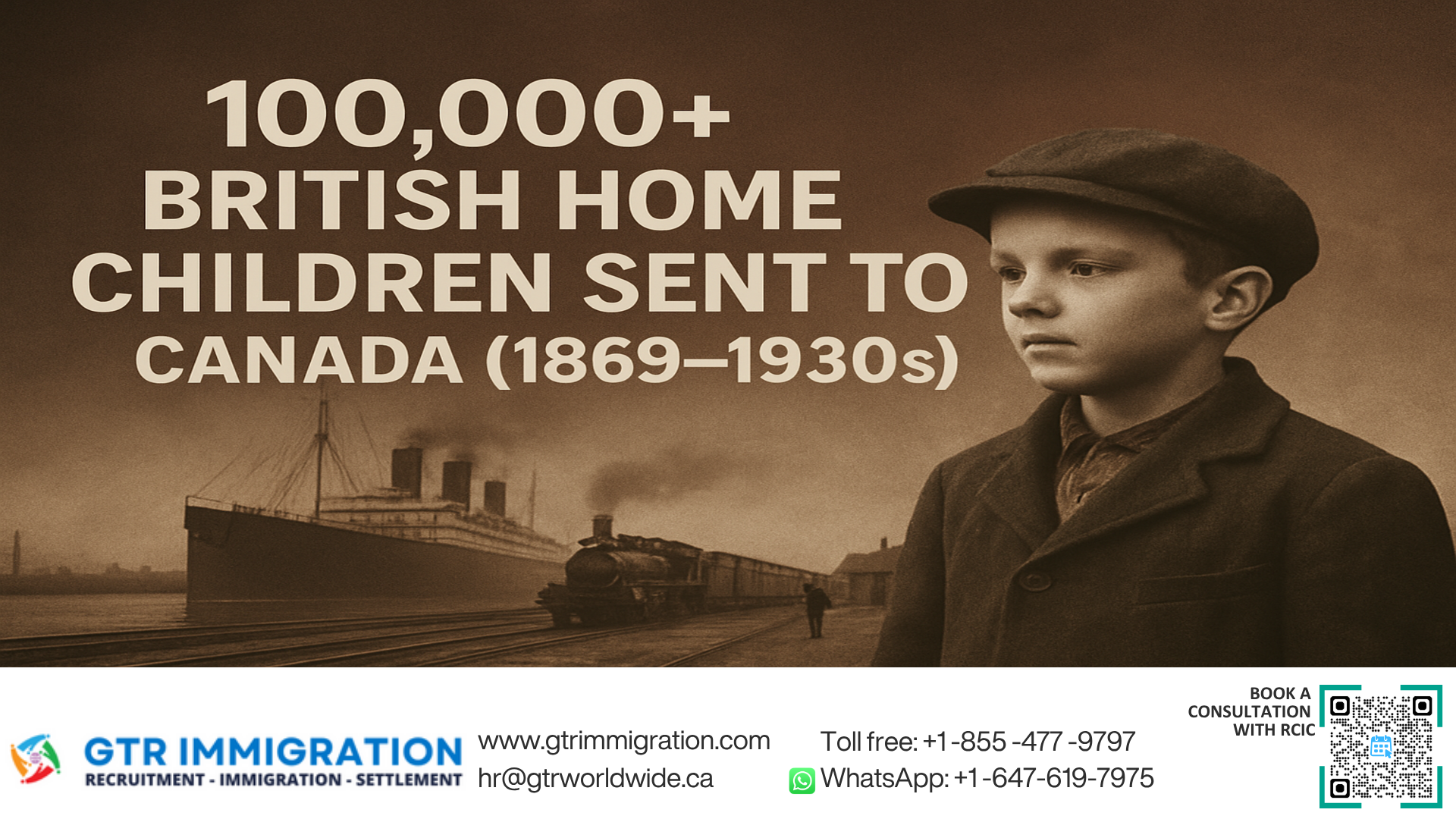
  • 100,000+ British Home Children Sent to Canada (1869–1930s)

    100,000+ British Home Children Sent to Canada (1869–1930s)

    British Home Children and Canadian Citizenship: How 1947, Bill C-3 and family records may mean you’re already Canadian

    Why this update matters right now
    Descendants of Britain’s child emigration programs—the British Home Children—may already be Canadian because of legal changes tied to January 1, 1947 and later statutory fixes. If your family story mentions a child sent from Britain or Ireland to a receiving home or a farm in Canada, that detail could start a citizenship claim. Citizenship can exist by operation of law without anyone ever having applied, but you will usually need documentary proof to obtain a Canadian passport or other official proof.

    How a historical migration became a modern citizenship issue
    From about 1869 to the late 1930s, charities, churches and local poor-relief boards in Britain arranged for children to be sent to Canada. Library and Archives Canada (LAC) estimates more than 100,000 children were sent in that period; the UK National Archives, counting only to 1930, reports about 80,000. Sending agencies included Maria Rye, Annie Macpherson and Dr. Barnardo’s Homes; receiving homes included places such as Fairknowe (Brockville) and Marchmont (Belleville). At the time these children arrived, people in Canada were British subjects; separate Canadian citizenship was created on January 1, 1947. What happened in 1947 is the legal pivot that can determine whether descendants qualify as citizens today.

    What changed in 1947 and afterward
    When Canada’s first Citizenship Act took effect on January 1, 1947, some British subjects living in Canada became Canadian citizens automatically, while others did not. In 2015 Parliament corrected part of that gap by recognizing some British subjects who were “ordinarily resident” in Canada on that date as having citizenship from 1947 (with certain exclusions). Separately, for decades Canada applied a “first-generation limit” to citizenship by descent. Bill C-3, which came into force on December 15, 2025, removed that barrier for many families and expanded the ability to claim citizenship across multiple generations born outside Canada. The practical result: if you can document an unbroken chain from a Home Child ancestor who meets the 1947 residency tests, you may now be able to claim citizenship.

    Who might be affected
    Many families will recognize a pattern: a grandparent or great‑grandparent who “came from Britain as a child,” a farm placement in Canada, or a relative who rarely talked about their past. A 2010 federal estimate suggests millions of Canadians descend from former Home Children, and some descendants living abroad may be Canadian by operation of law.

    Things to watch for:
    – Whether the Home Child was “ordinarily resident” in Canada on January 1, 1947.
    – Whether you can document each generation from that ancestor to the claimant.
    – Whether any ancestor renounced citizenship or otherwise changed status (which can break the chain).
    – Births before 1947 and ancestors who died prior to statutory recognition require individual assessment.

    Practical steps to check a possible claim
    Begin with family interviews and archival searches. The key facts you’ll want to establish are arrival and placement in Canada, residence on January 1, 1947, and an unbroken descent chain.

    Start with family memory
    – Ask oldest relatives for names, ship crossings, receiving homes, agency names (Barnardo, Quarrier, Macpherson, Middlemore, Maria Rye), and any farm or town names.

    Search archives and records
    – Search LAC’s Home Children records by name; entries often show ship, arrival date and sending agency. Passenger lists can confirm the crossing.
    – Use local and national vital records, census and passenger records to show presence and residence in Canada.

    Prove residence on January 1, 1947
    – Establish whether the ancestor was “ordinarily resident” in Canada that day using census, vital records, and other residency evidence. IRCC holds many citizenship files from the era that can be relevant.

    Build the descent chain
    – Collect birth certificates or other acceptable documents for each generation. IRCC provides guidance on alternative evidence when records are missing. Placement or adoption records alone do not establish citizenship.

    Common complications
    – Name variations, missing records, mobility across borders, renunciations, and births before 1947 can all complicate claims. Complex or unclear cases often benefit from an immigration lawyer or a professional experienced with historical records and citizenship law.

    Realistic outcomes
    If you can show a Home Child ancestor was “ordinarily resident” in Canada on January 1, 1947 and document an unbroken descent to you (or another relative), you may already be a Canadian citizen by operation of law. You will typically need a Proof of Citizenship certificate from IRCC to exercise rights such as obtaining a Canadian passport. Canada permits dual citizenship, so claiming Canadian status does not automatically affect other nationalities.

    Checklist: evidence to gather before applying for proof of citizenship
    – Home Child archival entry or passenger list showing crossing and receiving home.
    – Records showing the ancestor lived in Canada on January 1, 1947 (census, vital records, residency documents).
    – Birth records for each generation linking the ancestor to the claimant.
    – Any IRCC or citizenship files related to the ancestor.
    – Details of any known renunciations or legal steps affecting citizenship.

    Where to start
    Talk to the oldest relatives, search LAC’s Home Children database, and collect vital records showing residence on January 1, 1947 and birth records across generations. If you hit gaps or legal questions, consider professional help. Document carefully: spellings and dates can vary, and each link matters for a successful claim.

    🚀 Start Your Canada Immigration, Jobs & Settlement Journey Today

    Need help with Express Entry, PNP, LMIA, Work Permit, Study Permit, Visitor Visa, Family Sponsorship, Canada Jobs, Recruitment, or Settlement guidance? Book a paid consultant: https://gtrworldwide.zohobookings.com/#/greentechresourcesworldwidecanadawebsite

    📱 WhatsApp / Call: +1 647 619 7975 / + 1 639 560 3180
    🌐 Website: www.gtrimmigration.com
    💼 Canada Job Site: www.ciccanadajobs.com
    📊 Job Analytics & Labour Market Insights: www.jobmaze.ca
    🔗 LinkedIn: www.linkedin.com/in/manojcanada
    📘 Facebook: https://www.facebook.com/gtrimmigrationcanada
    ▶️ YouTube: https://www.youtube.com/@GTRImmigration
    📸 Instagram: https://www.instagram.com/gtr_immigration

    #BritishHomeChildren #CanadianCitizenship #BillC3 #1947Citizenship #FamilyHistory #ImmigrationCanada #ProofOfCitizenship

  • BCPNP Issues 10 Entrepreneur Immigration Invitations

    BCPNP Issues 10 Entrepreneur Immigration Invitations

    BCPNP Entrepreneur Draw (22 Sep 2026): 119 Cutoff, 10 Base Stream Invites — What Entrepreneurs Need to Know

    On September 22, 2026, the British Columbia PNP held an Entrepreneur Immigration selection round. The minimum registration score was 119 for both the Base and Regional streams. The province issued at least 10 invitations to Base Stream candidates; invitations were also issued to Regional Stream candidates, but the source does not state the exact number for the Regional Stream.

    Why this matters
    A 119 cutoff is the highest threshold seen in several months for both streams (since Feb. 10 for Base and Mar. 10 for Regional). It signals stronger competition and a preference for higher-scoring entrepreneur candidates. For those planning to start or buy a business in B.C., registration scoring is an important factor in selection chances.

    How this round fits 2026 activity
    – This was the province’s 10th entrepreneur-focused selection round of 2026.
    – Across entrepreneur selections through Sept. 22, BCPNP issued at least 114 entrepreneur invitations in 2026.
    – Combined with Skills Immigration invitations (>5,300), BCPNP has issued at least 5,414 invitations so far in 2026.
    – In 2026 the province has run 17 entrepreneur drawing events: ten targeting Base Stream candidates and seven targeting Regional Stream candidates.

    Key differences: Base Stream vs Regional Stream
    Both streams target entrepreneurs, but they differ in eligibility and early requirements:
    – Business geography: Base allows a new business or takeover anywhere in the province; Regional requires a business outside the Metro Vancouver Regional District.
    – Ownership: Base minimum 33.33% ownership; Regional requires 51%.
    – Net worth and investment: Base — $600,000 net worth and $200,000 minimum investment; Regional — $300,000 net worth and $100,000 minimum investment.
    – Experience and education: Base — three years as owner-manager in the last 10 years; Regional — three years as owner-manager in the last 5 years. A post-secondary credential is required unless applicants can show three years of active full ownership and management within the past five years.
    – Community requirements: Regional Stream requires an exploratory visit and a community referral up front; Base does not.
    – Registration minimums: Base registration minimum 115/200 (co-applicants permitted); Regional registration minimum 105/200 (no co-applicants).
    – Language: Both streams require minimum CLB 4.

    Work permits and the Bridging Open Work Permit (BOWP)
    – Approved provincial nomination applicants receive a work permit support letter from B.C., which they can use to apply to the federal government for a temporary work permit to establish their business.
    – Since June 9, 2026, a temporary federal measure allows nominees applying for PR through a base PNP pathway to apply for a BOWP earlier by removing the requirement to first receive an Acknowledgement of Receipt (AOR). This may shorten the wait time for open work authorization after PR submission for eligible base-stream nominees.

    Who is most affected
    – Registered entrepreneur candidates with scores near or below 119 should see this round as a sign of increased competition.
    – Prospective applicants should match their business concept and resources to the correct stream and prepare stronger registration profiles.
    – Nominees in the nomination/PR process should note the June 9 federal measure that may enable earlier BOWP access for base-stream PR applicants.

    Practical takeaways
    – Aim above the stream’s registration minimum (Base 115, Regional 105) to stay competitive—recent selections can occur above those baselines.
    – Choose the stream that matches your business location, ownership capacity, and willingness to complete community steps (Regional).
    – For Regional Stream applicants, plan the exploratory visit and community referral before registration.
    – Prepare verifiable financial documents (net worth, investment), business plans, and evidence of experience.
    – If invited, you must submit a provincial nomination application within four months.
    – If nominated, use the provincial work permit support letter to apply federally; base-stream nominees applying for PR should consider the June 9 temporary federal measure’s potential impact on BOWP timing.

    Numbers to remember from the Sept. 22 update
    – Date of draw: September 22, 2026
    – Minimum registration score this round: 119 (both Base and Regional)
    – Invitations issued (Base Stream): 10
    – Invitations issued (Regional Stream): invitations issued, exact number not provided in the source
    – BCPNP entrepreneur invitations in 2026 (to date through Sept. 22): at least 114
    – Total BCPNP invitations in 2026 when combined with Skills Immigration: at least 5,414
    – Program-specific minimums: personal net worth — $600,000 (Base) / $300,000 (Regional); minimum investment — $200,000 (Base) / $100,000 (Regional); minimum ownership — 33.33% (Base) / 51% (Regional); language CLB 4

    Final checklist before you register
    – Confirm which stream fits your business plan and location.
    – Estimate your registration score and aim to exceed recent cutoffs (119 in this round).
    – Gather verified financial statements, investment plans, and ownership documentation.
    – For Regional Stream: schedule the exploratory visit and secure a community referral before registering.
    – Be ready to submit a provincial nomination application within four months of an invitation.
    – If nominated, use the provincial work permit support letter to apply federally; base-stream PR applicants should review the June 9 federal measure regarding earlier BOWP application.

    The Sept. 22 draw (minimum score 119, at least 10 Base Stream invitations) underscores that B.C.’s entrepreneur streams remain active and competitive. Treat registration scoring as a central strategic variable, choose your stream based on the business plan and personal circumstances, and prepare provincial and federal steps in advance.

    🚀 Start Your Canada Immigration, Jobs & Settlement Journey Today

    Need help with Express Entry, PNP, LMIA, Work Permit, Study Permit, Visitor Visa, Family Sponsorship, Canada Jobs, Recruitment, or Settlement guidance? Book a paid consultant: https://gtrworldwide.zohobookings.com/#/greentechresourcesworldwidecanadawebsite

    📱 WhatsApp / Call: +1 647 619 7975 / + 1 639 560 3180
    🌐 Website: www.gtrimmigration.com
    💼 Canada Job Site: www.ciccanadajobs.com
    📊 Job Analytics & Labour Market Insights: www.jobmaze.ca
    🔗 LinkedIn: www.linkedin.com/in/manojcanada
    📘 Facebook: https://www.facebook.com/gtrimmigrationcanada
    ▶️ YouTube: https://www.youtube.com/@GTRImmigration
    📸 Instagram: https://www.instagram.com/gtr_immigration

    #BCPNP #EntrepreneurImmigration #BCBusinessVisa #BridgingOpenWorkPermit #CanadaPNP #BCStartupVisa #ImmigrationUpdates

  • Canadian by Descent: When to Hire an Immigration Lawyer

    Canadian by Descent: When to Hire an Immigration Lawyer

    Proof of Canadian Citizenship by Descent: why the paperwork, timelines and hidden complications matter more than ever

    You may have just learned you qualify as a Canadian citizen by descent — but getting an accepted proof of citizenship is often the harder step. As of September 2026, IRCC lists a 33‑month processing standard for a proof of citizenship certificate. Because incomplete or improperly sourced applications are frequently returned, careful planning is essential.

    The practical reality
    IRCC requires a complete package: correct forms, identity documents and original civil records issued by the authority that created them. Genealogy site downloads or third‑party copies are not acceptable primary evidence. Missing or wrong documents often lead to returned files rather than pauses for missing items, which can add months or years to the process.

    Why document sourcing is the bottleneck
    Each generation adds at least one more official record, another possible name variant, and more jurisdictions to check. Longer descent chains raise complexity rapidly — as immigration lawyers often note, the more generations you trace, the more likely you’ll hit archival, jurisdictional or documentary problems. Some records don’t exist as modern certificates and must be proved with historical documents held in archives.

    Ten situations where professional help is commonly useful
    1) Adoption in the line — may require a different application route and proof the adoption was legally complete.
    2) Indigenous ancestry or births on reserve — records may be held by non‑standard authorities and require specialist navigation.
    3) Possible formal renunciation by an ancestor — renunciation is a recorded legal act and can break the line if it occurred.
    4) Anchor ancestor born or naturalized before 1947 (or in Newfoundland and Labrador before April 1, 1949) — you may need archival records (censuses, manifests, naturalization files) rather than a modern certificate.
    5) Acadian/Cajun or displaced family lines — records may be scattered overseas, in parish registers, or in old scripts and languages.
    6) Names or dates that don’t match across documents — many issues can be fixed with a clear explanation, but knowing when to explain versus when to obtain a different record is a professional judgement.
    7) Quebec certificates printed before January 1, 1994 — IRCC does not accept those; you must obtain a reissued certificate from the Directeur de l’état civil (DEC) or, for very old records, documents from BAnQ.
    8) Need for expedited processing — IRCC can prioritize some cases (employment, education, certain benefits or serious hardship); a well‑prepared request can shorten waits.
    9) Not knowing where to start — tracing every person in the chain and identifying the issuing authority for each required record is often more complex than expected.
    10) No time to manage the process — assembling, ordering, translating and coordinating records is time‑consuming; many people hire help for this reason alone.

    Who is most likely to feel the effects
    – People tracing descent across multiple generations.
    – Ancestors born or naturalized before 1947 (or in Newfoundland and Labrador before April 1, 1949).
    – Families with Quebec record printing dates before Jan 1, 1994.
    – Cross‑border, Indigenous, or historically displaced lines.
    – Applicants needing a faster decision for work, study, benefits or safety.

    Practical impacts to plan for
    – Expect long waits: plan around the 33‑month processing standard.
    – Obtain originals from the issuing authority — genealogical copies usually won’t do.
    – Budget time and costs for reorders, translations and archival searches.
    – Collect alternative supporting records where modern certificates don’t exist.
    – Consider an early professional assessment to identify likely hurdles.

    A short checklist before you apply
    – Map your chain of descent and list the expected record and issuing authority for each person.
    – Verify whether any ancestor formally renounced Canadian citizenship.
    – Check Quebec certificate printing dates and re‑order from DEC if printed before 1994.
    – For pre‑1947 ancestors, prepare to use historical records instead of a citizenship certificate.
    – Gather originals from the relevant issuing authorities; don’t rely on genealogy site downloads.
    – Note name variants and prepare explanations; get professional advice on whether an explanation or new evidence is needed.
    – If time is critical, assess eligibility for expedited processing and prepare supporting documentation.
    – Be prepared for a lengthy process even with a complete application.

    Should you hire help?
    There’s no single rule. If your chain is short and you can obtain clean, modern certificates from the issuing offices, you may succeed on your own. But complexity increases with each generation and with any of the scenarios above. A brief conversation with an experienced practitioner can quickly indicate whether your case is likely straightforward or better handled with professional help.

    Discovering you are a Canadian citizen by descent is important — turning that discovery into accepted proof requires correct sourcing, archival attention and realistic timing. Start by mapping your chain, ordering records from the issuing authorities, and planning for a long processing timeline. When you hit historical, jurisdictional, or documentary obstacles, specialist help often speeds the path to an accepted application.

    🚀 Start Your Canada Immigration, Jobs & Settlement Journey Today

    #CanadaCitizenship #CitizenshipByDescent #IRCC #ImmigrationLaw #CanadianDocuments #QuebecRecords #Genealogy #CitizenshipCertificate

  • IRCC releases updated temporary residence processing times

    IRCC releases updated temporary residence processing times

    IRCC processing times update — Sept 22, 2026: What changing waits for work permits, study permits, visitor visas and super visas mean

    Quick overview
    IRCC published updated temporary residence processing estimates on September 22, 2026. Key shifts include a one‑week increase in work permit wait times for applicants in the United States, a one‑week decrease for applicants in the Philippines, a 50‑day drop in U.S. super visa processing, and no change to study permit estimates for the first time since mid‑July. Visitor visa waits moved slightly, with the largest single‑country increase of six days. Even small weekly changes can affect travel, job start dates and family reunification plans.

    How IRCC calculates these figures
    IRCC reports two related measures: processing time estimates and service standards. Processing estimates are not guarantees; they come from either historical data (the period to finalize 80% of past applications) or forward‑looking calculations that account for current inventory and processing capacity. Service standards are internal targets showing how quickly IRCC aims to process most applications under normal conditions. Actual timelines vary with file complexity, inventory size, staffing, requests for more information and further verifications.

    Detailed changes (Sept 22 vs. Sept 16)
    Below are the IRCC estimates published on September 22 compared with the previous weekly update on September 16. All figures are IRCC’s.

    Work permits
    – Canada (in‑country): 16 weeks on Sept 22 (IRCC now reports in weeks for in‑Canada work permits); previously listed as 109 days on Sept 16.
    – India: 10 weeks (unchanged).
    – Pakistan: 8 weeks (unchanged).
    – Nigeria: 10 weeks (unchanged).
    – United States: 4 weeks (up from 3 weeks).
    – Philippines: 6 weeks (down from 7 weeks).
    Service standards: In‑Canada submissions (initial and extensions) — 120 days; Outside Canada submissions — 60 days.

    Study permits
    Estimates were unchanged in this update — the first pause in movement since July 17.
    – Canada: 8 weeks.
    – India: 5 weeks.
    – Pakistan: 7 weeks.
    – Nigeria: 10 weeks.
    – United States: 6 weeks.
    – Philippines: 5 weeks.
    Service standards: In‑Canada submissions — 120 days; Outside Canada submissions — 60 days.

    Visitor visas
    Processing times rose for most featured countries, with increases of one to six days:
    – Canada: 11 days (unchanged).
    – India: 32 days (up from 29 days).
    – Pakistan: 78 days (up from 75 days).
    – Nigeria: 93 days (up from 87 days).
    – United States: 17 days (up from 16 days).
    – Philippines: 21 days (unchanged).
    Service standard (outside Canada): 14 days. (In‑Canada submissions: N/A.)

    Super visas
    Wait times fell for most featured countries; the U.S. saw the largest decline.
    – India: 70 days (unchanged).
    – Pakistan: 92 days (down from 95 days).
    – Nigeria: 44 days (down from 46 days).
    – United States: 66 days (down from 116 days — a 50‑day decline).
    – Philippines: 90 days (unchanged).
    Service standard: 112 days. Note: super visa applications must be submitted from outside Canada.

    Why small weekly changes matter
    Even modest shifts can disrupt plans when timelines are fixed. Examples:
    – Employers and international hires may need to adjust start dates if work permit estimates change.
    – Families planning visits via visitor or super visas may have to change travel, caregiving or housing arrangements.
    – Students benefit from stability in study permit estimates, but lack of improvement still requires cautious planning.
    Also note gaps between service standards and current estimates (for example, visitor visa estimates exceed the 14‑day outside‑Canada target in several countries), which can affect expectations.

    Who is most affected
    – Temporary foreign workers (in‑country extensions and abroad hires).
    – Prospective international students (short‑term predictability but no improvement).
    – Visitors and family members applying by visitor or super visa.
    – Employers, schools and settlement providers advising clients.

    Practical implications and tips
    – Build extra buffer time into travel, job start dates and academic plans based on country‑specific estimates, not service standards alone. For example, assume roughly 93 days for a visitor application from Nigeria per this update.
    – Employers should factor processing uncertainty into offers and onboarding timelines.
    – Applicants should submit complete files and respond promptly to IRCC requests to avoid avoidable delays.
    – Note IRCC’s switch to reporting in‑Canada work permit times in weeks (16 weeks) while service standards remain in days (120 days); reconcile both when planning.

    What to watch next
    IRCC updates temporary residence estimates weekly; the next update is expected on or around September 30, 2026. Monitor whether short‑term trends persist, the gap between service standards and current estimates, and any reporting‑format changes that affect comparisons.

    Key numbers to remember from Sept 22
    – Work permits: In‑Canada — 16 weeks; Outside Canada service standard — 60 days; In‑Canada service standard — 120 days.
    – Study permits: Canada — 8 weeks; India — 5 weeks; Pakistan — 7 weeks; Nigeria — 10 weeks; U.S. — 6 weeks; Philippines — 5 weeks. Service standards: In‑Canada — 120 days; Outside Canada — 60 days.
    – Visitor visas: Canada — 11 days; India — 32 days; Pakistan — 78 days; Nigeria — 93 days; U.S. — 17 days; Philippines — 21 days. Service standard (outside Canada) — 14 days.
    – Super visas: India — 70 days; Pakistan — 92 days; Nigeria — 44 days; U.S. — 66 days; Philippines — 90 days. Service standard — 112 days. Super visas must be applied for from outside Canada.
    – IRCC processed 1,832,065 temporary residence applications from January through July 2026; more than 394,000 remained awaiting finalization as of July 31, 2026.

    Next steps for applicants and advisers
    – Build contingency time into plans.
    – Prepare complete applications and monitor IRCC communications closely.
    – Track weekly updates — small shifts can change planning assumptions quickly.
    – When timelines are critical, consider alternatives but don’t assume faster processing without evidence from IRCC’s future updates.

    IRCC’s weekly estimates give directional insight. This Sept 22 update shows pockets of improvement (notably the U.S. super visa and the Philippines work permit) alongside modest slowdowns (visitor visas and U.S. work permits). The stability in study permit estimates offers short‑term predictability, but proactive planning remains essential.

    🚀 Start Your Canada Immigration, Jobs & Settlement Journey Today

    #IRCC #ProcessingTimes #WorkPermit #StudyPermit #VisitorVisa #SuperVisa #CanadaImmigration #ImmigrationUpdate