Blog

  • IRCC Invites 4,500 French-Speaking Candidates in Latest Express Entry Draw

    IRCC Invites 4,500 French-Speaking Candidates in Latest Express Entry Draw

    Immigration, Refugees and Citizenship Canada (IRCC) has held another Express Entry draw, issuing 4,500 Invitations to Apply (ITAs) to candidates with strong French language proficiency.

    Details of the September 2025 French-Proficiency Draw

    The latest category-based draw required a minimum Comprehensive Ranking System (CRS) score of 446. To be eligible, candidates needed to have submitted an Express Entry profile before 7:21 a.m. UTC on June 16, 2025.

    This draw highlights Canada’s continued focus on attracting French-speaking immigrants, as part of its strategy to strengthen bilingual communities and support Canada’s labor market needs.

    Express Entry Draws in 2025: At a Glance

    So far in 2025, IRCC has conducted a wide range of draws under different categories, including the Provincial Nominee Program (PNP), Canadian Experience Class (CEC), and category-based draws for healthcare, social services, education, and French language proficiency.

    Below is a summary of Express Entry draws held in 2025:

    DateDraw TypeITAs IssuedCRS Cut-off
    Sept. 3Canadian Experience Class1,000534
    Sept. 2Provincial Nominee Program249772
    Aug. 19Healthcare & Social Services2,500470
    Aug. 18Provincial Nominee Program192800
    Aug. 8French Language Proficiency2,500481
    Aug. 7Canadian Experience Class1,000534
    Aug. 6Provincial Nominee Program225739
    July 22Healthcare & Social Services4,000475
    July 21Provincial Nominee Program202788
    July 8Canadian Experience Class3,000518
    July 7Provincial Nominee Program356750
    June 26Canadian Experience Class3,000521
    June 23Provincial Nominee Program503742
    June 12Canadian Experience Class3,000529
    June 10Provincial Nominee Program125784
    June 4Healthcare & Social Services500504
    June 2Provincial Nominee Program277726
    May 13Canadian Experience Class500547
    May 12Provincial Nominee Program511706
    May 2Healthcare & Social Services500510
    May 1Education1,000479
    April 28Provincial Nominee Program421727
    April 14Provincial Nominee Program825764
    Mar. 21French Language Proficiency7,500379
    Mar. 17Provincial Nominee Program536736
    Mar. 6French Language Proficiency4,500410
    Mar. 3Provincial Nominee Program725667
    Feb. 19French Language Proficiency6,500428
    Feb. 17Provincial Nominee Program646750
    Feb. 5Canadian Experience Class4,000521
    Feb. 4Provincial Nominee Program455802
    Jan. 23Canadian Experience Class4,000527
    Jan. 8Canadian Experience Class1,350542
    Jan. 7Provincial Nominee Program471793

    Express Entry Trends in 2025

    • Total ITAs issued so far in 2025: 62,109
    • Most frequent draw type: Provincial Nominee Program (16 draws)
    • Other categories:
      • Canadian Experience Class – 9 draws
      • French language proficiency – 5 draws
      • Healthcare and social services – 4 draws
      • Education – 1 draw

    This year, IRCC has placed significant emphasis on PNP draws and category-based invitations, while continuing to provide opportunities for French-speaking candidates and those with Canadian work experience.

    What This Means for Applicants

    The latest draw shows that candidates with French proficiency continue to benefit from lower CRS cut-offs compared to other categories, making it an attractive pathway for immigration to Canada in 2025.

    Applicants are encouraged to keep their Express Entry profiles updated and monitor the evolving IRCC Express Entry draw schedule to maximize their chances of receiving an ITA.

  • Canada Immigration Update – Ontario Issues 2,643 Invitations in September 2025 PNP Draw

    Canada Immigration Update – Ontario Issues 2,643 Invitations in September 2025 PNP Draw

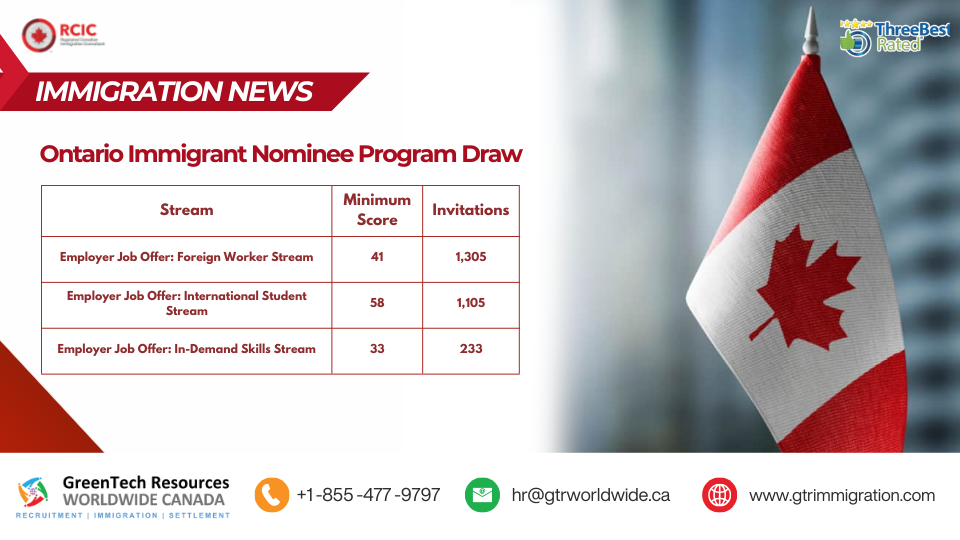
    The Ontario Immigrant Nominee Program (OINP) has conducted some of its largest draws of the year on September 2, 2025, issuing a total of 2,643 Invitations to Apply (ITAs) under the Employer Job Offer streams. This major selection round highlights Ontario’s strong demand for skilled workers, international graduates, and professionals in high-priority occupations.

    Breakdown of Ontario PNP Draws – September 2, 2025

    Ontario invited candidates from three major streams of the Employer Job Offer category. Here is the full breakdown:

    StreamMinimum ScoreNumber of Invitations
    Employer Job Offer: Foreign Worker Stream411,305
    Employer Job Offer: International Student Stream581,105
    Employer Job Offer: In-Demand Skills Stream33233

    Focus on Healthcare and Education Occupations

    The September 2 OINP draws specifically targeted candidates working in priority sectors such as:

    • Healthcare professionals (doctors, nurses, medical technicians)
    • Early childhood educators and assistants
    • Home support and related care roles under the In-Demand Skills stream

    Only candidates with valid job offers in eligible NOC (National Occupational Classification) codes were considered.

    Eligibility and Profile Requirements

    To qualify for these draws, candidates needed to:

    • Have an active Expression of Interest (EOI) profile submitted between July 2, 2025, and September 2, 2025.
    • Possess a valid job offer from an Ontario employer in eligible occupations.
    • Meet the minimum score cut-offs depending on the Employer Job Offer stream.

    Why This Draw Is Significant

    • With 2,643 ITAs issued, this marks one of the largest Ontario PNP draws in 2025, reinforcing the province’s commitment to welcoming skilled immigrants to address labor shortages in healthcare, education, and essential services.
    • The Ontario PNP (OINP) continues to play a crucial role in Canada’s immigration strategy, offering foreign workers and international graduates a pathway to permanent residency (PR) in Canada.
  • IRCC’s 2025 Express Entry Draw Schedule Revealed – Categories, ITAs, and CRS Insights

    IRCC’s 2025 Express Entry Draw Schedule Revealed – Categories, ITAs, and CRS Insights

    Immigration, Refugees and Citizenship Canada (IRCC) has unveiled its 2025 Express Entry draw schedule, giving candidates a clearer picture of upcoming opportunities to receive an Invitation to Apply (ITA) for permanent residence. Based on recently released internal memos and Access to Information (ATIP) requests, the new details shed light on category-based draws, Francophone immigration targets, and how provinces will coordinate their immigration planning.

    Key Highlights of IRCC’s 2025 Express Entry Plans

    • Category-Based Draws: Healthcare, trades, and education will remain the top focus for 2025.
    • Francophone Priority: IRCC aims for 8.5% of admissions outside Quebec to be Francophone in 2025, rising to 9.5% in 2026.
    • ITA Distribution: Tens of thousands of ITAs already issued, with more scheduled throughout 2025.
    • Provincial Coordination: Provinces will receive a three-month ITA forecast calendar to align draws with regional labor needs.
    • Link to 2026 Targets: ITAs issued late in 2025 may count toward 2026 admissions, due to processing timelines.

    Breakdown of Category-Based Draws for 2025

    Healthcare Professionals

    • Planned ITAs: 8,000
    • Issued so far: 7,500
    • Remaining in 2025: 500

    Healthcare remains the largest priority, reflecting Canada’s urgent need for nurses, doctors, and allied health professionals.

    Education Workers

    • Planned ITAs: 3,000
    • Issued so far: 1,000
    • Remaining in 2025: 2,000

    Teachers and early childhood educators are in demand, and more draws are expected before year-end.

    Skilled Trades

    • Planned ITAs: 3,300
    • Issued so far: 0
    • Remaining in 2025: 3,300

    Trades are the biggest untapped opportunity in 2025. Candidates in construction, transportation, and manufacturing may benefit from upcoming rounds with lower CRS cut-offs.

    Francophone Immigration: A Growing Priority

    Canada continues to push for strong Francophone immigration outside Quebec. IRCC’s 2025 memo revealed:

    • 18,500 ITAs issued in February–March Francophone draws.
    • 2,500 ITAs issued on August 8, likely counting toward 2026 targets.
    • Overall goal: 8.5% Francophone admissions in 2025.

    French-speaking candidates also receive up to +50 CRS points, making them more competitive in both category-based and general draws.

    ITA Calendar for Provinces and Territories

    For the first time, IRCC will share a three-month ITA calendar with provinces and territories. This calendar will outline:

    • Weeks when draws will occur
    • Types of draws (general, PNP, or category-based)
    • Projected CRS minimums (subject to operational changes)

    This greater transparency allows provinces to align Provincial Nominee Programs (PNPs) with federal Express Entry rounds, giving candidates more predictability.

    Link Between 2025 and 2026 Targets

    IRCC memos note that late-2025 ITAs may contribute to 2026 permanent resident admissions, given the average processing time. This means draws held in the final quarter of 2025 are designed not only to meet 2025 immigration levels but also to support Canada’s 2026 targets under the 2025–2027 Immigration Levels Plan.

    What This Means for Express Entry Candidates

    1. Trades candidates have the biggest opportunity – with over 3,300 ITAs still unissued.
    2. Healthcare and education workers remain strong contenders, with additional draws expected.
    3. Francophone applicants gain a competitive edge thanks to CRS bonuses and high ITA volumes.
    4. CRS score strategies matter – category-based draws often cut off 20–40 points lower than general draws, offering a path for candidates in the 480–490 range.
    5. Plan around timelines – applying late in 2025 may align your application with 2026 intake goals.

    IRCC’s 2025 Express Entry draw schedule confirms that healthcare, education, trades, and Francophone immigration will dominate the year’s priorities. With thousands of ITAs still available, especially in trades and education, candidates who align their profiles strategically stand a strong chance of success.

    By understanding the category-based allocations, CRS score advantages, and provincial coordination efforts, skilled workers can better position themselves to receive an ITA in the coming months.

  • Nova Scotia Provides Update on Available Immigration Spots for 2025

    Nova Scotia Provides Update on Available Immigration Spots for 2025

    Nova Scotia has confirmed the number of remaining immigration spaces for 2025 under the Provincial Nominee Program (PNP) and the Atlantic Immigration Program (AIP). The announcement highlights how the federal government’s immigration levels plan for 2025 has significantly reshaped opportunities for skilled workers, employers, and international applicants looking to settle in the province.

    Federal Immigration Allocation for Nova Scotia in 2025

    In 2024, Nova Scotia was granted 6,300 immigration spots through its provincial nomination streams and the Atlantic Immigration Program. However, under the Immigration Levels Plan 2025–2027, the federal government reduced Nova Scotia’s allocation by half to just 3,150 spaces in 2025.

    This sharp reduction has put pressure on Nova Scotia’s immigration system, forcing the province to carefully manage its allocation and prioritize applicants who can meet critical labour shortages.

    Current Status of Nova Scotia’s Immigration Quota

    Nova Scotia Immigration has confirmed that the 2025 quota is already full or close to being filled, as the number of applications submitted has exceeded the provincial allocation. This means that many categories are now paused, and only select applications will continue to be processed this year.

    Who Qualifies for Nova Scotia Immigration in 2025?

    With limited spaces, Nova Scotia has outlined clear priority groups for processing:

    1. Workers already in Nova Scotia
      • Applicants who are living and working in the province.
      • Individuals with work permits expiring in 2025.
    2. High-demand occupations
      • Healthcare workers (nurses, doctors, support staff).
      • Social assistance sector employees (NAICS code 62).
      • Construction workers (NAICS code 23).
    3. Applicants with strong settlement potential
      • Those who demonstrate long-term commitment to living and working in Nova Scotia.
      • Candidates filling urgent regional labour market needs.

    Options for International Applicants Outside Nova Scotia

    For applicants currently living abroad, immigration options are now very limited. Only certain groups may still be considered:

    • Healthcare, social services, and construction workers in demand by Nova Scotia employers.
    • Candidates recruited under the Atlantic Immigration Program (AIP) in specific sectors such as:
      • Trucking and transportation
      • Science and technology
      • Clean energy
      • Resource development

    Outside these sectors, most international applications will remain on hold until new allocations are released.

    What This Means for Skilled Workers and Employers

    The confirmation of Nova Scotia’s remaining provincial immigration spaces for 2025 has several important implications:

    • For skilled workers: Applicants already in Nova Scotia stand the best chance of receiving a provincial nomination. International candidates must align their profiles with priority sectors.
    • For employers: Businesses in healthcare, construction, and social assistance may still be able to recruit foreign talent through PNP or AIP streams, despite reduced quotas.
    • For future applicants: Those who cannot apply in 2025 should prepare for the 2026 immigration allocation, which may bring new opportunities.

    With only 3,150 spaces available in 2025, Nova Scotia has confirmed that it will strictly prioritize applicants who can meet its most urgent labour needs. While opportunities remain open for certain workers, the reduced allocation means competition is fierce, and many applicants will need to plan for future immigration rounds.

  • Ontario PNP Issues 468 Invitations in August 28, 2025 Draws

    Ontario PNP Issues 468 Invitations in August 28, 2025 Draws

    Ontario’s Provincial Nominee Program (PNP) has once again invited skilled workers and international graduates through multiple draws. On August 28, 2025, the Ontario Immigrant Nominee Program (OINP) issued a total of 468 invitations to apply (ITAs) across five draws under the Employer Job Offer streams.

    The invitations targeted candidates with job offers in Northern Ontario and those eligible under the Regional Economic Development through Immigration (REDI) pilot.

    Key Highlights of the August 28, 2025 OINP Draws

    • Total invitations issued: 468
    • Streams covered: Employer Job Offer – Foreign Worker, International Student, and In-Demand Skills
    • Targeted regions: Northern Ontario + REDI pilot communities (Lambton, Lanark, Leeds and Grenville)
    • Profile submission window: Between July 2, 2025 and August 28, 2025

    Invitations for Candidates in Northern Ontario

    • Ontario issued invitations to Foreign Workers and International Students with job offers in Northern Ontario.
    StreamMinimum ScoreInvitations Issued
    Employer Job Offer: Foreign Worker5394
    Employer Job Offer: International Student66236

    REDI Pilot: 138 Invitations Issued

    As part of the REDI pilot program, Ontario issued 138 invitations through the EOI system:

    StreamMinimum ScoreInvitations Issued
    Employer Job Offer: Foreign Worker4594
    Employer Job Offer: International Student6856
    Employer Job Offer: In-Demand Skills3425

    Targeted regions under REDI:

    • Lambton
    • Lanark
    • Leeds and Grenville

    NOC Codes Targeted Under REDI

    • In-Demand Skills Stream: Home support workers, farm machinery operators, machine operators, construction laborers, and food processing workers.
    • Foreign Worker & International Student Streams: Accountants, HR professionals, software engineers, web developers, nurses, social workers, educators, machinists, carpenters, auto technicians, and agricultural supervisors.

    The REDI pilot runs until December 31, 2025, offering a pathway to permanent residence for candidates with job offers in smaller Ontario communities.

    Ontario’s New Employer-Led EOI System

    Since July 2, 2025, Ontario has transitioned to a new employer-led Expression of Interest (EOI) system.

    • Employers must now submit job offers through the OINP Employer Portal.
    • Only candidates with an employer-submitted and approved EOI are eligible for draws.
    • Candidates who submitted EOIs before July 2 must re-submit with their employer’s support.

    This change shifts the OINP Employer Job Offer streams to an employer-driven process, ensuring that Ontario selects candidates aligned with real labor market needs.

    The August 28, 2025 OINP draws highlight Ontario’s strategy of targeting skilled workers, international graduates, and in-demand occupations to support economic development in both Northern Ontario and smaller REDI communities.

    With 468 invitations issued, the draws reinforce Ontario’s commitment to attracting talent in healthcare, skilled trades, IT, finance, and social services to address ongoing labor shortages.

  • 77 Skilled Workers Receive Invitations in Manitoba PNP August 2025 Draw

    77 Skilled Workers Receive Invitations in Manitoba PNP August 2025 Draw

    The Manitoba Provincial Nominee Program (MPNP) has once again invited skilled workers to apply for permanent residency in its latest provincial draw. The selection focused on candidates with the skills and experience most needed in the province, further strengthening Manitoba’s labor market and economy.

    Manitoba PNP Draw Results – August 21, 2025

    On August 21, 2025, Manitoba conducted its 17th provincial immigration draw of the year, issuing a total of 77 Letters of Advice to Apply (LAAs) under the Skilled Worker Stream.

    Of these, 18 invitations were awarded to candidates who submitted a valid Express Entry profile number and job seeker validation code, allowing them to be considered for both federal and provincial immigration programs.

    Key Highlights

    • Total invitations issued: 77
    • Lowest-ranked candidate score: 612
    • Draw type: Skilled Worker Stream
    • Date of draw: August 21, 2025

    Invitations Through Strategic Recruitment Initiatives

    This draw placed a strong emphasis on Manitoba’s strategic recruitment initiatives, which allow the province to target candidates with skills that meet specific workforce needs.

    The breakdown of invitations was as follows:

    Strategic Recruitment InitiativeNumber of LAAs Issued
    Employer Services6
    Francophone Community29
    Regional Communities31
    Ethnocultural Communities11

    Candidates who met or exceeded the minimum score but did not receive an invitation may have been excluded due to incomplete information, such as expired language test results or missing invitation numbers in their Expression of Interest (EOI).

    Why Strategic Recruitment Matters for Manitoba Immigration

    Strategic recruitment initiatives are a vital tool for Manitoba to attract international talent in sectors facing chronic labor shortages. Employers and communities play an active role by identifying candidates with the right qualifications, while the MPNP provides them with a pathway to Canadian permanent residency.

    • For employers: These initiatives help fill long-term vacancies in high-demand industries.
    • For candidates: Skilled workers gain access to a faster immigration process and settlement opportunities in Manitoba.

    To qualify, employers must complete the ABC Recruitment Process, while applicants must meet specific criteria related to age, work experience, education, and language proficiency.

    Manitoba PNP: A Pathway to Canada PR in 2025

    With each draw, Manitoba continues to create opportunities for skilled workers who want to build their future in Canada. The province’s immigration strategy not only supports its growing economy but also strengthens communities by welcoming diverse and talented newcomers.

    For skilled workers looking to immigrate, the Manitoba PNP remains one of the most reliable pathways to achieve Canada PR in 2025.

  • Saskatchewan Immigration Quota Increased for 2025

    Saskatchewan Immigration Quota Increased for 2025

    The Saskatchewan Immigrant Nominee Program (SINP) has received a significant boost in 2025. The federal government has approved an additional 1,136 nomination slots, raising Saskatchewan’s total immigration quota to 4,761 nominations for the year.

    This increase comes as welcome news for many skilled workers, employers, and international applicants who were affected by earlier cuts to Saskatchewan’s immigration allocation.

    Saskatchewan Immigration Quota 2025 Breakdown

    • Original Allocation (2025): 3,625 nominations (a 50% reduction compared to 2024)
    • Additional Nominations Approved: +1,136
    • New Total Quota: 4,761 nominations

    With the revised quota, Saskatchewan is now better positioned to attract skilled immigrants to support its labor market and economic needs.

    Impact on Key Sectors

    The new immigration slots will directly benefit industries that had previously reached their cap under the SINP. These include:

    • Trucking
    • Accommodation and Hospitality
    • Food Services
    • Retail Trade

    Each of these industries had hit the 25% sector cap, which forced the province to stop processing applications earlier this year. With the new allocation, these applications can now be resumed, giving employers and skilled workers renewed opportunities.

    Why Saskatchewan Needed a Higher Quota

    At the start of 2025, Saskatchewan’s immigration allocation was cut in half, creating challenges for employers struggling with labor shortages. In addition, the federal government required that 75% of provincial nominees be individuals already living in Canada, limiting international applicants.

    Priority nominations were reserved for healthcare, agriculture, and skilled trades, while sectors like food services and retail faced application rejections once their caps were reached.

    The increase in quota now helps Saskatchewan address these gaps and ensures a more balanced immigration intake across industries.

    What This Means for Immigration Candidates

    For skilled workers and international graduates, the expanded Saskatchewan PNP quota means:

    • More chances to receive a SINP nomination in 2025
    • Increased opportunities in high-demand industries
    • A pathway to permanent residence (PR) in Canada through provincial nomination

    Employers in Saskatchewan can also benefit by filling critical labor shortages and hiring foreign talent to support business growth.

    The increase in Saskatchewan’s immigration quota for 2025 is a positive development for both applicants and employers. With 4,761 SINP nominations now available, candidates in trucking, food services, accommodation, and retail will see their applications processed again.

    This decision highlights Saskatchewan’s ongoing commitment to welcoming skilled immigrants and supporting economic growth across the province.

  • Designated Employers Revealed in Peace Liard, North Okanagan–Shuswap, and Pictou County for Rural PR

    Designated Employers Revealed in Peace Liard, North Okanagan–Shuswap, and Pictou County for Rural PR

    Three Canadian regions — Peace Liard and North Okanagan-Shuswap in British Columbia, and Pictou County in Nova Scotia — have officially released their lists of designated employers under the Rural Community Immigration Pilot (RCIP).

    This update provides more opportunities for skilled foreign workers to secure job offers and apply for permanent residence (PR) through the rural pathway.

    What is the Rural Community Immigration Pilot (RCIP)?

    The RCIP is an employer-driven immigration program designed to attract and retain skilled foreign workers in smaller Canadian communities. To qualify, candidates must secure a job offer from a designated employer in a participating region and meet specific eligibility criteria, including:

    • Work experience: At least one year (1,560 hours) of relevant employment in the past three years (some exemptions apply for international graduates).
    • Language proficiency: Proof of English or French proficiency, usually CLB 4–6, depending on the job category.
    • Education: A Canadian secondary school credential or an equivalent foreign qualification.
    • Settlement funds: Proof of sufficient funds to support themselves and their family.

    Once an eligible candidate secures a job offer, the employer must have it endorsed by the community’s local economic development organization. If approved, the candidate may apply directly to the federal government for permanent residency.

    Peace Liard’s Designated Employers

    Peace Liard, located in northeastern British Columbia, has published an extensive list of approved employers across multiple sectors, including:

    • Healthcare & social services – Northern Health Authority, Northern Lights College, Campus Kids Daycare Society.
    • Hospitality & food services – Chubby FSJ Ltd., Dawson Creek Golf & Country Club, Sushi Heaven Japanese Restaurant Ltd.
    • Construction & trades – Surerus Construction and Development Ltd., Troyer Ventures Ltd., Pavlis Trucking Ltd.
    • Retail & services – City Furniture Ltd., Sobeys Capital Inc., Williston Drugs Limited.

    North Okanagan-Shuswap’s Designated Employers

    North Okanagan-Shuswap, in BC’s interior, has also shared its RCIP employer list, featuring opportunities in:

    • Healthcare & community services – Interior Health Authority, Kindale Developmental Association, Vernon & District Immigrant and Services Society.
    • Childcare & education – Harwood Montessori School, Kids Kingdom Childcare, North Okanagan Child Care Society.
    • Manufacturing & trades – Tolko Industries Ltd., KingFisher Boats Inc., Interfor Corporation.
    • Hospitality & retail – Best Western Premier Vernon, Predator Ridge Limited Partnership, Sobeys Capital Inc.

    Pictou County’s Designated Employers

    In Nova Scotia, Pictou County has published its RCIP employer list, which includes businesses in:

    • Hospitality & food services – Tim Hortons (Kyle Shaw Enterprises Ltd.), Sam’s Pizza – Stellarton, Subway (Highland Subshop Ltd.).
    • Construction & trades – Dustin’s Concrete, Scotsburn Lumber Ltd., Twin Rivers Home Builders.
    • Retail & services – Sobeys Capital Inc., Needs Convenience, Bowen’s Autobody Repair & Sales Inc.

    Why Designated Employers Matter

    The RCIP is employer-driven, which means a job offer from a designated employer is the first step toward applying for permanent residency. For skilled workers abroad, this is a valuable pathway to move to Canada and settle in communities that are actively seeking labor.

    As of today, 14 communities across Canada participate in the RCIP, with nearly all having launched their local programs. The program continues to see high demand since its launch, offering a vital option for both employers facing labor shortages and foreign workers seeking PR opportunities.

  • Canadian Immigration – Yukon Adds New Permanent Residency Nomination Spaces

    Canadian Immigration – Yukon Adds New Permanent Residency Nomination Spaces

    The Government of Yukon has announced that it will receive 67 additional nomination allocations for the Yukon Nominee Program (YNP) in 2025. This boost increases the total number of nominations available for permanent residence to 282, giving more skilled workers and employers an opportunity to benefit from the program.

    What is the Yukon Nominee Program (YNP)?

    The Yukon Nominee Program allows the territorial government to nominate foreign workers and international graduates for Canadian permanent residence. Candidates are usually nominated based on Yukon’s labour market needs, with a focus on priority sectors such as healthcare, skilled trades, and essential services.

    Through the YNP, employers can hire qualified foreign workers to fill labour shortages, while candidates gain a pathway to settle permanently in Yukon.

    Key Highlights of the 2025 Yukon Nominee Program

    1. Increase in Nomination Allocations

    • Original 2025 allocation: 215 nominations
    • Additional allocations received: +67 nominations
    • New total for 2025: 282 nominations

    This expansion will help Yukon address labour shortages, particularly in high-demand occupations.

    2. Expression of Interest (EOI) System

    Earlier this year, Yukon introduced an Expression of Interest (EOI) system to streamline the YNP application process. Employers submitted EOIs between March 31 and April 22, 2025, and over 500 applications were received.

    Nearly 400 EOIs met Yukon’s priority categories, which include:

    • Candidates who have lived and worked in Yukon for at least one year
    • Yukon University graduates
    • Francophone or French-speaking workers
    • Applicants holding a Temporary Measure Letter of Support

    3. Invitations to Apply (ITAs) in 2025

    So far, the territory has:

    • Issued 153 Invitations to Apply (ITAs) between May 23–27, 2025
    • Categories included:
      • 19 ITAs to 2024 Letter of Support holders
      • 54 ITAs to 2025 Letter of Support holders
      • 78 ITAs to other priority applicants
      • 2 ITAs to healthcare professionals

    Following 13 withdrawals, Yukon still has 80 ITAs to issue in August 2025.

    4. Reserved Healthcare Allocations

    Yukon has set aside 10 nomination slots specifically for regulated healthcare positions. These allocations are reserved until September 30, 2025. If unused, they will be reallocated to other candidates in the EOI pool.

    Why This Matters for Employers and Applicants

    The additional nominations will benefit both employers and foreign workers:

    • Employers gain more opportunities to fill critical labour shortages.
    • Skilled workers and graduates increase their chances of receiving a nomination for Canadian permanent residence.
    • Healthcare professionals have priority access to reserved spots, making it an excellent time to apply.

    Once an applicant receives a nomination, they can apply for permanent residence to Immigration, Refugees and Citizenship Canada (IRCC), paving the way to settle permanently in Yukon.

    The expansion of the Yukon Nominee Program 2025 demonstrates the territory’s commitment to supporting its labour market while providing more pathways for skilled workers to obtain permanent residence in Canada.

    With 282 total nominations now available and 80 ITAs still to be issued in August, employers and candidates should act quickly to take advantage of this opportunity.

    If you are considering immigration to Canada through the YNP, now is the perfect time to prepare your application.

  • Canada’s Student Cap Raises Concerns, Possible Policy Shift Expected

    Canada’s Student Cap Raises Concerns, Possible Policy Shift Expected

    Canada’s international student cap has become one of the most debated immigration policies of 2024–2025. While the government argues the cap is necessary to ease housing shortages and pressure on public services, universities, students, and industry leaders are raising concerns about its long-term impact. With the cap set to expire at the end of 2025, many are hopeful for a more balanced approach to international education in Canada.

    Canada’s Student Cap: What It Means for International Students

    In early 2024, Canada introduced a temporary cap on new study permits, reducing the number of approved applications by 35%. This lowered the total number of study permits to about 360,000, compared to nearly 560,000 in 2023.

    In 2025, the cap was extended with further restrictions. The federal government set the limit at 437,000 permits, representing another 10% reduction. For the first time, the cap included master’s and doctoral students, groups that were previously exempt.

    To qualify, all applicants must now submit a Provincial or Territorial Attestation Letter (PAL/TAL), ensuring that permits are distributed fairly across Canada.

    Why the International Student Cap Sparks Concern

    1. Financial strain on Canadian universities

    Post-secondary institutions in provinces like Ontario, British Columbia, and Alberta depend heavily on international tuition fees. With fewer international students, universities face reduced revenues, budget deficits, and potential cuts to staff and research programs.

    2. Uneven regional impact

    While some large provinces can absorb the reduction, smaller regions such as Nova Scotia and Prince Edward Island are experiencing sharper declines. This is worrying for local economies that rely on international graduates to fill labor shortages.

    3. Delays and administrative challenges

    The new requirement for attestation letters has caused significant application backlogs. Processing delays have reached 45%, nearly double the government’s target, leaving students uncertain about their future.

    4. Global competitiveness at risk

    Canada’s reputation as a top study destination could suffer. With Australia, the UK, and the U.S. competing for talent, a restrictive cap may drive prospective students elsewhere.

    Could Canada Change Course?

    The student cap is scheduled to expire in December 2025, creating an opportunity for policymakers to design a long-term framework. Experts and stakeholders are urging the government to:

    • Allocate study permits based on institutional quality and regional labor needs.
    • Target non-compliant private colleges rather than penalizing the entire education system.
    • Provide stable policies that support Canada’s $31 billion international education sector.

    Broader Immigration and Housing Policy Trends

    • The cap on students is part of a wider effort to control immigration levels and ease Canada’s housing crisis. In 2025, Canada also lowered permanent and temporary resident targets. Rental prices have already begun to fall, showing signs of stabilization after years of rapid increases.
    • One controversial move was a 31% reduction in study permits issued to Indian students, raising concerns in Canada’s largest source country for international enrollment.

    The Future of International Education in Canada

    • While the student cap has provided short-term relief for the housing market, it risks weakening Canada’s global competitiveness in higher education. Unless the government adopts a smarter, targeted strategy, universities, local economies, and international students could face lasting consequences.

    As the 2025 expiration date approaches, Canada has an opportunity to strike the right balance between managing immigration pressures and keeping its doors open to the world’s top talent