Category: Immigration

  • Canada’s New TR to PR Pathway Excludes Major Cities in 2026

    Canada’s New TR to PR Pathway Excludes Major Cities in 2026

    Canada’s New TR to PR Pathway Will Exclude Major Cities, Focus on Rural Communities

    Canada’s upcoming Temporary Resident to Permanent Resident (TR to PR) pathway for 2026 is taking a very different direction from previous programs. Immigration Minister Lena Metlege Diab has confirmed that temporary residents living in major Canadian cities such as Toronto, Vancouver, and Montreal will not qualify under the new pathway.

    Instead, the initiative will prioritize workers living and working in rural and smaller communities outside Census Metropolitan Areas (CMAs). This marks a significant shift in Canada’s immigration strategy and could impact thousands of temporary workers currently hoping to transition to permanent residence.

    What Is the New TR to PR Pathway?

    Canada’s new TR to PR pathway is a limited-time immigration initiative aimed at granting permanent residence to up to 33,000 temporary foreign workers between 2026 and 2027.

    The program is designed for workers already contributing to Canada’s economy, particularly in sectors experiencing ongoing labor shortages, including:

    • Healthcare
    • Agriculture
    • Food processing
    • Skilled trades

    Unlike the broader 2021 TR to PR program, the new version follows a “regional-first” approach that favors applicants living outside Canada’s largest urban centers.

    Which Cities Will Be Excluded?

    According to the latest announcement, all Census Metropolitan Areas (CMAs) will be excluded from eligibility. This means temporary residents living in many of Canada’s largest cities will not qualify under this pathway.

    Major excluded cities include:

    • Toronto
    • Vancouver
    • Montreal
    • Calgary
    • Edmonton
    • Halifax
    • Hamilton
    • Kitchener–Cambridge–Waterloo
    • Ottawa–Gatineau
    • Winnipeg
    • Quebec City

    Statistics Canada currently recognizes 41 CMAs nationwide, representing nearly 84% of Canada’s population. As a result, many temporary residents living in urban areas may not be eligible for this program.

    Why Is Canada Focusing on Rural Areas?

    The federal government is aiming to reduce the concentration of temporary residents in large urban centers while supporting labor shortages in smaller communities.

    By restricting eligibility to non-CMA regions, Canada hopes to:

    • Strengthen rural and regional economies
    • Support employers facing labor shortages
    • Encourage long-term settlement outside major cities
    • Reduce housing and infrastructure pressure in urban areas

    This approach aligns with Canada’s broader immigration and regional development strategy for 2026.

    Who May Still Qualify?

    Temporary residents may still be eligible if they:

    • Live and work outside a CMA
    • Hold valid temporary resident status
    • Work in an eligible in-demand occupation
    • Have Canadian work experience (likely at least one year)
    • Meet minimum language requirements (potentially CLB 4 or higher)

    While IRCC has not yet released the complete eligibility criteria, workers in rural communities are encouraged to begin preparing their documents early.

    What If You Live in a Major City?

    Temporary residents currently living in cities like Toronto, Vancouver, or Montreal may not qualify for this specific pathway, but several other immigration options remain available.

    1. Express Entry

    Candidates can improve their chances by:

    • Increasing language scores (CLB 9+)
    • Gaining additional skilled work experience
    • Learning French
    • Completing Canadian education credentials

    2. Provincial Nominee Programs (PNPs)

    Programs such as:

    • Ontario Immigrant Nominee Program (OINP)
    • BC Provincial Nominee Program (BC PNP)
    • Alberta Advantage Immigration Program (AAIP)

    continue to provide pathways for skilled workers in urban regions.

    3. Employer-Supported Immigration

    LMIA-supported job offers and employer sponsorships remain strong pathways toward permanent residence.

    Final Thoughts

    Canada’s new TR to PR pathway is no longer a broad immigration program open to most temporary residents. Instead, it is evolving into a targeted rural-focused initiative aimed at retaining workers in smaller communities across the country.

    For temporary residents living in major urban centers, understanding alternative PR pathways and planning strategically will now be more important than ever.

  • TR to PR Canada 2026: Fast-Track Immigration Pathway Details

    TR to PR Canada 2026: Fast-Track Immigration Pathway Details

    Canada is speeding up permanent residence (PR) processing for select temporary residents through a new targeted immigration initiative launched in 2026. The move reflects Canada’s growing focus on retaining workers who are already living, working, and contributing to the country’s economy.

    This limited-time strategy, commonly referred to as the TR-to-PR pathway (Temporary Resident to Permanent Resident), is designed to help eligible temporary residents transition to permanent status faster and more efficiently.

    Canada’s New TR-to-PR Fast-Track Initiative

    Under the 2026–2027 initiative:

    • Canada plans to support up to 33,000 workers
    • The focus is on individuals already living and working in Canada
    • The goal is to accelerate PR processing for targeted applicants
    • It is a temporary and strategic measure — not a permanent immigration program

    Rather than launching a broad new intake stream, Canada is prioritizing existing applicants and eligible workers already integrated into the labour market.

    What Does “Fast-Tracking” Mean?

    Fast-tracking does not mean instant permanent residence. Instead, it refers to:

    • Priority processing for eligible candidates
    • Faster transitions from temporary to permanent status
    • Accelerated handling of PR applications already in the system

    For example:

    • Around 3,600 workers received PR approvals between January and February 2026
    • Canada aims to finalize approximately 20,000 PR approvals during 2026 alone

    Who May Be Eligible?

    Although eligibility rules may vary depending on the program or pathway, the initiative generally targets temporary residents who:

    • Are already in Canada with valid temporary status
    • Have applied for permanent residence or qualify under designated pathways
    • Possess at least one year of Canadian work experience
    • Work in sectors facing labour shortages
    • Demonstrate strong community ties, especially in smaller or rural regions

    Priority Groups

    Canada is placing particular focus on:

    • Workers living in rural or smaller communities
    • Individuals helping address labour shortages
    • Long-term residents contributing through employment and taxes

    High-Priority Industries

    The initiative is aimed at sectors experiencing ongoing workforce shortages, including:

    • Healthcare (nurses, caregivers, support staff)
    • Transportation and logistics
    • Agriculture and agri-food
    • Hospitality and tourism
    • Construction and skilled trades

    These industries continue to play a critical role in Canada’s economic growth and labour market stability.

    Key Goals Behind the Initiative

    The fast-track PR strategy supports several broader immigration and economic objectives, including:

    • Reducing reliance on temporary labour
    • Retaining workers already established in Canada
    • Supporting population growth in rural communities
    • Improving immigration processing efficiency
    • Addressing urgent labour shortages across essential sectors

    The initiative also aligns with Canada’s broader 2026–2028 Immigration Levels Plan.

    Important Limitations

    While the program creates opportunities for many temporary residents, there are important limitations to understand:

    • It is not open to all temporary residents
    • It is not a broad new immigration stream in most cases
    • Selection is focused on targeted groups already in the system
    • Intake and approvals are expected to remain limited to approximately 33,000 applicants

    Timeline Overview

    • March–May 2026: Program launch and expansion phase
    • 2026: Majority of targeted approvals expected (around 20,000)
    • 2027: Remaining applications expected to be finalized

    Why Canada Is Prioritizing In-Canada Workers

    The policy is driven by three major priorities:

    1. Reducing pressure from large temporary resident populations
    2. Filling critical labour shortages in essential industries
    3. Supporting long-term economic growth in smaller communities

    Canada is increasingly prioritizing individuals who:

    • Already live and work in the country
    • Contribute through taxes and employment
    • Have demonstrated long-term integration potential

    TR-to-PR Fast Track vs Express Entry

    FactorTR-to-PR Fast TrackExpress Entry
    Selection BasisSector & location-focusedCRS score-based
    Processing SpeedFaster for targeted casesVaries
    EligibilityTemporary residents in CanadaGlobal applicants
    CompetitionLower within targeted groupsHighly competitive

    For many essential workers with lower CRS scores, the TR-to-PR initiative may provide a more realistic pathway to permanent residence.

    Conclusion

    Canada’s 2026 TR-to-PR fast-track initiative represents a major shift toward targeted, in-country immigration selection. By accelerating PR processing for workers already contributing to the economy, Canada aims to strengthen key industries, support rural communities, and improve long-term immigration outcomes.

    While the program is limited in scope, it offers valuable opportunities for temporary residents already building their lives and careers in Canada.

  • High-Wage Advantage: The New Strategy to Win Express Entry in 2026

    High-Wage Advantage: The New Strategy to Win Express Entry in 2026

    Canada is preparing for one of the biggest immigration reforms in more than a decade, with a proposed Express Entry overhaul that could dramatically change how candidates are selected for permanent residence. At the heart of this proposal is a new “high-wage occupation factor” aimed at prioritizing applicants with stronger earning potential and greater economic impact.

    This proposed change reflects Canada’s growing focus on selecting immigrants who can quickly integrate into the labour market and contribute to long-term economic growth.

    What Is the High-Wage Occupation Factor?

    The high-wage occupation factor is a proposed new element within the Comprehensive Ranking System (CRS) that would reward candidates working in high-paying occupations.

    Under the proposal, additional CRS points could be granted to candidates who:

    • Have Canadian work experience, or
    • Hold a valid Canadian job offer,
    • In an occupation considered “high-wage”

    The objective is to prioritize candidates who are more likely to achieve strong economic outcomes after immigrating to Canada.

    How Canada May Define “High-Wage” Occupations

    Instead of evaluating a candidate’s personal salary, the proposed system would rely on official wage data tied to occupation categories (NOC codes), using sources such as Canada’s Job Bank.

    Potential wage categories may include:

    • 2× median wage: Top-tier occupations such as physicians and senior executives
    • 1.5× median wage: High-demand professional roles like engineers and teachers
    • 1.3× median wage: Skilled occupations including financial analysts and certain trades

    In simple terms, the focus would be on the overall wage level of the occupation in Canada — not the applicant’s individual paycheck.

    Why Canada Is Considering This Change

    The proposed reform is based on growing evidence that immigrants with higher pre-arrival earnings often achieve stronger long-term economic success in Canada.

    Key goals behind the proposal include:

    • Aligning immigration selection with labour market needs
    • Addressing shortages in high-demand sectors
    • Prioritizing candidates with strong earning potential
    • Supporting Canada’s long-term economic growth

    This marks a clear move toward a more economically driven immigration model focused on attracting top talent.

    How the Change Could Affect CRS Scores

    Although the exact CRS point allocation has not yet been announced, the impact could be substantial.

    If implemented:

    • Candidates in high-wage occupations may receive extra CRS points
    • Existing CRS factors such as age, education, and language skills would still apply
    • Express Entry rankings could shift significantly as profiles are re-evaluated

    This may lead to major changes in who receives Invitations to Apply (ITAs) for permanent residence.

    Possible Return of Job Offer Points

    Canada previously removed CRS points for job offers due to concerns over LMIA fraud and misuse.

    Under the new proposal:

    • CRS points for job offers may return
    • However, they would likely apply only to high-wage occupations and regulated professions

    This approach aims to reward genuine economic contributions while reducing abuse within the immigration system.

    Who Could Benefit the Most?

    The proposed changes are expected to strongly favour candidates with:

    • Canadian work experience in high-paying occupations
    • Valid job offers in high-demand sectors
    • Experience in industries such as:
      • Healthcare
      • Engineering
      • Management
      • Skilled trades with strong wages

    Who Could Face More Challenges?

    Candidates in the following situations may become less competitive:

    • Low-wage or entry-level occupations
    • Applicants relying mainly on education and language scores
    • Candidates without Canadian work experience or employer support

    Important Things to Know

    As of May 2026:

    • The high-wage occupation factor is still under consultation and has not been finalized
    • No official list of eligible occupations has been released
    • The implementation timeline remains uncertain and could be phased in gradually

    What This Means for Future Express Entry Applicants

    This proposal signals a major shift in Canada’s immigration priorities.

    Previous FocusProposed New Direction
    Education & language abilityEconomic outcomes & earning potential
    Equal treatment across occupationsPriority for high-paying occupations
    Broad eligibilityMore targeted talent selection

    In practical terms, occupation type and labour market value may soon play a much bigger role in Express Entry selection.

    Strategic Tips for Applicants

    To remain competitive under the evolving system, candidates should consider:

    • Targeting occupations with strong wage potential in Canada
    • Gaining Canadian work experience whenever possible
    • Securing valid job offers in high-demand sectors
    • Monitoring official IRCC updates closely
    • Improving both language skills and professional qualifications

    Conclusion

    Canada’s proposed high-wage occupation factor could become one of the most transformative changes to Express Entry in recent years. By emphasizing earning potential and labour market impact, the country is moving toward a more targeted and economically focused immigration system.

    For future applicants, success may increasingly depend not only on CRS scores — but also on the real economic value they can bring to Canada’s workforce.

  • Canada Immigration Update 2026: New Options for Out-of-Status Workers & Students

    Canada Immigration Update 2026: New Options for Out-of-Status Workers & Students

    Canada has introduced an important immigration policy update in 2026 that offers new opportunities for out-of-status workers and international students to remain legally in the country. The new rules allow eligible temporary residents to restore their status from inside Canada without needing to leave and re-enter the country — providing a critical second chance for many individuals facing expired permits.

    What Does “Out-of-Status” Mean?

    A person becomes “out-of-status” when their temporary resident status in Canada expires. This usually applies to foreign workers or international students whose:

    • Work permit or study permit has expired, and
    • Legal immigration status is no longer valid

    Major Immigration Update (May 2026)

    Under the updated policy, Canada has introduced greater flexibility for individuals who have lost their temporary status.

    1. Restoration as a Visitor Now Allowed from Inside Canada

    One of the biggest changes is that eligible individuals can now apply to restore their status as a visitor without leaving Canada.

    Previously:

    • Many people had to exit Canada and return to regain visitor status

    Now:

    • Applicants can remain inside Canada and submit a restoration request directly

    This change reduces unnecessary travel, legal complications, and disruptions for temporary residents.

    2. 90-Day Restoration Period Remains in Place

    To qualify for restoration, applicants must:

    • Apply within 90 days of losing their status
    • Remain physically present in Canada while the application is being processed

    Missing the 90-day deadline can significantly limit future immigration options.

    3. Work and Study Must Stop Immediately

    An important rule still applies:

    • Once you lose your legal status, you must stop working or studying immediately
    • You cannot resume employment or education until a new permit is officially approved

    Continuing to work or study without authorization may negatively affect future immigration applications.

    4. Visitor Status Can Serve as a Temporary “Bridge”

    The updated policy creates a practical bridge option for individuals who need extra time to plan their next steps.

    Restoring status as a visitor allows applicants to:

    • Stay legally in Canada
    • Explore permanent residence pathways
    • Apply for a new work permit or study permit
    • Prepare supporting documentation without leaving the country

    This flexibility can be especially helpful for individuals facing unexpected permit expiration or employment changes.

    5. Multiple Applications Can Be Submitted Together

    Applicants may now submit:

    • A restoration request, and
    • A new work permit or study permit application at the same time

    However, immigration authorities will first decide whether restoration is approved before processing any new permit request.

    Important Risks and Considerations

    Restoration Is Not Guaranteed

    Approval remains discretionary, meaning:

    • Each application is reviewed individually
    • Officers may refuse restoration if eligibility requirements are not met

    Immigration History Still Matters

    Being out-of-status can still affect future applications for:

    • Work permits
    • Study permits
    • Visitor visas
    • Permanent residence

    Even if restoration is approved later, immigration records remain part of your file.

    Why This Policy Update Matters

    For Foreign Workers

    • Avoids the need to leave Canada immediately
    • Provides time to explore new employment opportunities
    • Helps maintain stability during transitions

    For International Students

    • Allows students to remain legally while changing programs or applying for new permits
    • Reduces disruptions to studies and future immigration plans

    For Canada

    • Helps retain skilled workers and students already living in the country
    • Supports labour market stability
    • Reduces unnecessary departures and re-entry applications

    Quick Comparison

    SituationBefore 2026After 2026
    Apply for visitor restoration inside CanadaOften not possibleAllowed
    Need to leave CanadaFrequently requiredNot required
    Work or study during restorationNot allowedNot allowed
    Restoration deadline90 days90 days

    Conclusion

    Canada’s 2026 restoration policy update provides a much-needed safety net for out-of-status workers and students. While maintaining valid status should always remain the priority, the new rules offer eligible individuals a valuable opportunity to regain legal status without leaving Canada.

    For many temporary residents, this change could provide the extra time and flexibility needed to continue building their future in Canada legally and successfully.

  • Express Entry Update: 4,000 Invitations Issued in Third Draw of the Week

    Express Entry Update: 4,000 Invitations Issued in Third Draw of the Week

    Canada continues to strengthen its immigration strategy with another major round of invitations through the Express Entry system. In the third draw conducted within the same week, Immigration, Refugees and Citizenship Canada (IRCC) issued 4,000 Invitations to Apply (ITAs) to eligible candidates under a targeted category-based selection round.

    Key Highlights of the Latest Express Entry Draw

    • Draw Date: April 29, 2026
    • Draw Category: French-language proficiency
    • Total ITAs Issued: 4,000
    • Minimum CRS Score: 400
    • Tie-Breaking Rule: April 7, 2026

    This draw gained significant attention due to its high number of invitations and relatively low CRS cut-off score, making it one of the more accessible Express Entry rounds of 2026 so far.

    Three Express Entry Draws Held in One Week

    The April 29 draw completed a busy week of Express Entry invitations by IRCC:

    • April 27, 2026: Provincial Nominee Program (PNP) draw – 473 ITAs
    • April 28, 2026: Canadian Experience Class (CEC) draw – 2,000 ITAs
    • April 29, 2026: French-language proficiency draw – 4,000 ITAs

    Altogether, Canada issued 6,473 ITAs within just three days, highlighting the government’s strong commitment to meeting its 2026 immigration targets.

    Canada Continues Prioritizing French-Speaking Immigrants

    The latest draw clearly demonstrates Canada’s growing focus on Francophone immigration outside Quebec.

    Key takeaways include:

    • The CRS requirement dropped to 400, much lower than many recent draws
    • French-language category-based selections are becoming more frequent and larger in scale
    • Candidates with strong French proficiency continue to receive a major advantage in the Express Entry system

    This strategy aligns with Canada’s broader goal of increasing French-speaking populations across provinces outside Quebec while supporting economic and demographic growth.

    Major Express Entry Trends in 2026

    1. Expansion of Category-Based Draws

    IRCC is increasingly selecting candidates based on targeted criteria such as:

    • French-language ability
    • In-demand occupations
    • Canadian work experience
    • Labour market priorities

    2. Continued Preference for In-Canada Candidates

    Programs such as:

    • Canadian Experience Class (CEC)
    • Provincial Nominee Program (PNP)

    remain key priorities in Canada’s immigration selection strategy.

    3. Large-Scale Invitations

    Canada has already issued more than 70,000 ITAs in 2026, reflecting one of the country’s most ambitious immigration intake plans in recent years.

    What This Means for Immigration Candidates

    This latest Express Entry draw offers several important insights for applicants:

    • Candidates with CRS scores around 400 or higher may now have stronger chances of receiving an ITA
    • French proficiency has become one of the most valuable advantages in Express Entry
    • Canada is moving further toward targeted immigration selection instead of broad all-program draws

    For many applicants, especially those applying from outside Canada, improving French language skills could significantly increase immigration opportunities.

    How to Improve Your Chances in Future Draws

    To stay competitive in the evolving Express Entry system, candidates should consider:

    • Improving French and English language test scores
    • Gaining Canadian work experience
    • Applying for Provincial Nominee Programs (PNPs)
    • Keeping Express Entry profiles updated with accurate information
    • Targeting category-based eligibility streams

    Conclusion

    The April 29, 2026 Express Entry draw highlights Canada’s evolving immigration priorities and its continued focus on attracting French-speaking talent. With 4,000 invitations issued and a CRS cut-off of just 400, this round offered promising opportunities for many skilled workers seeking permanent residence in Canada.

    As IRCC continues expanding category-based draws and increasing invitation volumes, candidates who align with Canada’s labour market and language priorities will likely remain in the strongest position for success.

  • Canada Immigration Update 2026: New PR Fees Effective April 30

    Canada Immigration Update 2026: New PR Fees Effective April 30

    Immigration, Refugees and Citizenship Canada has officially confirmed that permanent residence (PR) application fees across major immigration categories will increase effective April 30, 2026.

    The updated fee structure will impact applicants under:

    • Express Entry
    • Provincial Nominee Program
    • Family sponsorship programs
    • Business immigration streams
    • Humanitarian and protected persons pathways
    • Other permanent residence categories

    For anyone planning to apply for Canadian PR, reviewing the updated fees before submission is now more important than ever to avoid processing delays or payment-related issues.

    Why Canada Is Increasing PR Fees

    Under Canada’s immigration regulations, PR application fees are reviewed and adjusted every two years. The goal is to help offset rising operational and processing costs as immigration application volumes continue to grow.

    The previous fee adjustment took place on April 30, 2024. The new fee structure will apply to all permanent residence applications received on or after April 30, 2026.

    Updated Canada PR Fees (Effective April 30, 2026)

    1. Right of Permanent Residence Fee (RPRF)

    Fee TypePrevious FeeNew Fee
    Right of Permanent Residence FeeCAD $575CAD $600

    This fee applies to most principal applicants and accompanying spouses or common-law partners. Dependent children and protected persons are generally exempt.

    2. Express Entry & Economic Immigration Programs

    Programs affected include:

    • Federal Skilled Worker Program (FSWP)
    • Canadian Experience Class (CEC)
    • Federal Skilled Trades Program (FSTP)
    • Provincial Nominee Program (PNP)
    • Atlantic Immigration Program
    • Quebec Skilled Worker streams
    • Rural and Francophone pilots
    Applicant TypePrevious FeeNew Fee
    Principal ApplicantCAD $950CAD $990
    Spouse/Common-law PartnerCAD $950CAD $990
    Dependent ChildCAD $260CAD $270

    3. Business Immigration Programs

    Includes:

    • Start-up Visa
    • Self-Employed Program
    • Quebec Business Immigration
    Applicant TypePrevious FeeNew Fee
    Principal ApplicantCAD $1,810CAD $1,895
    Spouse/Common-law PartnerCAD $950CAD $990
    Dependent ChildCAD $260CAD $270

    Business immigration applicants will see some of the largest increases in total application costs.

    4. Family Sponsorship Programs

    Fee TypePrevious FeeNew Fee
    Sponsorship FeeCAD $85CAD $90
    Sponsored Principal ApplicantCAD $545CAD $570

    Programs affected include spouse sponsorship, parents and grandparents sponsorship, and other family class applications.

    5. Protected Persons & Humanitarian Applications

    CategoryPrevious FeeNew Fee
    Protected PersonsCAD $635CAD $660
    Humanitarian & Compassionate ApplicationsCAD $635CAD $660

    6. Permit Holders Class

    Fee TypePrevious FeeNew Fee
    Application FeeCAD $375CAD $390

    Who Will Be Affected?

    The fee increase applies if:

    • Your PR application is submitted on or after April 30, 2026
    • You have not yet paid your application fees
    • Your Right of Permanent Residence Fee (RPRF) is still outstanding

    Applications submitted before April 30 using the previous fee structure are generally not affected.

    What Happens If You Pay the Old Fee?

    Submitting an application after April 30, 2026 with outdated fees could lead to:

    • Processing delays
    • Requests for additional payment
    • Administrative complications or returned applications

    Applicants are strongly encouraged to verify the latest fee structure before submitting their application.

    What Applicants Should Do Now

    Confirm Your Immigration Pathway

    Each immigration category has its own fee structure, so it’s important to confirm the exact costs that apply to your case.

    Verify Fees Before Payment

    Always review the latest fee information before making payment to ensure accuracy.

    Submit Early If Possible

    Applicants with complete documentation may benefit from submitting before April 30 to avoid the increased fees.

    Keep Payment Records

    Save all payment receipts and confirmation records for future reference and application tracking.

    Conclusion

    Canada’s PR fee increase effective April 30, 2026 may appear modest at first glance, but for families and business applicants, the overall cost difference can become significant.

    Whether applying through Express Entry, Provincial Nominee Program, family sponsorship, or business immigration, early preparation can help avoid unnecessary delays and additional expenses.

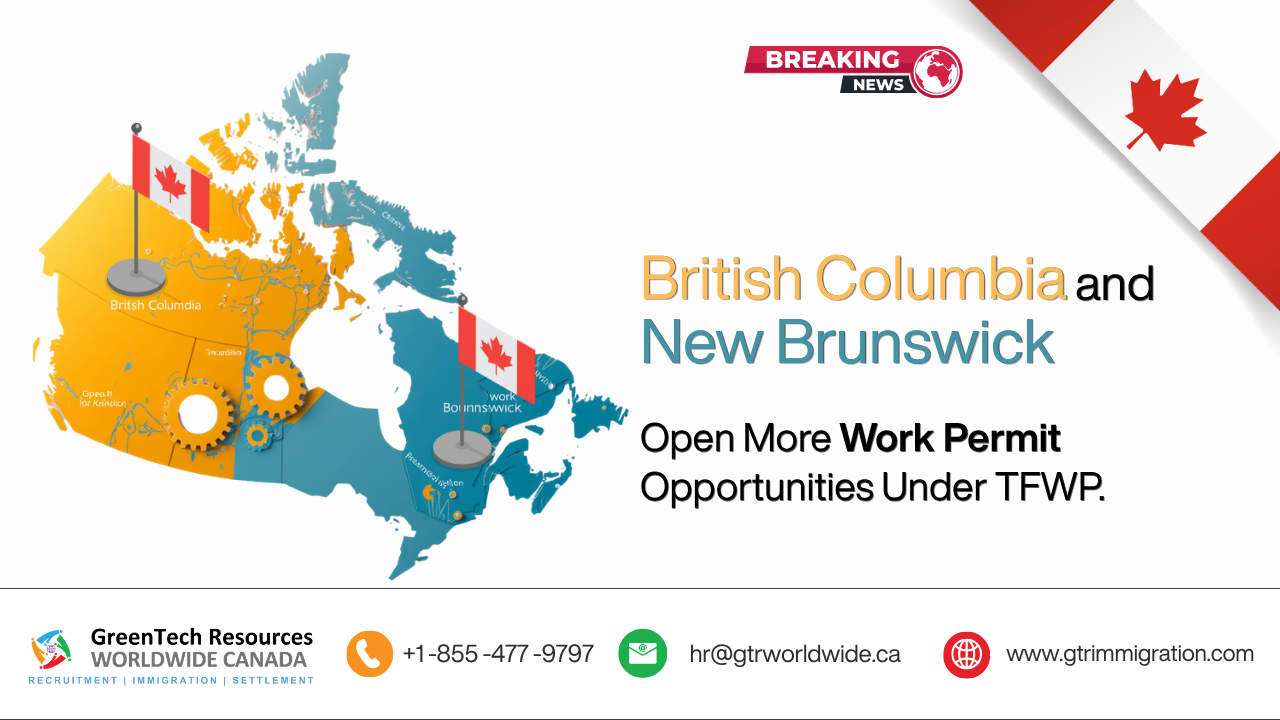
  • British Columbia and New Brunswick Open More Work Permit Opportunities Under TFWP

    British Columbia and New Brunswick Open More Work Permit Opportunities Under TFWP

    Rural employers in British Columbia and New Brunswick are now benefiting from increased flexibility to hire low-wage foreign workers under new temporary measures introduced through Canada’s Temporary Foreign Worker Program.

    These federal measures, in effect from April 1, 2026, to March 31, 2027, aim to support rural businesses struggling with labour shortages, while still requiring employers to prioritize hiring Canadian citizens and permanent residents first.

    Overview of the New Measures

    The government has introduced two key flexibilities for eligible rural employers:

    1. Retaining Existing Workforce Proportions
    Employers can maintain their current percentage of low-wage temporary foreign workers—even if it exceeds the standard 10% limit.

    2. Increased Cap to 15%
    Employers may raise the share of low-wage foreign workers from 10% to 15%, depending on provincial participation.

    These provisions apply only to new LMIA applications submitted after each province’s implementation date. Applications filed before that date are not eligible.

    British Columbia’s Approach

    Beginning May 4, 2026, British Columbia has adopted a more conservative option.

    • Employers in rural areas can retain their existing proportion of low-wage foreign workers, even above the usual cap
    • The province has not adopted the 15% cap increase

    This approach helps businesses maintain workforce stability without significantly expanding their reliance on low-wage foreign labour.

    New Brunswick’s Strategy

    Starting April 23, 2026, New Brunswick has chosen a different path.

    • Employers can increase their low-wage foreign worker cap to 15%
    • The retained proportion option is not available

    This gives businesses greater flexibility to hire additional workers, particularly in sectors like agriculture, food processing, hospitality, and manufacturing where labour shortages are more acute.

    Eligibility Requirements

    To qualify for these temporary measures, employers must:

    • Operate in a rural area (outside a Census Metropolitan Area)
    • Meet all standard Temporary Foreign Worker Program requirements
    • Demonstrate efforts to recruit Canadians and permanent residents first
    • Submit a new LMIA application during the policy period

    Certain industries already allowed a 20% cap will not be affected by these changes.

    Why This Matters

    With these updates, British Columbia and New Brunswick join provinces like Nova Scotia, Manitoba, and Quebec in supporting rural workforce needs.

    The broader objective is to:

    • Strengthen rural economies
    • Address persistent labour shortages
    • Help businesses maintain operations while staying compliant with labour regulations

    For both employers and foreign workers, this creates more structured and accessible employment opportunities in rural Canada.

    Conclusion

    These temporary measures mark another important shift in Canada’s 2026 immigration and labour strategy. Rural employers now have greater flexibility to address staffing challenges, but must still meet strict compliance requirements.

    Businesses should carefully evaluate their eligibility before applying, while workers should stay informed about participating provinces and emerging opportunities. As Canada continues refining its immigration policies, these rural-focused initiatives may play a key role in long-term workforce planning.

  • BC PNP 2026 – New PR Pathway for Hospital Cleaners and Security Workers

    BC PNP 2026 – New PR Pathway for Hospital Cleaners and Security Workers

    British Columbia has introduced a new, limited-time permanent residence (PR) pathway under the BC Provincial Nominee Program, specifically aimed at health authority cleaners and security personnel working in rural and remote communities.

    Announced on April 23, 2026, this one-time initiative creates a rare opportunity for support workers in roles that are typically not prioritized in Canada’s immigration system. It reflects the province’s growing focus on strengthening healthcare services and supporting regional communities through targeted immigration strategies.

    What Is the New BC PNP Initiative?

    Under this temporary program, the BC PNP will allow up to 250 eligible workers to apply for permanent residence through its Expression of Interest (EOI) system.

    The initiative targets individuals employed in:

    • Cleaning roles within public healthcare facilities
    • Security positions supporting hospitals and health authorities
    • Rural and remote communities across British Columbia

    The intake is expected to open in June 2026, with full eligibility criteria to be released before registration begins.

    Why This Pathway Is Important

    Traditionally, immigration pathways in healthcare have focused on highly skilled professionals such as doctors, nurses, and licensed practitioners. Support roles like cleaning and security have had very limited access to PR options.

    This initiative changes that by recognizing the essential role these workers play in maintaining healthcare operations—especially in underserved regions.

    Through this program, British Columbia aims to:

    • Improve retention of frontline support staff
    • Strengthen healthcare delivery in smaller communities
    • Address ongoing labour shortages in essential roles
    • Encourage population growth outside major urban centers

    Notably, at least 35% of BC PNP nominations in 2026 are expected to go to candidates working outside Metro Vancouver.

    Part of Broader 2026 Immigration Changes

    This one-time pathway is part of a wider restructuring of the BC Provincial Nominee Program. The province has realigned its immigration priorities around three main pillars:

    Care
    Focusing on healthcare, education, childcare, and other public service roles.

    Build
    Supporting construction workers and skilled trades for infrastructure development.

    Innovate
    Attracting high-impact talent, including entrepreneurs and specialized professionals.

    At the same time, British Columbia has:

    • Closed the Entry Level and Semi-Skilled (ELSS) stream
    • Cancelled new international student streams
    • Ended priority tech occupation draws
    • Expanded lists of ineligible occupations and employers

    These changes highlight a shift toward highly targeted, needs-based immigration selection.

    Who Should Consider This Opportunity?

    This pathway is particularly relevant for:

    • Hospital cleaners working under BC health authorities
    • Healthcare security staff in rural or remote areas
    • Temporary foreign workers already employed in these roles
    • Employers facing staffing shortages in regional healthcare facilities

    Eligible workers are encouraged to prepare early by reviewing their employment records, employer eligibility, and required documentation ahead of the June intake.

    Conclusion

    This new one-time PR pathway offers a unique and meaningful opportunity for support workers who are often overlooked in immigration programs.

    Although limited to just 250 spots, it could be life-changing for those already contributing to healthcare services in rural communities. As Canada continues to align immigration with labour market needs, essential support workers are finally gaining recognition and access to permanent residence pathways.

    For individuals working in hospital cleaning or security roles, the upcoming June 2026 intake may be a crucial opportunity to secure their future in Canada.

  • Canada’s Latest Express Entry Draw: 2,000 ITAs Issued Under CEC Program

    Canada’s Latest Express Entry Draw: 2,000 ITAs Issued Under CEC Program

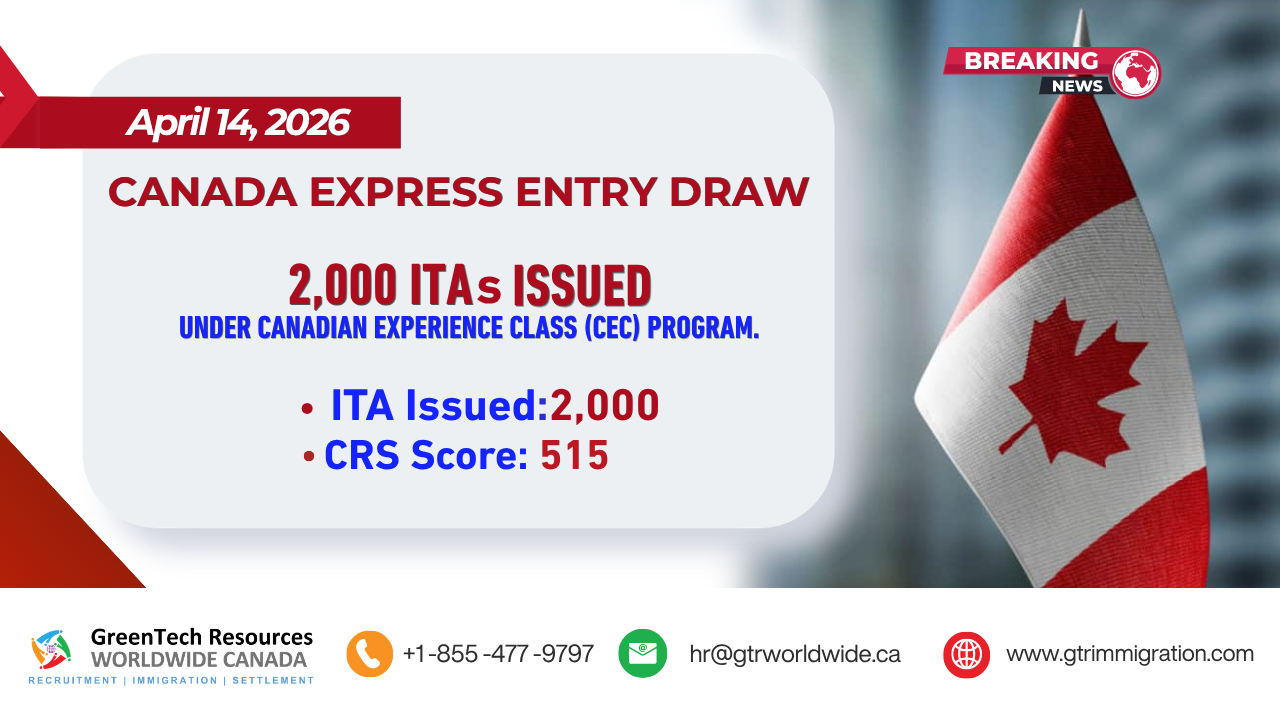
    Canada has conducted a new Express Entry draw targeting candidates under the Canadian Experience Class, issuing 2,000 Invitations to Apply (ITAs) for permanent residence on April 14, 2026.

    This latest round highlights Canada’s continued emphasis on selecting candidates with Canadian work experience, reinforcing its strategy to prioritize talent already in the country.

    Key Details of the Draw

    • Program: Canadian Experience Class (CEC)
    • Date: April 14, 2026
    • Invitations issued: 2,000
    • Minimum CRS score: 515
    • Tie-breaking rule: June 10, 2025 (profile submission date)

    To qualify, candidates needed:

    • At least one year of skilled work experience in Canada
    • A CRS score of 515 or higher
    • An active profile submitted before the tie-breaking cutoff

    CRS Score Climbs Higher

    The CRS cut-off rose to 515, making it one of the highest scores recorded for CEC draws in recent years. This represents a 6-point increase from the previous draw held on March 31 (CRS 509).

    This jump suggests:

    • Increasing competition among candidates already in Canada
    • A growing number of high-scoring applicants, particularly those with post-graduation work experience

    Smallest CEC Draw of 2026

    This round also stands out as the smallest CEC draw so far this year. Earlier draws issued significantly more invitations:

    • 6,000 ITAs (February 17)
    • 4,000 ITAs (March 17)
    • 2,250 ITAs (March 31)

    A smaller draw combined with a higher CRS cut-off typically signals a more selective approach.

    What This Means for Candidates

    This draw sends several clear signals to applicants in the Express Entry pool:

    1. Competition is increasing
    Candidates with CRS scores below 515 may need to improve their profiles to stay competitive.

    2. Strong focus on in-country applicants
    CEC draws prioritize individuals already working in Canada, helping employers retain talent and easing labour shortages.

    3. Profile optimization is essential
    To improve chances of receiving an ITA, candidates should:

    • Boost language scores (IELTS/CELPIP)
    • Gain additional Canadian work experience
    • Explore Provincial Nominee Program options for an extra 600 CRS points

    Express Entry Trends in 2026

    So far, 2026 has seen a shift toward targeted draws, including:

    • Canadian Experience Class (CEC)
    • Provincial Nominee Program (PNP)
    • French-language proficiency
    • Occupation-specific categories (such as healthcare and skilled trades)

    This confirms Canada’s move away from general draws toward more strategic, needs-based selection.

    Conclusion

    The April 14, 2026 draw reflects a clear trend: higher CRS thresholds and fewer invitations are making the system more competitive.

    For candidates, this means:

    • Strengthening CRS scores is more important than ever
    • Staying updated on draw patterns is essential
    • Being fully prepared can help you act quickly when an invitation arrives
  • Canada Issues 4,000 PR Invitations in Latest Express Entry Draw – CRS Jumps to 419

    Canada Issues 4,000 PR Invitations in Latest Express Entry Draw – CRS Jumps to 419

    Canada held a new Express Entry draw on April 15, 2026, inviting 4,000 candidates to apply for permanent residence under a French-language category-based round. According to Immigration, Refugees and Citizenship Canada, the Comprehensive Ranking System (CRS) cut-off rose to 419, reflecting increased competition among applicants.

    Key Highlights of the April 15, 2026 Draw

    • Draw date: April 15, 2026
    • Category: French-language proficiency
    • Invitations issued: 4,000
    • CRS cut-off score: 419
    • Draw type: Category-based selection

    This was the third draw conducted that week, bringing the total number of invitations issued between April 13 and April 15 to 6,324.

    Rising CRS Score: What It Indicates

    The increase in the CRS cut-off score signals:

    • A more competitive pool of French-speaking candidates
    • Growing demand for bilingual professionals
    • Continued emphasis on Francophone immigration outside Quebec

    For context, the previous French-language draw on March 18, 2026 had a lower cut-off score of 393.

    Why French-Speaking Candidates Are Being Prioritized

    Canada is actively expanding Francophone immigration pathways to:

    • Support French-speaking communities outside Quebec
    • Address labour shortages across key sectors
    • Promote linguistic diversity nationwide

    Candidates with strong French proficiency (typically CLB/NCLC 7 or higher) are more likely to receive invitations in these targeted rounds, even with comparatively lower CRS scores.

    Express Entry Trends in 2026

    So far this year, several clear patterns have emerged in the Express Entry system:

    • Increased use of category-based draws (French, healthcare, skilled trades)
    • Continued focus on candidates already in Canada (CEC and PNP)
    • Larger invitation volumes in targeted categories

    French-language draws, in particular, have become one of the most active streams in 2026.

    What This Means for Applicants

    This draw highlights several important takeaways:

    • French proficiency is a strong advantage: It can lead to more frequent invitations and lower CRS requirements compared to general draws
    • CRS scores are becoming more dynamic: Scores can rise quickly depending on pool size and candidate quality
    • Targeted draws are now central: Skills like language ability and occupation relevance are increasingly more important than overall CRS alone

    Final Thoughts

    The April 15, 2026 draw underscores Canada’s strong focus on attracting French-speaking immigrants while shifting toward a more strategic and competitive selection process.

    For candidates, success now depends on:

    • Strengthening language skills (especially French)
    • Optimizing Express Entry profiles
    • Staying updated with evolving draw trends and categories

    As the system continues to evolve, aligning your profile with Canada’s priority categories will be key to securing an invitation.