Category: Immigration

  • Alberta Prioritizes Construction Jobs in Latest Immigration Draw

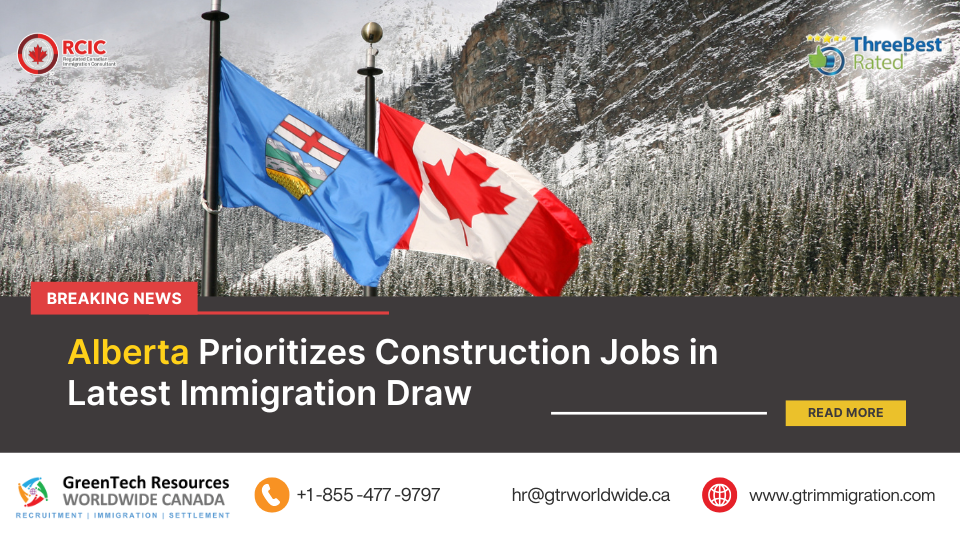
    Alberta Prioritizes Construction Jobs in Latest Immigration Draw

    In a July 2025 Alberta PNP draw, the Alberta Advantage Immigration Program (AAIP) targeted construction worker occupations through its Express Entry–aligned Priority Sector stream. A total of 39 Invitations to Apply (ITAs) were issued, with a minimum CRS cut‑off of just 66.

    This draw is part of Alberta’s strategy to prioritize key sectors—Construction, Agriculture, Aviation, and Healthcare—under its enhanced streams aimed at supporting economic growth and labor market needs

    Why This Matters to Construction Workers

    Construction professionals—including carpenters, masons, heavy‑equipment operators, and project supervisors—can significantly benefit from this draw. The low CRS threshold and sector-specific invitations present an accessible path for candidates who may not meet federal Express Entry minimums but are in high demand within Alberta.

    Draw Results at a Glance

    DateStreamOccupation FocusInvitations IssuedCRS Cut‑off
    July 2025Alberta Express Entry – Priority SectorsConstruction3966

    Eligibility & Stream Overview

    To qualify for an invitation under the Express Entry–aligned construction stream:

    1. You must have an active Express Entry profile, listing a primary occupation in an eligible NOC construction role.
    2. A job offer in Alberta from a local employer in that eligible occupation is strongly encouraged.
    3. You must have a CRS score of at least 66 (though most successful candidates may score higher to be competitive)

    Alberta also operates the Alberta Opportunity Stream (AOS) for candidates already working in the province, but Priority Sector draws through Express Entry remain a faster route for many construction professionals.

    Industry Context & Backdrop

    With Canada facing a national shortage of construction workers—short by an estimated 64,000 jobs—Alberta’s targeted invitation approach is part of a broader labour market response. Additionally, a federal pilot project is underway granting legal status to undocumented construction workers, further emphasizing the sector’s critical labour demand.

    This latest draw demonstrates Alberta’s commitment to attracting skilled construction talent through lower CRS thresholds and sector‑targeted pathways. If you’re a construction professional with Express Entry eligibility and a relevant Alberta job offer, this could be a timely opportunity to move your permanent residency process forward.

    Stay updated with Alberta PNP draw announcements and assess your eligibility using Alberta’s official score calculator. For personalized guidance, consider consulting a licensed Canadian immigration advisor.

  • BC’s West Kootenay Unveils Employers for Rural PR Pathway under RCIP

    BC’s West Kootenay Unveils Employers for Rural PR Pathway under RCIP

    The West Kootenay region in southeastern B.C. has officially published its list of designated employers under the Rural Community Immigration Pilot (RCIP), offering foreign workers a direct pathway to permanent residence in select rural communities including Nelson, Castlegar, Trail, Kaslo, Nakusp, Creston, and others

    Why the Designated Employer List Matters

    Only job offers from these officially designated employers—in five priority sectors—qualify candidates for a community recommendation under the RCIP. Employers must be approved, offer eligible positions, and support newcomer settlement to maintain their status

    Priority Sectors & Eligible Occupations

    West Kootenay RCIP supports employment in these five key sectors:

    • Health
    • Education, law, social & community services
    • Sales & service
    • Trades, transport & equipment operators
    • Manufacturing & utilities

    Eligible occupations include 19 NOC codes such as:

    • Carpenters, cooks, early childhood educators, health care aides
    • Transport truck drivers (≥ 75% duties within the West Kootenay region)
    • Heavy-duty equipment mechanics, material handlers, painters, social/community service workers, office support staff, and more, each with CLB language level requirements of 4–6 .

    Sample List of Designated Employers by Sector

    According to the official listing last updated July 23, 2025, designated employers include:

    Health sector:

    • Ancron Medical Services (Nelson)
    • CareCorp (Mountain Lake Village, Nelson)
    • Castleview Care Centre (Castlegar)
    • Misha Zibin Society (Grand Forks)
    • Trail Association for Community Living

    Education & Community Services:

    • Blueberry Creek Community School (Castlegar)
    • Brent Kennedy Learning Centre (South Slocan)
    • Community Connections Support Services (Trail/Nelson)
    • Four Winds Daycare, Golden Bears Children’s Centre (Rossland), Kootenay Family Place, Songbird Early Learning Centre (Nelson), Silly Monkeys Childcare (Castlegar), and more

    Sales, Retail, Food & Accommodation:

    • Boston Pizza (Castlegar), Kootenay Tamil Kitchen (Nelson, Creston), Ashley Furniture (Trail), Ainsworth Hot Springs Resort, The Adventure Hotel, Kootenay Co‑op Grocery, El Taco, Ferraro Foods, Mainstreet Diner, and others across Nelson, Trail, Castlegar, Creston, Grand Forks, Slocan, Rossland

    Trades, Transport & Equipment Operators:

    • A3 Plumbing (Nelson), Ace Couriers (Castlegar/Grand Forks), Martech Electrical Systems (Castlegar), Paradise Painters (Nelson), The Sutherland Group (Salmo), Valor Painting (Nelson), and more

    Manufacturing & Utilities:

    • Kalesnikoff Lumber (Thrums), Kalesnikoff Mass Timber (Castlegar), Spearhead (Nelson), Nelson Naturals, KC Recycling (Trail), Treasure Life Flour Mills (Creston), Popov Leather and others

    Eligibility & How the RCIP Works

    To be eligible for permanent residence via the West Kootenay RCIP:

    1. You must receive a full‑time, permanent job offer from one of the designated employers listed above.
    2. The job must belong to a priority sector and eligible occupation.
    3. You must meet other RCIP criteria:
      • Minimum 1,560 hours of work experience in the past 3 years (or be a local graduate without experience)
      • Required language proficiency (CLB levels 4–6 depending on occupation)
      • Equivalent education credentials and proof of settlement funds if not already in Canada

    Applicants not yet living in West Kootenay must relocate permanently if recommended by the community.

    Application Timeline & Community Limit

    • Employer designation applications launched in June 2025, followed by community recommendation applications in early July, with the RCIP portal now accepting applications as of July 21, 2025
    • Each designated employer can recommend max 3 candidates/year if they have 1–65 employees, or up to 6 candidates if 66+ staff

    With its first official list of designated employers now live, the West Kootenay RCIP offers foreign professionals and workers across key sectors a promising route to permanent residence in rural B.C. If you hold a job offer from one of these employers in an eligible occupation, consider applying through this employer‑driven pilot.

    Stay updated via the official West Kootenay RCIP site for new employer listings and detailed application instructions. And remember: never contact designated employers directly unless you’re replying to a public job ad.

  • Express Entry Update – August 6, 2025

    Express Entry Update – August 6, 2025

    Canada Issues 225 PR Invitations to PNP Candidates

    The latest Express Entry draw was held on August 6, 2025, where 225 candidates under the Provincial Nominee Program (PNP) received Invitations to Apply (ITAs) for permanent residency. The minimum CRS score required was 739, and only candidates who had submitted their Express Entry profile before April 23, 2025, at 6:35 a.m. UTC were eligible.

    This is the first Express Entry draw in August. In July, draws were held for:

    • July 22: Healthcare & Social Services
    • July 21: PNP-specific
    • July 8: Canadian Experience Class (CEC)

    As of now, 49,628 ITAs have been issued through Express Entry in 2025.

    📊 Breakdown of Express Entry Draws in 2025

    IRCC has been targeting key labour needs with a mix of draw types:

    • 14 draws for PNP candidates
    • 7 draws for CEC
    • 3 draws for French-speaking candidates
    • 3 draws for Healthcare & Social Services
    • 1 draw for the Education stream

    Since June 10, IRCC has been alternating between PNP and CEC draws every two weeks, alongside monthly healthcare-focused draws.

    What Is Express Entry?

    Express Entry is Canada’s primary application system for skilled immigrants seeking permanent residence. It manages three main federal programs:

    • Federal Skilled Worker Program (FSWP)
    • Federal Skilled Trades Program (FSTP)
    • Canadian Experience Class (CEC)

    Candidates are ranked using the Comprehensive Ranking System (CRS). Those with the highest scores are invited to apply for PR during regular draws.

    PNP candidates receive an additional 600 CRS points upon nomination, significantly increasing their chances of selection.

    How the PNP Supports Skilled Immigration

    The Provincial Nominee Program (PNP) allows Canadian provinces and territories to nominate individuals who meet their specific economic and labour market needs.

    Benefits of the PNP:

    • Tailored immigration streams for skilled workers and entrepreneurs
    • In many cases, faster processing times
    • Opportunities to settle beyond major cities

    Note: Quebec runs its own separate immigration system and does not participate in the PNP.

    GTR Immigration – Your Trusted Partner

    At GTR Immigration, we guide you through every step of the Express Entry and PNP application process. Whether you’re a skilled professional, recent graduate, or entrepreneur, our team of licensed RCIC consultants will help you:

    • Assess your eligibility
    • Boost your CRS score
    • Secure a provincial nomination
    • Prepare and submit a strong PR application

    📞 Contact us today to start your journey to Canada with confidence!

  • Alberta Issues 443 Invitations Through Eight PNP Draws in July 2025

    Alberta Issues 443 Invitations Through Eight PNP Draws in July 2025

    Alberta continues to strengthen its workforce by attracting skilled professionals through strategic immigration draws. In July 2025, the Alberta Advantage Immigration Program (AAIP), also known as Alberta PNP, conducted eight separate draws, issuing 443 invitations to apply for permanent residence (PR) across various streams.

    These draws targeted high-demand sectors vital to Alberta’s economic development, including healthcare, construction, IT, agriculture, aviation, and law enforcement.

    Alberta PNP Draws – July 2025 Overview:

    DateStreamMinimum ScoreInvitations
    July 25, 2025Express Entry – Priority Sectors (Construction)6639
    July 17, 2025Express Entry – Accelerated Tech Pathway6922
    July 16, 2025Express Entry – Law Enforcement49<10
    July 11, 2025Alberta Opportunity Stream72269
    July 9, 2025Healthcare Pathway – Non-EE5332
    July 8, 2025Express Entry – Priority Sectors (Aviation)5320
    July 4, 2025Express Entry – Priority Sectors (Agriculture)6415
    July 3, 2025Healthcare Pathway – Express Entry6236

    July’s Significance for Alberta Immigration

    Alberta’s July draws reflect a strong, sector-focused approach, aimed at addressing labor shortages in critical industries. With targeted draws for both Express Entry and non-Express Entry candidates, the province set minimum Comprehensive Ranking System (CRS) scores as low as 49.

    Focused Occupations:

    The following occupations were prioritized in Alberta’s July draws:

    • Construction trades and project managers
    • IT professionals, including developers and analysts
    • Law enforcement and public safety officers
    • Healthcare workers (both Express Entry and non-EE pathways)
    • Aviation maintenance and technical specialists
    • Agricultural technicians and workers

    Why Alberta Offers a Unique PR Opportunity

    Alberta PNP remains an attractive option for those with moderate CRS scores due to its:

    • Low CRS thresholds (as low as 49)
    • Strong job opportunities in key sectors
    • Affordable living compared to Ontario and British Columbia
    • Business-friendly immigration policies
    • Fast-tracked options for eligible Express Entry candidates

    What’s Next?

    If you are employed in one of Alberta’s priority sectors and have an active Express Entry profile, you could be among the next to receive a nomination. Now is the perfect time to review your documents and ensure your profile matches Alberta’s current needs.

    Need Assistance?

    GTR Worldwide provides comprehensive support for professionals looking to immigrate to Canada through Alberta PNP. Contact our experts today to evaluate your eligibility and take the next step toward permanent residency in Canada.

  • Nova Scotia Immigration Update 2025 – What You Need to Know Now

    Nova Scotia Immigration Update 2025 – What You Need to Know Now

    Nova Scotia has made important updates to its immigration programs in 2025, impacting both local residents and international applicants. With reduced federal quotas, paused programs, and new processing priorities, understanding these changes is essential for anyone hoping to immigrate to Nova Scotia in 2025 or beyond.

    Reduced Immigration Quotas

    Under Canada’s national Immigration Levels Plan 2025–2027, Nova Scotia’s immigration allocation has been cut nearly in half.

    • Provincial Nominee Program (PNP) and Atlantic Immigration Program (AIP) nominations have dropped from 6,300 in 2024 to 3,150 in 2025.

    This change means tighter competition and a stronger focus on in-province applicants.

    Nova Scotia Nominee Program (NSNP) Prioritization

    The NSNP continues to operate, but application processing is now strictly focused on key priority groups. Nova Scotia immigration authorities are prioritizing:

    • In-province candidates with work permits expiring in 2025
    • Workers in healthcare, social assistance (NAICS 62), and construction sectors (NAICS 62)

    Out-of-province and international applicants will only be considered if they belong to critical occupations such as:

    • Nurses and healthcare support workers
    • Construction tradespersons
    • Select roles in trucking, clean energy, and technology

    New Online Platform: LaMPSS

    On May 1, 2025, Nova Scotia launched LaMPSS (Labour Market Programs Support System)—a new digital portal that replaces the AIP Online system.
    This platform allows designated employers to:

    • Submit and track immigration endorsements
    • Manage applications through a centralized system
    • Retain current designation without reapplying

    Employers must register through MyNS to access the system.

    Navigating Nova Scotia Immigration in 2025

    With reduced immigration quotas, the temporary AIP pause, and a firm focus on in-province workers, Nova Scotia is prioritizing strategic immigration that meets local labor demands. The introduction of LaMPSS also marks a shift toward digital modernization.

    Whether you’re an employer, a temporary foreign worker, or an international candidate dreaming of moving to Canada’s East Coast, staying informed on the latest Nova Scotia immigration updates for 2025 is key to long-term success.

  • Canada Updates Minimum Funds for Atlantic Immigration Program

    Canada Updates Minimum Funds for Atlantic Immigration Program

    In a recent update, Immigration, Refugees and Citizenship Canada (IRCC) has officially announced an increase in the minimum settlement funds requirement for the Atlantic Immigration Program (AIP), effective July 29, 2025. This adjustment ensures that newcomers are better financially prepared to establish themselves in Atlantic Canada.

    What Are Settlement Funds and Why Do They Matter?

    Settlement funds are financial resources immigrants must show to prove they can support themselves and their families upon arriving in Canada. This requirement applies to AIP candidates who are not already working in Canada on a valid work permit.

    The increase aligns with Canada’s Low-Income Cut-Off (LICO) changes and aims to reflect the current cost of living in provinces like Nova Scotia, New Brunswick, Prince Edward Island, and Newfoundland and Labrador.

    Updated Settlement Fund Requirements (2025)

    Below is the updated table of settlement funds by family size:

    Family Size2025 Required Funds (CAD)2024 Required Funds (CAD)
    1$3,815$3,672
    2$4,750$4,572
    3$5,840$5,620
    4$7,090$6,824
    5$8,042$7,740
    6$9,070$8,729
    7$10,098$9,718
    Each additional member over 7$1,028$989

    Who Needs to Show Proof of Funds?

    You must show proof of funds if:

    • You are applying under AIP from outside Canada.
    • You do not currently hold a valid Canadian work permit.

    You do not need to show proof of funds if you:

    • Already live in Canada with a valid work permit.
    • Are currently employed full-time in an Atlantic province under an eligible AIP job offer.

    What Qualifies as Acceptable Proof of Funds?

    To meet AIP financial requirements, applicants must submit official documents from recognized financial institutions that include:

    • Applicant’s name
    • Institution’s contact details
    • Account numbers and current balance
    • Six-month average balance
    • Confirmation of any outstanding debts

    Funds must be readily available and unencumbered. Borrowed money, real estate, or assets held in someone else’s name do not qualify.

    About AIP

    The Atlantic Immigration Program (AIP) is an employer-driven immigration pathway designed for foreign workers who wish to live and work permanently in one of Canada’s four Atlantic provinces: New Brunswick, Newfoundland and Labrador, Nova Scotia, or Prince Edward Island.

    To be eligible for the AIP, international applicants must:

    • Have a valid job offer from a designated employer in one of the Atlantic provinces
    • Ensure that the job offer is officially endorsed by the province

    In addition, applicants must fall into one of the following categories:

    • Skilled workers with relevant work experience (whether gained inside or outside Canada)
    • Recent graduates from a recognized post-secondary institution in Atlantic Canada

    Applicants are also required to meet criteria in the following areas:

    • Educational qualifications
    • Language proficiency (English or French)
    • Settlement funds – applicants must provide proof of minimum financial resources as per the latest IRCC guidelines

    Once applicants meet the eligibility requirements and receive a valid job offer, they may:

    • Submit an application for permanent residence (PR) directly to the Government of Canada
    • Apply for a special temporary work permit, valid for up to two years, allowing them to work legally while their PR application is being processed

  • Processing Time Updates from IRCC – September 2024

    Canada Immigration

    Updated Application Processing Times – September 2024

    After submitting your application, candidates often feel stressed while waiting for processing. The processing time depends on various factors. Monitoring monthly updates for citizenship, family sponsorship, and economic immigration applications, along with weekly updates for business immigration, all temporary residency applications, and permanent resident cards, will give you a better idea of the waiting time, as well as help you plan and arrange your work, family, and other related matters.

    Proper and complete preparation of your documents is crucial for your application to be approved as soon as IRCC opens it. If your application is incomplete or unclear, IRCC will request additional information, which may extend the processing time. iCanPR, operated by RCIC, ensures that your application will be handled by two specialists simultaneously. This helps ensure that your documents are thorough and meet all of IRCC’s requirements.

    Citizenship
    (Updated Monthly):

    • Citizenship Grant: 7 months (No change since July 31, but reduced by 1 month since June 3)
    • Citizenship Certificate (Proof of Citizenship): 3 months (No change since June 3)
    • Renunciation of Citizenship: 16 months (Increased by 3 months since July 31)
    • Search of Citizenship Records: 11 months (Reduced by 2 months since July 31)

    PR Cards
    (Updated Weekly):

    • New Permanent Resident Card: 25 days (Reduced by 3 days since August 20 and 17 days since July 30)
    • PR Card Renewals: 71 days (Reduced by 1 day since September 4 and 4 days since June 25)

    Family Sponsorship
    (Updated Monthly):

    • Spouses

      • Outside Canada (excluding Quebec): 10 months (No change)
      • Outside Canada (Quebec): 35 months (Increased by 3 months since July 3)
      • Inside Canada (excluding Quebec): 13 months (Increased by 2 months since July 31)
      • Inside Canada (Quebec): 27 months (Increased by 3 months since July 31)
    • Parents or Grandparents

      • Outside Quebec: 24 months (No change)
      • Quebec: 48 months (No change)

    Express Entry

    • Canadian Experience Class (CEC): 5 months (No change)
    • Federal Skilled Worker Program (FSWP): 5 months (No change)
    • Federal Skilled Trades Program (FSTP): No updates since March 1, 2023
    • Provincial Nominee Program (PNP) via Express Entry: 6 months (No change)

    Non-Express Entry

    • Provincial Nominee Program (PNP) outside Express Entry: 12 months (Increased by 1 month since July 31)
    • Quebec Skilled Workers (QSW): 9 months (No change)
    • Quebec Business Class: 47 months (Increased by 1 month since July 31)
    • Federal Self-Employed: 48 months (Increased by 1 month since July 31)
    • Atlantic Immigration Program (AIP): 7 months (No change)
    • Start-Up Visa: 40 months (Increased by 2 months since July 31)

    Visitor Visa

    • Vietnam: 66 days
    • India: 83 days
    • Nigeria: 171 days
    • United States: 37 days
    • Pakistan: 35 days
    • Philippines: 24 days (Reduced by 1 day since September 4)

    Visitor Visa Extension

    • 110 days

    Super Visa

    • Vietnam: 72 days
    • India: 77 days
    • Nigeria: 66 days
    • United States: 237 days
    • Pakistan: 149 days
    • Philippines: 108 days

    Study Permit

    • Vietnam: 7 weeks
    • India: 5 weeks
    • Nigeria: 8 weeks
    • United States: 12 weeks
    • Pakistan: 9 weeks 
    • Philippines: 7 weeks

    Inside Canada

    • 13 weeks (Increased by 1 week since September 4, 2 weeks since August 14, and 3 weeks since July 24)

    Study Permit Extension

    • 96 days (Increased by 7 days since September 4 and 26 days since August 20)

    Work Permit

    • Vietnam: 10 weeks
    • India: 27 weeks 
    • Nigeria: 15 weeks 
    • United States: 16 weeks
    • Pakistan: 8 weeks 
    • Philippines: 10 weeks 
  • What should I do when Canada has recently ended the temporary policy that allowed visitors to apply for work permits from within the country​

    What should I do when Canada has recently ended the temporary policy that allowed visitors to apply for work permits from within the country​

    Immigration to Canada

    What should I do when Canada has recently ended the temporary policy that allowed visitors to apply for work permits from within the country

    You may know that Immigration, Refugees and Citizenship Canada (IRCC) has officially ended the temporary public policy that permitted visitors to apply for work permits from within Canada, effective immediately.


    I am in Canada as a visitor

    What should I do?

    • Explore Other Immigration Options: Look into different immigration pathways that may suit your situation

    • Consult with an Immigration Expert: Seek advice from an immigration consultant or lawyer to understand your options and get guidance on the best course of action based on your specific circumstances.

    • Check Your Eligibility for Extensions: If your visitor status is close to expiring, you might be able to apply for an extension to stay longer in Canada legally.

    • Plan for Departure: If staying in Canada isn’t feasible under your current status, begin making arrangements to return to your home country before your visitor status expires.

    • Stay Informed: Keep updated on any new policies or changes to immigration laws that might offer new opportunities in the future.

    We have options

    Please contact us for personal advice

    Tol free: +1 855 477 9797

  • Which country can a Canadian PR card holder travel to?

    Which country can a Canadian PR card holder travel to?

    Which country can a Canadian PR card holder Visa Free Travel to?

    Visa Free Travel for Canadian PR card holder

    As a Canadian Permanent Resident (PR) cardholder, you are entitled to the convenience of visa-free travel to many countries across the globe. This benefit allows you to explore numerous destinations without the need to apply for a visa beforehand. Whether you’re looking for a short getaway or a long-term stay, here is a comprehensive guide to countries where visa-free travel is available for Canadian PR holders, along with visa-on-arrival and eVisa options.

    1. Caribbean Visa-Free Travel
    Anguilla, Antigua and Barbuda, Aruba, Bahamas: Enjoy these stunning Caribbean destinations with visa-free travel for stays ranging from 30 to 90 days.
    Bermuda, Cayman Islands, Sint Maarten: Take advantage of visa-free travel for 30 days to relax in these tropical paradises.
    Bonaire (Dutch Territory), Turks and Caicos (British Territory): These islands offer 90 days of visa-free travel for Canadian PR holders.
    2. Eastern Europe Visa-Free Travel
    Armenia, Georgia, Moldova: Experience the rich culture and history of Eastern Europe with 90 days of visa-free travel in these countries.
    3. Visa-Free Travel in Central America
    Belize: Explore the natural beauty of Belize with 30 days of visa-free travel for Canadian PR holders.
    El Salvador, Guatemala, Honduras, Panama: Each of these Central American countries offers 90 days of visa-free travel for Canadian PR holders.
    Nicaragua: Enjoy 30 days of visa-free travel in Nicaragua.
    4. Asian Visa-Free Travel
    Japan: Discover Japan with a 90-day eVisa, available to Canadian PR holders for visa-free travel.
    Philippines: Indian citizens with Canadian PR can enjoy 14 days of visa-free travel in the Philippines.
    South Korea: Select nationalities can enjoy 30 days of visa-free travel while transiting through South Korea.
    Singapore: Indian and Chinese nationals can experience 96 hours of visa-free travel while transiting through Singapore.
    Thailand: Canadian PR holders can stay in Thailand for 60 days with an eVisa, making it an ideal destination for visa-free travel.
    5. Middle East and Africa Visa-Free Travel
    Oman: Certain nationalities can take advantage of 30 days Visa on Arrival (VOA) for visa-free travel in Oman.
    Qatar: Enjoy 30 days of visa-free travel in Qatar with an eVisa.
    Morocco: Canadian PR holders can explore Morocco with 90 days of visa-free travel using an eVisa.
    6. Visa-Free Travel in Mexico and Latin America
    Mexico: Canadian PR holders are eligible for 180 days of visa-free travel in Mexico, making it perfect for long-term stays.
    Costa Rica: Visit Costa Rica and enjoy 30 days of visa-free travel.
    Dominican Republic: Canadian PR holders can experience 90 days of visa-free travel in the Dominican Republic.
    7. United Kingdom Transit Visa-Free Travel
    United Kingdom: If you’re transiting through the UK, Canadian PR holders can enjoy 24 hours of visa-free travel while passing through.
    Important Considerations for Visa-Free Travel
    Before embarking on any journey, it is crucial to double-check the latest entry requirements and ensure your visa-free travel privileges remain valid. Rules and regulations for visa-free travel can change, so it’s always advisable to verify the current policies before departure.


    Do you know?

    There are many pathways to have Canadian PR

    Canada offers a variety of opportunities for individuals seeking Canadian Permanent Residency (PR). With numerous immigration programs, it’s easier for skilled workers, entrepreneurs, and students to settle permanently. Once you obtain Canadian PR, you can enjoy the benefits of visa-free travel to many countries, adding convenience and flexibility to your global mobility. In this blog, we’ll explore the different pathways to acquiring Canadian PR and how visa-free travel enhances the experience.

    1. Express Entry System

    The Express Entry program is one of the fastest ways to achieve Canadian PR for skilled workers. This points-based system ranks candidates, and those with the highest scores are invited to apply for permanent residency. Once you have PR, you’ll also benefit from visa-free travel to multiple countries.

    Benefits of PR via Express Entry:

    • Fast processing time (often within six months).
    • Access to visa-free travel as a PR holder.
    • Freedom to live and work anywhere in Canada.

    2. Provincial Nominee Programs (PNPs)

    Each Canadian province and territory has its own immigration streams under the Provincial Nominee Program (PNP). These are designed to attract individuals with specific skills needed in that region. Once nominated, your chances of securing Canadian PR improve greatly, allowing you to enjoy visa-free travel as well.

    Benefits of PR via PNP:

    • Opportunity to settle in a specific province.
    • Visa-free travel to numerous countries post-PR.
    • Economic growth opportunities in smaller regions.

    3. Business Immigration Programs

    Canada offers several business-focused immigration programs, such as the Start-Up Visa and Self-Employed Persons Program. These are ideal pathways for investors, entrepreneurs, and self-employed individuals looking to gain Canadian PR. Once you become a PR, you’ll also unlock visa-free travel privileges to various international destinations.

    Benefits of PR via Business Programs:

    • Establish your own business or invest in Canadian markets.
    • Enjoy visa-free travel as a PR holder.
    • Access to Canadian economic and business opportunities.

    4. Canadian Experience Class (CEC)

    For those who have already gained skilled work experience in Canada, the Canadian Experience Class (CEC) is a suitable path to Canadian PR. This is ideal for international students or foreign workers who want to transition to permanent residency. Once PR is granted, you’ll be eligible for visa-free travel to several countries.

    Benefits of PR via CEC:

    • No job offer is needed to apply.
    • Visa-free travel benefits post-PR to destinations worldwide.
    • Freedom to live and work in any part of Canada.

    5. Family Sponsorship

    The Family Sponsorship Program allows Canadian citizens and permanent residents to sponsor their close relatives, including spouses, children, or parents, for Canadian PR. After obtaining PR, you can explore the world with visa-free travel benefits.

    Benefits of PR via Family Sponsorship:

    • Reunite with family in Canada.
    • Access to visa-free travel after PR approval.
    • The ability to enjoy all the social benefits Canada offers.

    Benefits of Canadian PR and Visa-Free Travel

    Once you obtain Canadian PR, you can enjoy visa-free travel to numerous countries around the world. Some of the destinations offering visa-free travel or visa-on-arrival options to Canadian PR holders include:

    • Mexico: Stay for up to 180 days with visa-free travel.
    • Japan: Explore for up to 90 days with an eVisa.
    • Singapore: Transit visa-free for up to 96 hours.
    • Caribbean Islands: Many Caribbean nations offer visa-free travel for Canadian PR holders, including Antigua and Barbuda, Bahamas, and more.

    These visa-free travel opportunities make it easier for Canadian PR holders to explore the world without dealing with lengthy visa processes.

    Conclusion: Pathways to Canadian PR and Global Travel Freedom

    Canada offers multiple immigration pathways for obtaining Canadian PR, from the Express Entry system to Provincial Nominee Programs and business options. Once you have secured Canadian PR, one of the key advantages is the ability to enjoy visa-free travel to several countries. This opens up a world of opportunities for global exploration and convenience.

    Working in Canada:
    LMIA, Express Entry, Job Approval Letter (JAL) of Saskatchewan, and Community Endorsement in Alberta are key routes for skilled workers to gain work permits and eventually PR.
    Business Opportunities:
    Entrepreneurs can achieve PR through the Start-Up Visa or by establishing and operating a business under various Provincial Nominee Programs
    Post-Graduation Work Permit (PGWP):
    International students can work in Canada after graduation, gaining experience to help them apply for PR when eligible

    Let GTR Immigration guide you through the process.

    Ready to make Canada your new home?Contact us today at +1 855 477 9797 to explore your pathway to Canadian permanent residency. We’re here to help you every step of the way!

    Contact us +1 855 477 9797
  • How to Increase Your Express Entry Score for Canada Immigration?

    How to Increase Your Express Entry Score for Canada Immigration?

    How to Increase Your Express Entry Score for Canada Immigration

    Express Entry is one of the advanced immigration systems used by the Canadian government to provide permanent residence to skilled immigrants. Increasing your score can give you a fair advantage in Canada immigration.

    Being one of the quickest ways to get permanent residency in Canada, there are lots of candidates applying for Express Entry. Due to a large number of applications only top applicants get invited. This system is point-based and based on multiple areas your application will get the score. Candidates can improve their score to stay at the top of the pool by working on the following main points.

    1. Identify areas where you can increase your score

    It’s always better to have a broad view as that helps to focus on multiple areas. The points are divided into multiple areas like education, skill, experience, language, etc. Identify and check another area where you can score or improve the points, which you might not have in your focus. It can improve the overall points if you’ll consider and focus on all the factors and respective areas.

    2. Getting a Provincial nomination

    Provincial nomination helps candidates to improve the score and stay at the top of the pool. Each province has its own priority occupations. It’s always best to keep yourself updated and have the application updated as per the changes and requirements.

    3. Try for a Job offer

    This can totally change the scenario for an applicant because a job offer can add up to 200 points for the candidate. You may search online for available jobs and by contacting online recruitment agencies. It’s best to visit the country once so that you can have an idea about the job market and upgrade your skills accordingly. You can meet the employer and have a better idea about the companies by contacting them in person.

    4. Enhance your Education

    There are points based on the qualification and the degree of a candidate. Clearly, achieving a higher level of education means more points, although qualifications achieved outside Canada must first be verified through Educational Credential Assessment.

    Higher education (e.g. bachelor’s, master’s) degree is also one of the screening criteria for many Canadian employers. So, keep it in mind as advancing education helps in two ways, first adding points to improve the score and second helping you to get employment.

    5. Check who should be the Principle applicant – you or your spouse?

    One very important point is to select, who will be the principal applicant. Usually, candidates assume that whoever is more qualified while applying as a couple should be the principal applicant, which isn’t true always.

    First, check the list of in-demand occupations for the province. Someone with the in-demand skill set has more chances to get picked up than the other with a better education. Another factor is age as that will add some points too so you should select the principle applicant accordingly. For a couple, you may also apply twice each as a principal applicant. Once you’ve decided on the principle applicant, the spouse can boost your score up to 40 points based on experience, education or language skills.

    6. Enhance your Work experience

    Experience is another important factor that can increase your score by some 100 points. That depends if you’ve Canadian experience or non-Canadian experience. Canadian experience always counts more but even if you’ve non-Canadian experience that does count. You may combine non-Canadian experience with language skills and enhance the score. You should keep your profile up to date by updating the experience. Each province has different skillset and experience required and that can be changed so keep tracking those requirements as the in-demand occupation lists keep on updating.

    7. Improve your English Language Skills

    Language plays an important role in the candidate’s profile, as you can improve the overall score by getting good marks in English or French (NCLC for French and CLB for English). You may keep upgrading your language score by retaking the tests for the language. You may go online and do check available language tutorials. You may also take classes and check the available institutes to help and get better coaching for the language. This can also help you later for employment.