Author: Jenny

  • Live Webinar: What to Know Before Buying Your First Home in Canada: A Guide for Newcomers

    Live Webinar: What to Know Before Buying Your First Home in Canada: A Guide for Newcomers

    Canadian Immigration and Home Buying: Understanding Your Mortgage Options
    The Canadian home-buying journey can be unfamiliar and overwhelming for many newcomers, especially when it comes to understanding how mortgages work and what costs to expect. As a newcomer to Canada, taking the time to learn the basics of the Canadian home-buying process can help you move forward with greater clarity and confidence.

    Understanding the ins and outs of mortgages, including key concepts such as down payments, interest rates, and prepayment options, is essential for making informed decisions about your home-buying journey. Additionally, considering costs beyond the purchase price, such as closing fees and property taxes, can help you determine what you can afford.

    For those looking to purchase a home in Canada, it’s essential to have a clear understanding of the mortgage process and the various financing solutions available. This includes understanding common mortgage terminology and exploring the different mortgage options designed specifically for newcomers to Canada.

    The Canadian housing market can be complex, especially for those who are new to the country. However, with the right guidance and support, newcomers can navigate the home-buying process with confidence. Whether you’re planning to purchase a home in the near future or just starting your research, having a clear understanding of the mortgage process and the various financing options available can help you make informed decisions about your home-buying journey.

    As a newcomer to Canada, it’s essential to have access to reliable and trustworthy resources to help you navigate the home-buying process. With the right support and guidance, you can feel more informed and confident as you explore your options and take the first steps towards homeownership in Canada.

    For personalized support with your Canadian immigration pathway, contact GTR Immigration.
    Call us: +1 855 477 9797
    #CanadianImmigration #HomeBuyingInCanada #MortgageOptionsForNewcomers #NewcomersToCanada #CanadianHousingMarket


  • Untitled post 18738

    Canada Border Crossing Requirements: What You Need to Declare
    When seeking entry to Canada, it’s essential to understand what items you need to declare, which items are illegal to bring into the country, and which items you’ll have to pay taxes and/or duty on. Failing to declare these items can have consequences, including being denied entry to Canada.

    When arriving at a Canadian port of entry, you must declare certain items to border officials, including alcohol, tobacco, firearms and weapons, food, plant, and animal products, animals, and currency or financial instruments in excess of $10,000 CAD. The Canada Border Services Agency (CBSA) defines alcoholic beverages as products exceeding 0.5% alcohol content by volume, and the minimum age to bring alcohol into Canada varies by province.

    You must also declare all tobacco products, including cigarettes, cigars, manufactured tobacco, and tobacco sticks. Firearms and weapons must be declared, and you must be 18 or over to bring a firearm or weapon into Canada. Canada classifies firearms within one of three categories: non-restricted, restricted, and prohibited. Before attempting to enter Canada with a firearm, you should determine how your firearm is classified by Canadian authorities.

    Food, plant, and animal products must also be declared, including live animals, animal products, and plant products such as fruits, vegetables, seeds, and nuts. Failure to declare or provide the relevant permits can lead to detention of your products, a penalty of up to $1,300 CAD, and/or prosecution.

    Gifts must be declared, and you can bring in gifts worth $60 CAD or less each duty-free and tax-free. However, you may have to pay duties and taxes on any gift having a value in excess of $60 CAD. Animals must be declared, and some examples of animals you must declare include dogs, domestic cats, parrots, lizards, turtles, and snakes.

    You must also declare any currency or financial instruments in excess of $10,000 CAD. Although you may legally bring any amount of money into Canada, you must declare it at the border before being allowed to enter Canada. Failing to declare these items can have consequences and result in you being unable to enter Canada.

    Some items are illegal to bring into Canada, including cannabis or cannabis-contained products, illegal drugs, prohibited firearms or other prohibited weapons, sick animals, endangered species, or parts from endangered species. Cannabis and cannabis-containing products are illegal to bring into Canada, despite being legal to purchase and consume in the country.

    Under no circumstances should you attempt to bring illegal drugs into Canada, as this can result in a sentence ranging from one year to life imprisonment. Prohibited firearms and weapons are also illegal to bring into Canada, regardless of what license you hold or the weapon’s status in your home country.

    Endangered species and sick animals are prohibited from entering the country, and Canada has strict laws against trading in endangered species or parts from endangered species. Packages with uncertain contents should not be brought into Canada, as you will assume responsibility for the item once it is in your possession.

    When bringing items into Canada, they may be subject to sales tax and/or duty. In general, you will have to pay the appropriate sales tax based on the market value of the item. However, there are some scenarios in which you won’t have to pay sales tax, such as when you first move to Canada or when the value of the items you are bringing in falls under your personal exemption.

    For personalized support with your Canadian immigration pathway, contact GTR Immigration.
    Call us: +1 855 477 9797
    #CanadianImmigration #BorderCrossing #CBSA #ImmigrationCanada #NewcomersToCanada

  • Untitled post 18731

    Canada Introduces SIN@Entry to Streamline Social Insurance Number Services for Newcomers
    The Canadian government has announced a new program called SIN@Entry, aimed at improving Social Insurance Number (SIN) services for newcomers to the country. This initiative, set to launch in 2025-2026, will allow applicants for immigration streams, such as work permits or permanent residence, to request a SIN and view their SIN Confirmation Letter directly through their Immigration, Refugees and Citizenship Canada (IRCC) secure account.

    This integration will eliminate the need to apply separately for a SIN, making the process more efficient and convenient for newcomers. According to the first State of Service Report, released on March 7, this initiative could reduce in-person visits to Service Canada locations by as much as 50%, which would also reduce wait times for those accessing other programs in person.

    SIN@Entry is different from SIN@Landing, an existing initiative that allows Temporary Residents and Permanent Residents to apply for their SIN upon arrival at select Canadian airports. SIN@Landing is available at major airports, including Toronto Pearson International Airport, Montréal Trudeau International Airport, and Vancouver International Airport, among others. However, Service Canada centres in airports are not open 24/7, and newcomers are advised to check timings in advance.

    The Canadian government has also announced measures to improve Canada’s eSIN Automation, which allows individuals to apply for a SIN online. In September 2025, an enhanced eSIN system will be launched, using new technology to process eligible online SIN applications in just minutes. Currently, it takes five business days to process a SIN application online. Additionally, starting May 2025, digital copies of the SIN confirmation letter will be generated as a PDF through My Service Canada Account (MSCA), reducing the reliance on mailed confirmation letters.

    A SIN is required by anyone working in Canada or accessing government programs and benefits, including temporary residents, permanent residents, and Canadian citizens. International students also need a SIN if they plan to work part-time, provided their study permit allows it. With the introduction of SIN@Entry, newcomers will have a more streamlined and efficient experience when applying for a SIN.

    For personalized support with your Canadian immigration pathway, contact GTR Immigration.
    Call us: +1 855 477 9797
    #CanadianImmigration #SIN #NewcomersToCanada #ImmigrationServices #IRCC

  • LGBTQ Americans are getting expedited Canadian citizenship certificates

    LGBTQ Americans are getting expedited Canadian citizenship certificates

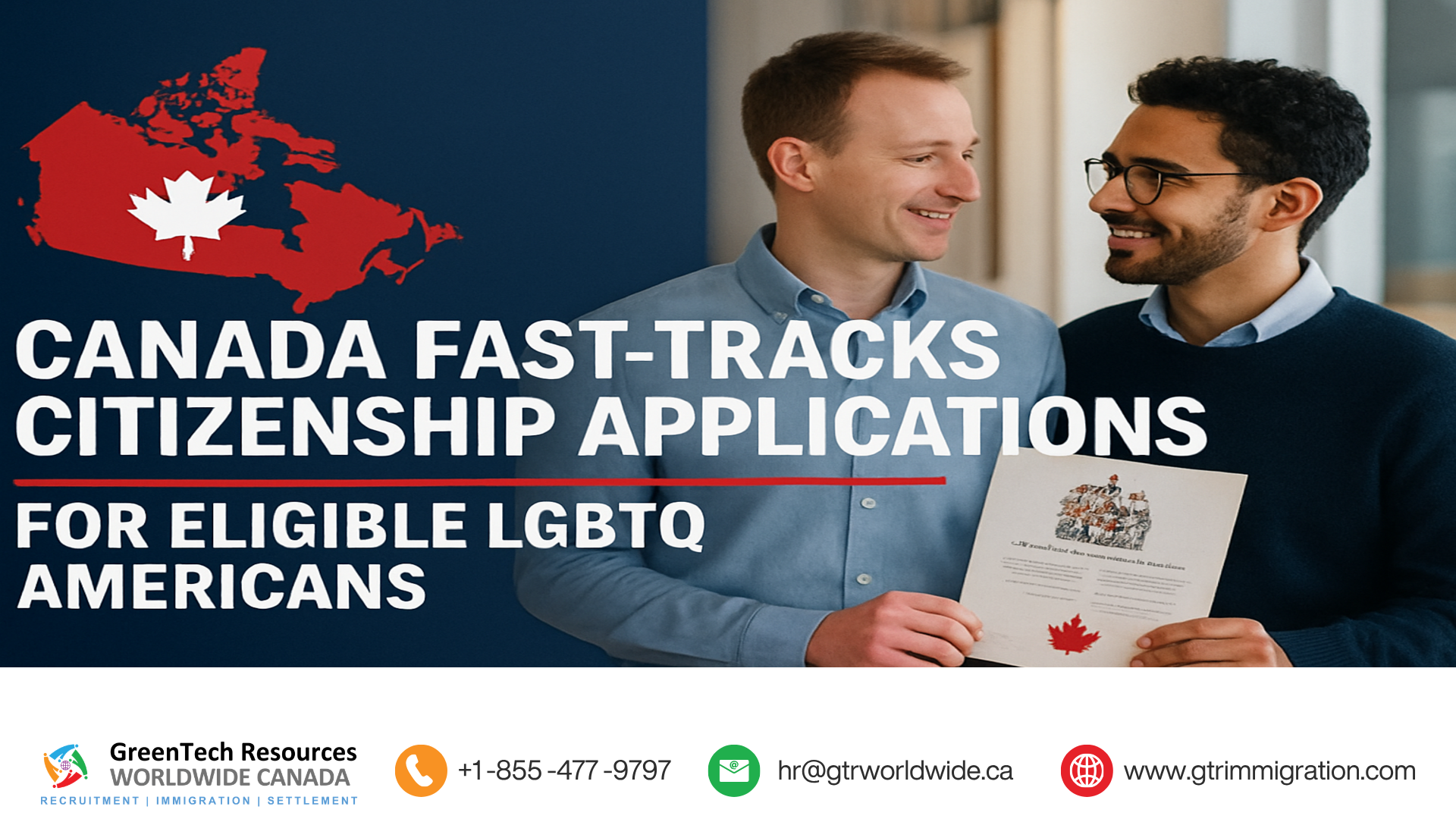
    Canada Fast-Tracks Citizenship Applications for Eligible LGBTQ Americans

    Eligible LGBTQ Americans are being fast-tracked in their applications for proof of Canadian citizenship certificates, with some receiving their certificates in as little as two weeks. This expedited processing is a result of the Canadian government’s efforts to support individuals who may be facing harm or hardship due to their sexual orientation, gender identity, or expression. In contrast, most American applicants can expect to wait about a year to receive their proof of Canadian citizenship certificates.

    The changes to the Citizenship Act, which came into force last year, removed the first-generational limit to inheriting Canadian citizenship for anyone born before December 15, 2025. This has resulted in millions of Americans with Canadian ancestry gaining the right to Canadian citizenship, including many whose families had lived entirely in the United States for four or more generations. Proof of Canadian citizenship certificates are issued by Canada’s citizenship department to individuals born outside Canada who have inherited citizenship, including those born in the United States who now legally qualify as U.S.-Canadian dual citizens.

    To apply for urgent processing, an applicant must include a letter of explanation for the urgent processing request along with supporting documents, in addition to their complete proof of citizenship application. If the officer reviewing the file judges that the applicant qualifies for expedited processing, the citizenship department will expedite the request. A proof of citizenship application must be submitted on paper by mail or courier, including the appropriate completed application form(s), along with copies of accepted official documents proving the applicant’s continuous line of descent from a Canadian ancestor.

    The application process can be complex, and minor errors or omissions can result in an application being rejected without processing. Applicants can handle their applications themselves or hire representatives legally authorized by the Canadian government, such as Canadian immigration lawyers licensed under provincial law societies. Once a citizen by descent receives their certificate, they can apply for a Canadian passport, the application for which is typically processed within 10-20 business days.

    For those eligible, this expedited processing can provide a safe and welcoming pathway to Canadian citizenship. The Canadian government’s efforts to support LGBTQ individuals and provide a safe haven for those facing persecution or discrimination are a significant step forward in promoting inclusivity and diversity.

    For personalized support with your Canadian immigration pathway, contact GTR Immigration.
    Call us: +1 855 477 9797
    #CanadianCitizenship #LGBTQRights #ImmigrationCanada #DualCitizenship #CanadianPassport

  • Canada holds second consecutive provincial nominee draw

    Canada holds second consecutive provincial nominee draw

    Canada Issues 334 Invitations to Apply Through Express Entry System

    The latest Express Entry draw has taken place, with Immigration, Refugees and Citizenship Canada (IRCC) issuing 334 invitations to apply (ITAs) to Provincial Nominee Program (PNP) candidates. To be eligible for this draw, candidates needed to have a minimum Comprehensive Ranking System (CRS) score of 805 and have created their Express Entry candidate profile before October 16, 2025.

    This draw is the twenty-eighth Express Entry selection of 2026, with a focus on immigration candidates within the country, particularly those with provincial nominations and Canadian work experience. So far this year, IRCC has issued 72,341 ITAs across various draw types, including Canadian Experience Class, French-Language proficiency, and Provincial Nominee Program.

    The latest draw highlights the importance of having a competitive Express Entry profile, with a high CRS score and relevant work experience. For those looking to immigrate to Canada, it’s essential to understand the Express Entry system and how to increase their chances of receiving an ITA. With the right guidance and support, candidates can navigate the complex immigration process and achieve their goals.

    For personalized support with your Canadian immigration pathway, contact GTR Immigration.
    Call us: +1 855 477 9797
    #CanadianImmigration #ExpressEntry #ImmigrationCanada

  • Manitoba targets skilled workers invited under a strategic recruitment initiative in 10th draw of the year

    Manitoba targets skilled workers invited under a strategic recruitment initiative in 10th draw of the year

    Manitoba Issues 96 Invitations to Apply for Provincial Nomination
    The Manitoba Provincial Nominee Program (MPNP) has held its 10th immigration selection round of the year, issuing 96 Letters of Advice to Apply (LAAs) to candidates with Expression of Interest (EOI) profiles. This draw targeted candidates directly invited under a strategic recruitment initiative, with invitations extended through both pathways of the MPNP’s Skilled Worker Stream.

    The majority of LAAs, 48, were issued to candidates who declared being invited through the Temporary Public Policy to Facilitate Work Permits for Prospective Provincial Nominee Program Candidates (TPP). Additionally, 20 LAAs were issued to candidates with a valid Express Entry profile number and job seeker validation code. The distribution of LAAs aligns with Manitoba’s plans to conduct selection rounds targeting individuals who’ve received Manitoba-specific work permits under the TPP.

    Some candidates who satisfied the selection criteria may not have received an LAA due to issues such as incomplete or invalid language test results, or failure to submit a valid invitation number. TPP work permit holders with Manitoba Support Letters approved after June 30, 2025, may also not have received an LAA. The MPNP publishes monthly statistics on the Skilled Worker Stream, including information on EOIs drawn, nominations issued, and nomination applications received.

    The practical impact of this draw is that candidates who received an LAA will be able to apply for provincial nomination, bringing them one step closer to permanent residence in Manitoba. For those who did not receive an LAA, it’s essential to review their EOI profile and ensure that all required information is accurate and up-to-date.

    For personalized support with your Canadian immigration pathway, contact GTR Immigration.
    Call us: +1 855 477 9797
    #ManitobaPNP #CanadianImmigration #ProvincialNomineeProgram

  • Alberta invites over 1,000 healthcare, tech, and rural community-bound candidates across four draws

    Alberta invites over 1,000 healthcare, tech, and rural community-bound candidates across four draws

    Alberta Issues Over 1,000 Invitations to Healthcare, Tech, and Rural Community Candidates in May Draws

    Between May 1 and May 13, the Alberta Advantage Immigration Program (AAIP) held four provincial nomination draws, extending 1,051 invitations to candidates across healthcare, technology, rural renewal, and general opportunity streams. These draws are part of Alberta’s ongoing effort to meet labour needs in prioritized sectors.

    Most invitations—about 79%—were issued through the Alberta Opportunity Stream. Other invitations targeted healthcare professionals via the Dedicated Health Care Pathway and tech workers through the Alberta Express Entry Stream’s Accelerated Tech Pathway. A smaller number were invited under the Rural Renewal Stream, focused on attracting candidates to rural Alberta communities.

    As of mid-May, Alberta has conducted 36 draws in 2026 and nominated over 6,200 applicants, with more than 2,100 nomination spaces already used from the federal allocation of 6,403. Notably, rural renewal and health care pathways remain key priorities alongside technology and general skilled worker streams.

    For applicants, this means increased opportunities to receive a provincial nomination, which can significantly enhance chances of Canadian permanent residence. If you have experience in these sectors or interest in living in Alberta’s rural communities, it’s timely to assess your eligibility for these enhanced pathways.

    For personalized support with your Canadian immigration pathway, contact GTR Immigration.
    Call us: +1 855 477 9797

    #AlbertaImmigration #ProvincialNomineeProgram #HealthcareJobs #TechTalent #RuralCanada

  • Prince Edward Island issues over 100 invitations to foreign students and workers, in fifth draw of the year

    Prince Edward Island issues over 100 invitations to foreign students and workers, in fifth draw of the year

    Prince Edward Island has issued over 100 invitations in its latest Provincial Nominee Program (PNP) draw, continuing a strong trend of steady immigration activity in 2026. On May 21, the province conducted its fifth draw of the year, sending out 114 invitations to foreign workers and international student graduates in occupations and sectors deemed vital to the local economy.

    This draw targeted candidates under the Labour Impact and PEI Express Entry pathways, prioritizing individuals currently employed in the province as well as graduates from the University of Prince Edward Island, Holland College, and Collège de l’Île. Notably, PEI has been consistent with its draw schedule this year, holding five draws and inviting a total of 477 candidates since January, often adhering precisely to its published invitation timeline.

    The implications are significant for prospective immigrants eyeing PEI: the consistent volume of invitations combined with a clear schedule enhances transparency and predictability. Candidates who meet the province’s criteria—which assess factors like language skills, education, work experience, and alignment with local labor market needs—have ongoing opportunities to secure provincial nomination. Importantly, the application window for invitation recipients has been reduced to 30 days, emphasizing the need for prompt action.

    For those aiming to immigrate to Prince Edward Island, now is an opportune moment to evaluate eligibility and prepare an Expression of Interest. Staying aligned with PEI’s priorities can improve your chances, especially if you are within in-demand occupations or have qualifications recognized by the province. With future draws tentatively scheduled in June and July, timely preparation is essential to take advantage of these ongoing opportunities.

    Contact GTR Immigration today for personalized support in navigating the PEI PNP and to maximize your chances of success. Call us at +18554779797.

    #PrinceEdwardIsland #PEIPNP #ProvincialNomineeProgram #CanadaImmigration #ImmigrationUpdates

  • IRCC’s latest update reveals Express Entry application backlog at all-time low

    IRCC’s latest update reveals Express Entry application backlog at all-time low

    IRCC’s latest update shows the Express Entry backlog has hit an all-time low, signaling significant progress in processing times. As of March 31, 2026, only 10% of Express Entry applications remain backlogged—a remarkable drop from 32% just four months earlier in November 2025. This is the lowest backlog level on record since IRCC began sharing this data.

    Overall, IRCC’s total application inventory stood at over 2.15 million, with about 935,000 classified as backlog—applications not processed within official service standards. Notably, the Provincial Nominee Program backlog also improved, down to 38% from 40%, while study permit backlogs decreased to 40% from 46%. However, the work permit backlog rose to 34%, reversing previous improvements, and visitor visa backlogs slightly eased to 46%.

    Permanent residence applications totaled approximately 1,019,200, with 47% processed within standards, leaving 542,100 backlogged. From January through March 2026, IRCC finalized 112,600 decisions on permanent residence applications and welcomed 83,000 new residents. Temporary residence applications amounted to 865,000, with a 34% backlog in work permits and significant improvement in study permits.

    The data indicates who benefits most: skilled workers and provincial nominees can expect faster processing times now, while those applying for work permits should remain aware of increasing delays. Understanding these shifting backlogs helps applicants and immigration professionals better plan and strategize.

    If you’re preparing an application or want to navigate these evolving processing timelines, expert guidance is more important than ever. Contact GTR Immigration for personalized support to maximize your chances of success under current IRCC service conditions. Don’t wait—acting now can help you capitalize on these improving processing trends.

    #ExpressEntry #ImmigrationUpdate #IRCCBacklog #PermanentResidence #WorkPermitBacklog #StudyPermitBacklog

    Call us today at +18554779797 for expert immigration support tailored to your needs.

  • The top 11 mistakes that can derail a proof of Canadian citizenship application, according to a lawyer

    The top 11 mistakes that can derail a proof of Canadian citizenship application, according to a lawyer

    The Top 11 Mistakes That Can Derail Your Proof of Canadian Citizenship Application

    As of now, processing times for proof of Canadian citizenship applications stand at 12 months. For Americans born before December 15, 2025, with at least one Canadian ancestor, the right to Canadian citizenship by descent is clear—but the application process can be complex and unforgiving. Even minor errors risk returns, delays, or refusals.

    Common pitfalls include submitting photos that don’t meet strict IRCC specifications—such as incorrect size, background color, or missing photographer stamps. Another frequent issue is submitting black-and-white photocopies instead of required color copies, or missing crucial documents like marriage certificates that explain name changes. Leaving fields blank instead of writing “N/A,” failing to sign the application in black ink, or not including proof of correct payment are other avoidable errors.

    Applicants must also ensure all documents are legible, properly formatted, and translated if not in English or French. After mailing your application, using a tracked courier with signature confirmation is essential to monitor receipt and processing timelines. Additionally, promptly responding to any officer correspondence prevents rejection due to missed deadlines. Using outdated forms or misinterpreting instructions can further jeopardize your application.

    With the volume of applications increasing, and a current 12-month processing timeline, attention to detail is critical. These mistakes create unnecessary setbacks that can stretch out your wait or even nullify your application.

    If you qualify for Canadian citizenship by descent, take the time to carefully review every requirement before submitting. Consulting with immigration professionals can significantly reduce risk and increase your chances of a smooth application process.

    Contact GTR Immigration today for personalized support and guidance tailored to your unique situation. Don’t wait—ensure your application is complete and compliant from the start to avoid costly delays.

    Call us now: +18554779797

    #CanadianCitizenship #ProofOfCitizenship #ImmigrationLaw #DualCitizenship #LegalAdvice