Author: Admin

  • Canadian Premiers Push for More Immigration Power as Doug Ford Targets Federal Minister

    Canadian Premiers Push for More Immigration Power as Doug Ford Targets Federal Minister

    Canadian premiers, led by Ontario’s Doug Ford, are demanding greater provincial authority over immigration policies. Tensions rise as Ford criticizes federal minister’s approach.

    A growing number of Canadian provincial premiers are calling for more control over immigration decisions, with Ontario Premier Doug Ford leading the charge. The move marks an escalating dispute between provincial leaders and the federal government over who should shape the country’s immigration policies.

    Doug Ford Demands Stronger Provincial Say

    During a recent Council of the Federation meeting, Premier Doug Ford called out the federal immigration minister, accusing Ottawa of ignoring the specific needs of provinces like Ontario. Ford argued that provinces are best positioned to determine their labour market needs and should have a larger role in selecting newcomers.

    “We know what’s best for our workers, our businesses, and our communities,” Ford said. “The federal government needs to stop dictating immigration policies from a distance.”

    Ford’s criticism comes amid rising labour shortages in sectors such as construction, healthcare, and manufacturing. The Ontario government says it needs more autonomy to fast-track skilled immigrants into critical roles.

    Other Premiers Join the Call

    Ontario is not alone. Premiers from Alberta, Saskatchewan, and Quebec have also voiced support for increased provincial authority over immigration.

    • Quebec already controls its own immigration system under a special agreement.
    • Alberta Premier Danielle Smith echoed Ford’s concerns, saying, “We need to bring in workers who can contribute right away, not just wait for federal bureaucracy.”

    This unified stance has put pressure on Ottawa to reconsider its current immigration strategy, particularly around the Provincial Nominee Program (PNP) and the allocation of immigrant spots per province.

    Federal Government Pushes Back

    In response, the federal immigration minister defended the centralized approach, stating that immigration policy must balance national priorities such as family reunification, humanitarian support, and economic growth.

    “While provinces play an important role, immigration is a national responsibility,” the minister said.

    However, critics argue that this response fails to acknowledge the unique regional needs and the rising demand for targeted immigration programs.

    Why This Matters: The Future of Canadian Immigration

    The debate could have significant implications for the future of immigration in Canada. If provinces gain more power, we could see:

    • Customized immigration streams that address local labour shortages.
    • Faster processing times through streamlined provincial pathways.
    • More newcomers settling in smaller communities that actively seek population growth.

    At the same time, experts caution that a fragmented system may lead to inconsistencies and competition between provinces.

  • Canadian Passport Ranks Higher Than U.S. in 2025 Global Passport Index

    Canadian Passport Ranks Higher Than U.S. in 2025 Global Passport Index

    The latest Henley Passport Index 2025 shows the Canadian passport has outperformed the U.S. passport, ranking 7th globally with visa-free or visa-on-arrival access to 188 destinations. In comparison, the United States passport has slipped to 10th place, offering access to 182 countries—its lowest position in 20 years.

    Canada Outpaces the U.S. in Global Mobility

    In the 2025 edition, Canada ranks 7th globally, with visa-free or visa-on-arrival access to 188 destinations. This marks a stable or slightly improved position compared to previous years, where Canada typically hovered between 8th and 9th.

    In contrast, the United States passport has dropped to 10th place, offering access to only 182 countries—a significant decline from its previous top-five position a decade ago. This is now the lowest ranking for the U.S. passport in 20 years.

    Canada’s consistent performance is credited to:

    • Strong diplomatic relations
    • Expanding visa waiver agreements
    • A favorable international image

    Top of the List: Asia Dominates Again

    The Henley Passport Index ranks passports based on how many countries their holders can access without needing a visa in advance.

    Here are the Top 5 Most Powerful Passports in 2025:

    1. Singapore – 193 visa-free destinations
    2. Japan & South Korea – 190 destinations each
    3. Germany, Italy, Spain – 189 destinations
    4. Finland, Sweden, Netherlands, Austria, Luxembourg – 188 destinations
    5. Canada, Poland, Malta – 188 destinations

    Canada shares its rank with Poland and Malta, reflecting its strong global mobility.

    What This Means for Travelers

    The Canadian passport is globally recognized for its:

    • Visa-free travel to Europe’s Schengen Zone, the U.K., Japan, and much of Latin America
    • Efficient and secure passport renewal system
    • Favorable reputation of Canadian travelers worldwide

    Additionally, Canada has avoided major diplomatic disputes that affect visa agreements—unlike the U.S., which has faced new restrictions from countries like Brazil and proposals such as the $250 “visa integrity fee.”

    This ranking offers Canadian citizens:

    • Easier access to travel, tourism, and business opportunities
    • Fewer visa applications and travel delays
    • Stronger mobility compared to U.S. travelers

    In today’s globalized world, a powerful passport is more than a document—it’s a gateway to opportunity. The Canadian passport’s global standing not only reflects the country’s diplomatic strength but also enhances the quality of life and mobility for its citizens.

  • Canada Adjusts Minimum Income for PGP Applications

    Canada Adjusts Minimum Income for PGP Applications

    Immigration, Refugees and Citizenship Canada (IRCC) has announced updated income thresholds for sponsoring parents or grandparents under the Parents and Grandparents Program (PGP) for 2025. Canadian citizens and permanent residents who wish to sponsor family members must now demonstrate an annual income of at least $47,549 for the year 2024, which is an increase of approximately $3,000 compared to the previous year.

    2025 PGP Income Requirements: What You Need to Know

    To be eligible to sponsor under the PGP in 2025, sponsors must meet the Minimum Necessary Income (MNI) for the three tax years prior to applying—that is, 2022, 2023, and 2024.

    The required income varies based on family size. Here’s a breakdown:

    Family size202420232022
    2 people$47,549$44,530$43,082
    3 people$58,456$54,743$52,965
    4 people$70,972$66,466$64,306
    5 people$80,496$75,384$72,935
    6 people$90,784$85,020$82,259
    7 people$101,075$94,658$91,582
    Each additional person$10,291$9,636$9,324

    Sponsors may meet the MNI on their own or combine their income with a co-signer, such as a spouse or common-law partner.

    Sponsors need to provide Notices of Assessment (NOAs) from the Canada Revenue Agency (CRA) for proof To authorize IRCC to verify these, sponsors must check “Yes” on the CRA authorization section of the IMM 5768 form and provide their SIN.

    Invitation to Apply: Only 2020 Pool Eligible

    IRCC will issue Invitations to Apply (ITAs) starting July 28, 2025, aiming to invite approximately 17,860 sponsors to reach a cap of 10,000 complete applications over about two weeks

    Only individuals who submitted an Interest to Sponsor form in 2020, and haven’t yet been invited, are eligible

    No new interest forms will be accepted in 2025.

    Processing Times & Undertaking

    Processing times remain lengthy: approximately 24 months for applications outside Québec, and 48 months for Québec-bound applications

    Upon inviting, sponsors must sign an undertaking to financially support their parents/grandparents for 20 years (or 10 years if residing in Québec)

    What Is the Parents and Grandparents Program?

    The PGP is part of Canada’s family reunification stream, allowing eligible Canadians and permanent residents to sponsor their parents or grandparents for permanent residency. Because demand for this program far exceeds the number of available spots, IRCC uses a randomized lottery system to issue invitations.

    The last time the form to express interest in sponsoring under this program was open was in 2020.

    Super Visa: A Practical Alternative

    For those who don’t receive an ITA, the Parents and Grandparents Super Visa is a viable option:

    • Allows stays of up to 5 years per entry with multiple entries over 10 years
    • Recent updates relaxed health insurance requirements, including acceptance of non-Canadian providers, reducing costs
    • Sponsors must still meet basic income criteria (LICO-based) and secure insurance coverage

    Canada’s 2025 updates to the Parents and Grandparents Program reinforce the importance of family unity while ensuring that sponsors have the financial capacity to provide for their loved ones. By tightening income verification and limiting access to the 2020 pool, IRCC intends to manage demand and delivery effectively under national immigration targets.

  • US Visa Fee Expected to Increase Starting Oct 2025

    US Visa Fee Expected to Increase Starting Oct 2025

    The United States is proposing a new Visa Integrity Fee that could impact Canadian permanent residents, foreign workers, and even some Canadian citizens seeking to enter the U.S. for work or temporary visits.

    A non-waivable $250 surcharge added to most nonimmigrant U.S. visas—including tourist (B‑1/B‑2), student (F, M, J), work (H‑1B, L, O, P), and more—promulgated under the “One Big Beautiful Bill Act” signed July 4, 2025.

    Who Would Be Affected?

    The fee would apply to visa-exempt foreign nationals entering the U.S. under certain work authorizations, including:

    • Canadian permanent residents using U.S. nonimmigrant work visas (such as H-1B, L-1, or TN status)
    • Foreign workers in Canada who are eligible for U.S. work visas
    • Some Canadian citizens who use employment-based visa categories (despite being visa-exempt)

    Why the Fee?

    According to U.S. lawmakers, the fee is designed to ensure compliance with visa rules and help offset the costs of immigration enforcement. Critics, however, argue that it may pose an unfair financial burden on law-abiding travelers, students, and workers.

    When Will It Take Effect?

    The fee will take effect starting in October 2025, aligning with the U.S. government’s fiscal year 2026. However, reports suggest that some categories of travelers — including Canadian PRs — may see this fee implemented as early as July 18, 2025.

    Is the Fee Refundable?

    The $250 Visa Integrity Fee is refundable — but only under certain conditions. To qualify for a refund, the visa holder must:

    • Enter and leave the U.S. in compliance with visa terms;
    • Maintain legal status while in the U.S.;
    • Not overstay or violate the conditions of their visa.
    • Lawfully change or extend status

  • IRCC to Send PGP Invitations Starting July 28

    IRCC to Send PGP Invitations Starting July 28

    Some Canadian citizens and permanent residents will soon have the chance to sponsor their parents or grandparents for permanent residence in Canada.

    Through this family reunification stream, the government aims to strengthen family ties while ensuring sponsors can meet the financial and legal responsibilities required under the program.

    Those who do not receive an invitation through this process may still be able to bring their parents or grandparents to Canada through the Super Visa program, which grants long-term visitor status for up to 10 years.

    Key Details of the 2025 PGP Intake

    • Opening Date: July 28, 2025
    • Invitation Period: Approximately 2 weeks
    • Number of Invitations: 17,860
    • Targeted Applications: 10,000 complete submissions

    Immigration, Refugees and Citizenship Canada (IRCC) will issue invitations to apply (ITAs) to randomly selected potential sponsors from the 2020 pool of Interest to Sponsor submissions. No new applications to enter the sponsor pool will be accepted this year.

    Parents and Grandparents Program (PGP)

    The Parents and Grandparents Program (PGP) is a key pathway for family reunification in Canada. It allows Canadian citizens, permanent residents, and registered Indians to sponsor their parents or grandparents for permanent resident (PR) status.

    Due to high demand and limited capacity, the program uses a lottery system to randomly select potential sponsors who are then invited to apply.

    How to Apply

    If invited, sponsors must submit a full application through the Permanent Residence Portal (or the Representative Portal if applying through a legal representative).

    Required documents may include:

    • Proof of status in Canada (Canadian citizen or permanent resident)
    • Income documents (e.g., Notice of Assessment from the Canada Revenue Agency for the past 3 years)
    • Signed undertaking and sponsorship agreement
    • Proof of relationship (e.g., birth certificate, family documents)
    • Valid identification and civil status documents of the parents/grandparents
    • Sponsors must also meet the Minimum Necessary Income (MNI) requirements for the last 3 tax years, based on family size.

    Super Visa: A Flexible Alternative

    For families who are not invited in this intake, the Super Visa remains a valuable option.

    Unlike standard visitor visas—which are typically valid for up to six months—the Super Visa allows for multiple entries over a 10-year period, with each stay lasting up to five years (depending on conditions at issuance).

    To be eligible, applicants must:

    • Be admissible to Canada;
    • Purchase private medical insurance from a Canadian provider;
    • Be sponsored by a host in Canada who meets the minimum income requirements and agrees to financially support them during their stay.
  • Regions Where Low-Wage LMIAs Are No Longer Accepted as of July 11

    Regions Where Low-Wage LMIAs Are No Longer Accepted as of July 11

    As of July 11, 2025, Employment and Social Development Canada (ESDC) has halted the processing of low-wage LMIA applications in 26 Census Metropolitan Areas (CMAs) with unemployment rates ≥ 6%. This freeze remains in effect until at least October 10, 2025

    Updated CMA List & Unemployment Rates:

    Census metropolitan area (CMA)Unemployment rate
    St. John’s, Newfoundland and Labrador7.2
    Halifax, Nova Scotia6.2
    Moncton, New Brunswick6.4
    Saint John, New Brunswick7.4
    Fredericton, New Brunswick6.2
    Montréal, Quebec6.9
    Ottawa-Gatineau, Ontario/Quebec6.4
    Kingston, Ontario7.2
    Belleville – Quinte West, Ontario7.1
    Peterborough, Ontario9.9
    Oshawa, Ontario9.2
    Toronto, Ontario8.9
    Hamilton, Ontario6.6
    St. Catharines-Niagara, Ontario6.4
    Kitchener-Cambridge-Waterloo, Ontario6.9
    Brantford, Ontario6.8
    London, Ontario6.9
    Windsor, Ontario11
    Barrie, Ontario7.3
    Calgary, Alberta7.3
    Edmonton, Alberta7.6
    Kamloops, British Columbia8.7
    Chilliwack, British Columbia6.3
    Abbotsford-Mission, British Columbia6.1
    Vancouver, British Columbia6.3
    Nanaimo, British Columbia7.3

    CMAs Regaining Eligibility

    The following CMAs have dropped below the 6% unemployment threshold and reopened to low-wage LMIA applications since July 11:

    • Drummondville (QC)
    • Guelph (ON)
    • Kelowna (BC)
    • Red Deer (AB)

    Why This Is Happening?

    ESDC policy prohibits processing low-wage LMIAs in CMAs with unemployment ≥ 6% to protect the local labor force.

    These quarterly updates occur in January, April, July, and October—next review due October 10, 2025

    Employers offering wages below provincial/territorial TFWP thresholds must submit low-wage LMIA; those above must use the high-wage stream, which is unaffected by this restriction.

    Implications & Next Steps

    For Employers in Affected CMAs:

    • Cannot apply for or renew low‑wage LMIAs until October.
    • Options include:
      1. Raise wages to qualify under high-wage stream,
      2. Relocate roles to eligible CMAs or rural areas,
      3. Use LMIA-exempt categories (e.g., agricultural, healthcare)

    For Foreign Workers:

    • Unable to renew low-wage work permits in restricted CMAs.
    • Could seek employer support to switch to high-wage stream or relocate.
    • Those with expiring permits may apply for maintained status or apply for a visitor record to remain and seek alternatives.

    What You Should Do?

    1. Identify CMA via postal code lookup on the Statistics Canada website.
    2. Check current status:
      • If in a restricted CMA, evaluate wage increase, relocation, or sector alternatives.
      • If in resumed CMA (Drummondville, Guelph, Kelowna, Red Deer), low-wage LMIA is now acceptable again.
    3. Stay informed—the policy updates again on October 10, 2025.
  • IRCC raises proof of funds threshold for Express Entry applicants

    IRCC raises proof of funds threshold for Express Entry applicants

    Canada’s Immigration, Refugees and Citizenship Canada (IRCC) has updated the minimum proof‑of‑funds requirement for Express Entry applicants under the Federal Skilled Worker (FSWP) and Federal Skilled Trades (FSTP) programs. These changes took effect July 7, 2025, and applicants must revise their settlement funds in their Express Entry profiles by July 28, 2025, to maintain eligibility

    Who Is Affected?

    The new settlement fund thresholds apply to:

    • Federal Skilled Worker Program (FSWP)
    • Federal Skilled Trades Program (FSTP)

    Candidates in these two programs must update their Express Entry profiles to reflect the new fund requirements if they wish to remain eligible.

    Note: Those applying under the Canadian Experience Class (CEC) or those who already have a valid job offer in Canada are exempt from the proof of funds requirement.

    Updated Settlement Fund Requirements

    The amount of money required depends on the number of family members. Below is the updated table effective July 28, 2025:

    Number of family membersFunds needed as of July 7, 2025Previous proof of fund requirement (valid June 3, 2024 – July 7, 2025)
    1 (the applicant)$15,263$14,690
    2$19,001$18,288
    3$23,360$22,483
    4$28,362$27,297
    5$32,168$30,690
    6$36,280$34,917
    7$40,392$38,875
    For each additional family member over 7$4,112$3,958

    Who Must Demonstrate Funds

    Applicants must show proof of funds if they are applying under FSWP or FSTP without a valid Canadian job offer. However, exemptions apply if they:

    • Apply through the Canadian Experience Class (CEC); or
    • Hold a valid job offer and work authorization in Canada—even if technically filing under FSWP or FSTP.
      In exempt cases, while funds evidence isn’t required, they must upload a letter to your profile confirming the exemption

    What Counts as Proof of Funds

    To meet requirements, applicants must present:

    • An official bank letter on institutional letterhead, including:
      • Your name, account numbers, opening dates, current balances, 6-month average balance
      • Any outstanding debts (e.g., loans, credit card balances)
      • Bank’s contact information
    • Funds must be liquid and immediately accessible—real estate equity, borrowed money, or locked investments aren’t acceptable

    What Applicants Should Do Now

    1. Review the Express Entry profile
    2. If applying under FSWP or FSTP without exemption, update settlement funds as per the new table
    3. Arrange for the updated official bank letter
    4. If exempt, write and upload a declaration letter explaining the CEC or job-offer status

    Meeting these requirements ensures their continued eligibility in the Express Entry pool and keeps their ranking intact.

  • Canada’s Start-Up Visa – 5 Major Advantages You Should Know

    Canada’s Start-Up Visa – 5 Major Advantages You Should Know

    Canada’s Federal Start-Up Visa (SUV) Program continues to attract ambitious entrepreneurs from around the world who are looking to establish innovative businesses in one of the world’s most welcoming immigration systems. Designed to link immigrant entrepreneurs with Canadian private sector investors, the SUV program offers a direct pathway to permanent residency (PR) while contributing to Canada’s economic growth and innovation.

    Here are the five key advantages that make the Start-Up Visa Program a compelling choice for global innovators:

    1. Direct Pathway to Permanent Residency

    Unlike many other entrepreneur programs that require years of temporary status or business performance before qualifying for PR, Canada’s Start-Up Visa provides a direct route to permanent residence. Once you secure a letter of support from a designated organization and meet the other eligibility criteria, you can apply for permanent residency from the start.

    This offers long-term stability for entrepreneurs and their families, enabling them to live, work, and study anywhere in Canada without the need for additional permits.

    2. No Age, Education, or Work Experience Requirements

    The SUV program stands out for its inclusive eligibility criteria. Unlike many immigration programs that impose strict age limits, minimum education levels, or extensive work experience requirements, the Start-Up Visa is focused primarily on your business idea and its potential.

    This means more flexibility for applicants of various backgrounds, including self-taught innovators and entrepreneurs who may not have formal qualifications but possess a viable and scalable start-up concept.

    3. Lower Language Requirements Than Other Immigration Streams

    While Canada does require proof of language ability for all PR pathways, the Start-Up Visa has a lower threshold than programs like Express Entry. Applicants must demonstrate a minimum Canadian Language Benchmark (CLB) level 5 in either English or French in speaking, reading, writing, and listening.

    This lower requirement makes the program more accessible to talented entrepreneurs whose language skills may still be developing but who have a solid business concept and a willingness to integrate into Canadian society.

    4. Work Permit While Awaiting PR Approval

    While the permanent residence application is being processed, entrepreneurs can apply for a temporary work permit to move to Canada and launch their start-up. This allows founders to start working on their business immediately without waiting months or years for PR approval.

    Being physically in Canada during the development phase increases the chances of success and helps meet program requirements effectively.

    5. Flexibility to Live and Work Anywhere in Canada (Except Quebec)

    Successful applicants under the Start-Up Visa Program are free to live and work in any Canadian province or territory, except Quebec, which has its own immigration selection system. Whether you want to build your business in a major urban center like Toronto or Vancouver, or tap into emerging markets in Atlantic Canada or the Prairies, the choice is yours.

    This geographic flexibility offers a major advantage for startups that want to explore different ecosystems, access various provincial funding programs, or simply enjoy a particular lifestyle or cost of living.

    Canada’s Federal Start-Up Visa Program combines innovation-driven immigration policy with practical, long-term benefits for entrepreneurs and their families. With flexible eligibility criteria, a direct route to PR, and broad geographic freedom, it is a powerful option for global founders looking to launch a successful business and build a future in Canada.

    If you’re an entrepreneur with a high-potential idea and a vision to grow it in a dynamic, stable economy—Canada may be your ideal destination.

  • Latest IRCC Immigration Application Processing Times – July 2025

    Latest IRCC Immigration Application Processing Times – July 2025

    Immigration, Refugees and Citizenship Canada (IRCC) has published its latest update on application processing times for various immigration and citizenship programs. This July 2025 update provides important insights into how long applicants can expect to wait for decisions, reflecting changes in efficiency, application volumes, and program demand.

    Whether you’re sponsoring a family member, applying for a PR card, or waiting on a study or visitor visa, this update is essential for planning your next steps.

    Key Processing Times (As of July 2, 2025)

    Permanent Residence Cards

    • New PR Card: Approximately 50 days
    • PR Card Renewal/Replacements: Approximately 16 days
      This marks a slight increase in renewal processing time from June’s figures (15 days).

    Canadian Citizenship

    • Citizenship Grant Applications: Approximately 10 months
    • Proof of Citizenship (Citizenship Certificate): Approximately 5 months
    • Renunciation of Citizenship: Around 7 months
    • Citizenship Record Search: About 15 months

    Family Sponsorship Processing Times

    Spouse or Common-law Partner:

    • Outside Quebec: 11 months
    • Inside Quebec: 38 months

    Parents and Grandparents:

    • Outside Quebec: 36 months
    • Inside Quebec: 48 months

    Note: Applications involving Quebec generally take significantly longer due to additional provincial review steps.

    Permanent Residency – Economic Class

    For skilled workers and entrepreneurs, here are the latest stats:

    • Canadian Experience Class (CEC): 5 months
    • Federal Skilled Worker Program (FSWP): 7 months (↑ 1 month)
    • PNP via Express Entry: 8 months
    • Non-Express Entry PNP: 19 months
    • Start-Up Visa: 51 months (↑ 8 months)
    • Federal Self-Employed: 58 months (↑ 3 months)

    The Start-Up Visa and Self-Employed programs continue to see extended processing times due to application volume and complexity.

    Temporary Visas & Permits

    Visitor Visas (Outside Canada):

    • India: 26 days (↑ 2 days)
    • Pakistan: 34 days (↑ 3 days)
    • Nigeria: 63 days (↓ 18 days)
    • Philippines: 34 days (↑ 2 days)

    Inside Canada: 22 days (↓ 1 day)

    Super Visas (Parents/Grandparents):

    • India: 86 days
    • Philippines: 110 days (↑ 19 days)
    • Pakistan: 155 days (↓ 31 days)

    Study Permits:

    • India: 3 weeks
    • Pakistan: 11 weeks
    • Philippines: 11 weeks (↓ 1 week)
    • Vietnam: 6 weeks

    Inside Canada: 13 weeks (↑ 1 week)
    Extension: 182 days (↓ 7 days)

    Work Permits:

    • India: 9 weeks (↓ 3 weeks)
    • Pakistan: 6 weeks
    • Philippines: 6 weeks
    • Vietnam: 10 weeks
      Inside Canada: 188 days (↓ 8 days)

    Canadian Passport Timelines:

    • In-Person: 10 business days
    • Mail: 20 business days
    • Urgent Pick-Up: Next business day
    • Express Pick-Up: 2–9 business days

    While IRCC continues to improve turnaround times in some areas, family reunification—especially in Quebec—remains slower than average. Temporary resident processing, including study permits and visitor visas, has become more efficient for most countries.

    Staying informed and planning ahead is key. Applicants are encouraged to monitor processing times regularly and ensure their submissions are accurate and complete.

  • Two-Year Permit Extension Planned for Skilled Workers in Saskatchewan

    Two-Year Permit Extension Planned for Skilled Workers in Saskatchewan

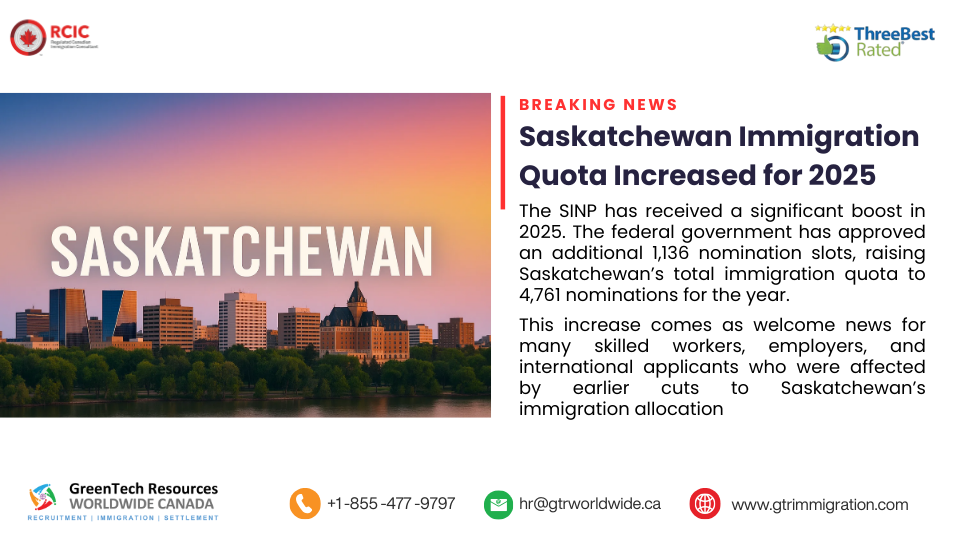
    Saskatchewan is actively pursuing a two-year work permit extension for skilled temporary foreign workers whose permits are set to expire in 2024 or 2025. This initiative aims to provide these workers with additional time to secure permanent residency and to support employers facing labor shortages.

    Background and Rationale

    The federal government’s recent decision to reduce Saskatchewan’s immigration quota to 3,600 has significantly impacted the province’s ability to retain skilled workers. Given that over 90% of Saskatchewan’s economic newcomers arrive through the Saskatchewan Immigrant Nominee Program (SINP), this reduction poses challenges for both workers and employers. In response, Saskatchewan’s Immigration and Career Training Minister, Jim Reiter, is seeking a similar arrangement to Manitoba’s, which allows temporary workers to extend their permits until the end of 2025 .

    Proposed Extension Details

    Jim Reiter, Saskatchewan’s Minister of Immigration and Career Training, is leading efforts to negotiate with the federal government for a two-year work permit extension. The proposed extension would apply to workers who:

    • – Had a valid Saskatchewan work permit as of May 7, 2024

    • – Are currently employed in the province

    • – Are prospective SINP nominees

    If approved, eligible workers would apply through Immigration, Refugees and Citizenship Canada (IRCC) and, upon approval, receive a two-year open work permit. This permit would allow them to continue working in Saskatchewan while pursuing permanent residency .

    Impact on Employers and Workers

    The proposed extension is expected to benefit sectors experiencing labor shortages, such as healthcare, agriculture, and skilled trades. It would also alleviate stress for workers facing the expiration of their permits without a clear path to permanent residency. Employers would retain experienced staff, ensuring continuity and stability in their operations .

    Next Steps

    For Workers:

    • – Verify that your work permit was valid on May 7, 2024, and check its expiration date.
    • – Ensure you are currently employed in Saskatchewan.
    • – Stay informed about updates from the SINP and IRCC regarding the extension process.

    For Employers:

    • – Identify employees who may be eligible for the extension.
    • – Prepare to provide necessary documentation or support letters if required.
    • – Monitor communications from provincial authorities for further guidance.