Author: Admin

  • Canada’s Labour Market Shifts as Foreign Worker Arrivals Fall Below 2025 Targets

    Canada’s Labour Market Shifts as Foreign Worker Arrivals Fall Below 2025 Targets

    Canada’s immigration data shows that foreign worker arrivals in 2025 have already decreased significantly, putting the country on track to meet the major reductions planned for 2026. According to government statistics, Canada has admitted more than 100,000 fewer foreign workers compared to the 2025 target—primarily due to policy shifts affecting the Temporary Foreign Worker Program (TFWP) and the International Mobility Program (IMP).

    This marks one of the largest year-over-year slowdowns in Canada’s temporary worker intake in the past decade.

    1. Canada Is Already on Track for 2026 Reductions

    The Government of Canada announced in 2024 that it would reduce temporary resident levels by 2026, targeting a major cut to foreign worker admissions.
    By late 2025, data shows the reductions are already happening naturally through:

    • Stricter labour market rules
    • Reduced Labour Market Impact Assessment (LMIA) approvals
    • More limited employer access to low-wage workers
    • Scaling back of open work permit pathways

    As a result, current foreign worker admissions are more than 100,000 below what was projected for 2025, suggesting the country may exceed its 2026 reduction goals ahead of schedule.

    2. Key Data Overview

    Foreign Worker Admissions — Actual vs. Projected (2024–2026)

    YearProjectedActual/EstimatedChangeTrend
    2024605,000580,000-25,000Small decline
    2025550,000440,000-110,000Major decline
    2026 Target430,000TBDOn trackExpected stabilization

    Reductions by Program

    Category / Program20242025 EstimateChange% ChangeNotes
    IMP Total360,000260,000-100,000-28%Biggest drop
    • Open Work Permits (Spouses)140,00090,000-50,000-36%Tightened eligibility
    • PGWP65,00045,000-20,000-30%Public-private college restriction
    • Employer-Specific IMP155,000125,000-30,000-19%More audits
    TFWP Total220,000180,000-40,000-18%LMIA tightened

    3. Why the International Mobility Program (IMP) Saw the Greatest Reductions

    The IMP accounts for the biggest drop in foreign worker arrivals. Several factors contributed:

    a. Reduced availability of open work permits

    Canada has been shifting away from broad open-work categories, especially:

    • Post-graduation work permits (PGWP) — new restrictions in 2024 for public college partnerships
    • Open work permits for spouses — no longer universal across occupations
    • Fewer humanitarian open work-permit exemptions

    b. Employer-specific programs tightened

    Some employer-specific work permits under IMP saw:

    • Higher refusal rates
    • Increased compliance audits
    • Additional documentation requirements

    c. Shift toward permanent immigration

    The federal government wants the number of temporary residents to fall to 5% of the population by 2026.
    IMP reductions are central to achieving this.

    4. What This Means for Employers and Foreign Workers

    For Employers

    • Expect longer processing times for both LMIA and IMP permits
    • Prepare for more compliance checks
    • Consider alternative pathways such as PR-focused recruitment
    • Higher wages or improved working conditions may be required

    For Foreign Workers

    • Fewer open work permit options
    • Stricter eligibility rules
    • Must demonstrate stronger ties, qualifications, or job offers
    • Transitioning to PR is becoming more difficult but pathways still exist

    5. Policy Outlook for Late 2025 and 2026

    Canada is expected to continue reducing temporary resident entries through:

    • Updated LMIA rules
    • Stricter study-permit issuance
    • Further restrictions on PGWP eligibility
    • New caps on employer sectors with high reliance on temporary labour

    The transition marks a structural shift toward a more controlled approach to temporary labour.

    6. Conclusion

    Canada’s temporary foreign worker arrivals in 2025 indicate the country is already aligned with the planned 2026 reductions, with over 100,000 fewer workers admitted than expected.
    The biggest drop occurs in the IMP, driven by policy reform and reduced open-permit categories.

    Employers and workers should prepare for a more selective system—one prioritizing permanent, stable immigration over temporary labour dependence.


  • Canada PR Admissions 2025 What the Latest Numbers Reveal

    Canada PR Admissions 2025 What the Latest Numbers Reveal

    Canada is projected to fall short of its 2025 permanent resident (PR) admissions target, according to recent data from Immigration, Refugees and Citizenship Canada (IRCC) and independent analysis. Despite a strong start earlier in the year, reduced provincial allocations, fewer Express Entry invitations, and policy shifts have placed downward pressure on PR admissions.

    Historical & Current PR Admissions: 2023–2025

    Here is a breakdown of real PR admissions in recent years, based on IRCC and publicly reported data:

    YearReal PR AdmissionsNotes / Source
    2023471,550Actual 2023 admissions
    2024~483,395 (or ~483,000)Reported 2024 total.
    2025 (Jan–Aug)276,870Admissions Jan–Aug 2025.

    Interpretation:

    • Canada significantly exceeded its 2023 target of 465,000 PRs by admitting 471,550.
    • In 2024, Canada again recorded strong PR intake, with ~483,395 PRs reported.
    • In contrast, the admission pace for 2025 (as of August) suggests a risk of under-shooting the 2025 goal of 395,000 PRs.

    Why Canada May Miss the 2025 Target

    1. Lower PNP Allocations
      • The Provincial Nominee Program (PNP) target is cut from ~110,000 in 2024 to 55,000 in 2025.
      • Some provinces have paused or limited their PNP streams, reducing their capacity to nominate new PRs.
    2. Decline in Express Entry Invitations
      • From January to October 2025, IRCC issued 9,350 fewer Invitations to Apply (ITAs) compared to the same period in 2024.
      • There have been no STEM-category draws in 2025, unlike 2024, where there were ~4,500 STEM ITAs.
    3. Policy Shift Focusing on Temporary Residents Already in Canada
      • The 2025–2027 Immigration Levels Plan puts more emphasis on transitioning temporary residents (students, workers) who are already in Canada into permanent residency.
      • More than 40% of 2025 PR admissions are expected to come from this in-Canada transition.

    Strategic Recalibration, Not Failure

    The data suggests the expected shortfall in 2025 isn’t just due to operational underperformance — it reflects a deliberate shift in policy:

    • The government appears to be intentionally scaling back new immigrant arrivals to better align with infrastructure, housing, and community capacity.
    • By reducing PNP quotas and deprioritizing overseas PR entries, Canada is prioritizing sustainable and steady immigration growth.
    • After very high intake in 2023–2024, this shift could signal a new, more controlled phase in Canada’s immigration strategy.

    Implications & Takeaways

    • Labor Market: A slower PR intake could tighten the talent pipeline, but focusing on in-Canada applicants may help retain skilled people already in the country.
    • Provinces: Regions that rely heavily on PNP may struggle to meet their own goals.
    • Social Services: Reduced inflow may help ease strain on housing, health care, and public infrastructure.
    • Long-Term Strategy: This may mark a transition to more predictable and sustainable immigration, rather than rapid growth.

    Conclusion

    Despite a strong performance in 2023 (471,550 PRs) and 2024 (~483,000 PRs), Canada’s early-2025 admission trends suggest it may fall short of its 395,000 PR target. The main reasons include deep cuts to PNP allocations, fewer Express Entry ITAs, and a strategic pivot to prioritize permanent residency for temporary residents already in Canada. While this could slow population growth, it reflects a more measured, long-term immigration approach.

  • Foreign Work Experience and Express Entry – Rules, CRS Points & PR Success Tips

    Foreign Work Experience and Express Entry – Rules, CRS Points & PR Success Tips

    Foreign work experience is one of the most powerful factors that can boost your Comprehensive Ranking System (CRS) score and help you qualify for Canadian Permanent Residence (PR) through the Express Entry system. While many applicants focus on improving language scores or gaining Canadian work experience, the truth is that foreign skilled work experience can add up to 50 CRS points under the “Skill Transferability” category — often making the difference in highly competitive draws.

    This guide explains what counts as foreign work experience, how IRCC evaluates it, and how to maximize your CRS score using work you already completed outside Canada.

    How Foreign Work Experience Helps Your CRS Score

    In Express Entry, foreign work experience does not earn stand-alone core points. Instead, it adds significant points under the Skill Transferability section when combined with:

    • Strong English/French language proficiency (CLB 7 or CLB 9+), or
    • Canadian work experience.

    You can earn up to:

    • 50 CRS points for foreign work experience + language ability
    • 50 CRS points for foreign work experience + Canadian experience

    This means your time working abroad can directly influence your competitiveness in the Express Entry pool.

    What Counts as Valid Foreign Work Experience?

    To be counted by IRCC, foreign work must meet specific requirements.

    Eligibility Requirements (IRCC Rules)

    RequirementDescription
    Paid work onlyMust be paid, full-time or equivalent
    Skilled occupationNOC TEER 0, 1, 2, or 3
    Within the last 10 yearsOlder experience does not count
    At least 1 continuous yearFull-time (30 hrs/week) or equivalent
    Reference letter requiredMust include job duties, hours, salary, and start/end dates
    Matching IRCC job dutiesMust match NOC job description

    If work does not match the NOC duties or lacks documentation, IRCC may refuse to count it.

    CRS Points for Foreign Work Experience

    Foreign experience gives a big CRS boost, especially when combined with CLB 9+ language scores.

    CRS Points: Foreign Experience Alone

    Years of Foreign ExperienceCRS Points (Human Capital)
    0 years0
    1 year13
    2 years25
    3+ years50

    Bonus Points: Skill Transferability

    This is where foreign experience becomes extremely valuable.

    CRS Points: Foreign Experience + Language Ability

    Years of Foreign Skilled WorkWith CLB 7With CLB 9+Maximum Points
    1 year1325Up to 25
    2 years1325Up to 25
    3+ years255050

    CRS Points: Foreign + Canadian Work Experience

    Experience CombinationCRS Points
    1–2 years foreign + 1 year Canadian25
    3+ years foreign + 2+ years Canadian50

    Does Work Experience While Studying Count?

    Yes — unlike Canadian experience, foreign work experience earned while studying full-time can count, as long as it meets the requirements above.

    Can Remote Foreign Work Count?

    Yes — sometimes.

    If you worked for a foreign employer while living in Canada, IRCC may treat it as foreign work experience, but this is evaluated case-by-case. You must provide strong proof, such as:

    • Foreign employment contract
    • Payslips
    • Job duties and hours
    • Clear explanation letter

    Remote foreign work can help some applicants secure both Canadian and foreign work experience points simultaneously — but accuracy is crucial.

    Strategy Tip: Combining Canadian + Foreign Experience

    Applicants who accumulate:

    • 3+ years foreign experience, plus
    • 1–2 years Canadian experience, plus
    • CLB 9+ language score

    can reach the maximum 100 skill transferability points.

    This can push CRS scores into the competitive range even during high cut-off periods.

    Why Foreign Experience Matters More in 2024–2025

    IRCC trends show increased emphasis on:

    • Skilled global talent
    • STEM, healthcare, trades, and tech roles
    • Skill Transferability points
    • Category-based Express Entry draws

    Foreign work experience has become one of the most reliable ways to differentiate your CRS profile and increase your chances of receiving an Invitation to Apply (ITA).

    Foreign work experience is more than a background detail — it can be a strategic advantage that significantly increases your CRS score. Whether you worked abroad years ago or recently, ensuring it meets IRCC criteria and is well documented can make the difference between waiting in the pool and receiving your PR invitation.

  • New Alberta Rural Renewal Stream Rules 2026- Updated AAIP Requirements for Canada PR

    New Alberta Rural Renewal Stream Rules 2026- Updated AAIP Requirements for Canada PR

    The Alberta Advantage Immigration Program (AAIP) is implementing significant changes to its Rural Renewal Stream (RRS), effective January 1, 2026. These updates aim to better align the program with Alberta’s labour-market needs, reduce over-subscription, and strengthen the strategic use of endorsement spaces by rural communities.

    Here are the key changes, their implications, and what prospective applicants, employers, and communities should do to prepare.

    Key Changes in the RRS (Effective Jan 1, 2026)

    1. Valid Work Permit Requirement for In-Canada Applicants
      • Candidates already in Canada must hold a valid work permit when they submit their AAIP application and when the application is assessed.
      • Previously, “maintained status” (implied status) or restoration applications were allowed; under the new rules, these will no longer qualify.
      • This ensures legal status is secure throughout the application process.
    2. TEER-Based Endorsement Model
      • Alberta is shifting toward a TEER (Training, Education, Experience, Responsibilities)-based model for endorsements.
      • Designated communities are likely to prioritize higher- or mid-skilled occupations, especially TEER 0–3, which correspond to in-demand roles in rural areas.
      • More skilled roles will be more competitive for endorsement, while lower-skilled TEER 4 and 5 roles will face stricter conditions, especially for applicants outside Alberta.
    3. Endorsement Allocation Caps for Communities
      • Starting in 2026, each designated community will have a fixed annual cap on how many Endorsements of Candidate letters it can issue.
      • This change is introduced to prevent over-endorsement, where communities previously issued more endorsements than Alberta could nominate.
      • It forces communities to be more strategic in selecting candidates who truly fill their labour-market gaps.
    4. 12-Month Validity for Endorsement Letters
      • Any Endorsement of Candidate letter issued by a community will now expire after 12 months.
      • If an applicant does not submit their AAIP application within that period, they will need to secure a new endorsement — assuming the community still has allocation.
      • This encourages timely progression from endorsement to application and discourages endorsement hoarding.

    Why Are These Changes Being Made?

    • Oversubscription Problem: Designated communities have been endorsing far more candidates than there were provincial nomination spots, leading to a backlog.
    • Labor Market Alignment: Alberta wants to better target its nomination spaces to actual rural labour needs — especially in essential and higher-skilled occupations.
    • Sustainability: By capping endorsements and introducing TEER prioritization, Alberta can manage its nomination quotas more strategically, avoiding a “first-come, first-served” rush.

    Impact on Stakeholders

    For Applicants

    • If you are in Canada: Make sure your work permit is valid, and don’t rely on maintained status.
    • Understand your TEER code: Know whether your job offer falls under TEER 0–3 (likely preferred) or 4–5.
    • Be ready to submit your application within 12 months of getting an endorsement, or risk losing it.

    For Employers

    • Start hiring and recruitment planning early to secure community endorsement before allocations are used up.
    • Focus job offers on in-demand TEER categories aligned with community priorities.
    • Be aware of the new tighter timelines: endorsement letters expire, so coordinate closely with candidates.

    For Designated Communities

    • Develop clear endorsement strategies: decide which TEER categories to prioritize based on local labour gaps.
    • Implement systems to track referral allocations and manage endorsement expiry.
    • Educate employers and potential immigrant workers about the new rules and the importance of timely application.

    Preparing for January 1, 2026: Action Steps

    1. Candidates: Renew work permits early; research TEER classifications; communicate with your community’s economic development organization.
    2. Employers: Align job offers with prioritized TEER jobs; plan hiring cycles; work closely with your community to secure endorsements.
    3. Communities: Set up endorsement quotas; communicate new policies to employers and applicants; monitor endorsement timelines strictly.

    Conclusion Alberta’s tightened Rural Renewal Stream rules reflect a strategic rethink. Rather than endorsing as many people as possible, the province is now prioritizing quality, alignment with labour needs, and efficient use of limited nomination spaces. While the process may become more competitive and time-sensitive, high-demand occupations and well-prepared applicants still stand a strong chance. If you’re considering applying under the RRS, now is the time to get organized and align your strategy with the new 2026 framework.

  • Canada Announces 2026 Study Permit Cap- 7% Cut and Full Breakdown for International Students

    Canada Announces 2026 Study Permit Cap- 7% Cut and Full Breakdown for International Students

    Canada has officially announced the 2026 study permit cap, confirming a 7% reduction in the total number of permits the government plans to issue. As the country works to lower temporary resident levels and ease pressure on housing and public services, the new rules will significantly shape the landscape for international students planning to study in Canada.

    This updated cap follows similar reductions in 2024 and 2025, solidifying Canada’s shift toward a more controlled and sustainable international student system.

    Study Permit Targets for 2024–2026: A Three-Year Decline

    Canada has been reducing international student intake since 2024. The targets across the three years show a clear downward trend:

    YearNational Study Permit TargetChange From Previous Year
    2024485,000
    2025437,000–10%
    2026408,000–7%

    In total, Canada will issue 77,000 fewer study permits in 2026 compared to 2024, reflecting a shift toward stabilization after years of record-high student arrivals.

    2026 Study Permit Allocation by Category

    IRCC released a detailed category-based breakdown:

    A. New Students vs. Returning Students

    • 155,000 permits — for new international students entering Canada for the first time
    • 253,000 permits — for returning/continuing students, including extensions

    This means new students account for only 38% of the 2026 quota.

    B. Allocation by Student Type / Program Level

    1. Master’s & PhD Students — 49,000 permits

    • Exempt from PAL/TAL beginning January 1, 2026
    • Prioritized for processing
    • Recognized for strong economic and labor-market contributions

    2. K–12 Students — 115,000 permits

    • Remain fully exempt from the attestation letter requirement
    • Represents the largest exempt group in the overall cap

    3. Other Exempt Students — 64,000 permits

    Includes:

    • Exchange students
    • Certain public-policy exemptions
    • Temporary residents transitioning to student status

    4. PAL/TAL-Required Applicants — 180,000 permits

    This applies to:

    • Most undergraduate programs
    • Colleges (public & private)
    • Non-exempt post-secondary programs

    This is expected to be the most oversubscribed category nationwide.

    Why Canada Is Reducing Study Permits

    The federal government’s objective is to bring the temporary resident population down to below 5% by the end of 2027.
    The study-permit cap plays a major role in controlling population growth and reducing pressure on:

    • Housing availability
    • Health care systems
    • Provincial education capacities
    • Urban infrastructure

    Despite the cuts, Canada says it remains committed to welcoming international students—especially those pursuing high-value graduate programs.

    Implications for Prospective Students in 2026

    1. Higher Competition for Undergraduate Applicants

    With only 180,000 PAL/TAL-required permits, undergraduate applicants will face intensified competition.

    2. Graduate Students Gain a Strategic Advantage

    The removal of PAL/TAL requirements and a dedicated quota of 49,000 permits make master’s/PhD pathways more attractive.

    3. Apply Early & Prepare Strong Applications

    Due to tighter caps, incomplete or late applications may face higher refusal risk.

    4. Province-by-Province Allocation Will Matter

    Major provinces like Ontario, British Columbia, and Alberta may have stricter limits, impacting popular schools and programs.

    Conclusion

    Canada’s 2026 study permit cap represents a major shift in the international education landscape. While total numbers are decreasing, the country continues to prioritize high-skilled graduate pathways and maintain opportunities for qualified students. Applicants aiming for undergraduate or college programs should prepare early and stay informed about provincial attestation requirements.

  • Nova Scotia Immigration Update 2026 – New EOI Pool, Priority Jobs & PR Rules

    Nova Scotia Immigration Update 2026 – New EOI Pool, Priority Jobs & PR Rules

    Nova Scotia has introduced major changes to how it selects permanent residents. On November 28, 2025, the Nova Scotia Provincial Nominee Program (NSPNP) announced the adoption of a new Expression of Interest (EOI) model for all immigration submissions — a shift aligning it with most other Canadian provinces’ nominee programs.

    What’s Changing

    • Going forward, every submission — old or new — to Nova Scotia’s immigration streams (NSPNP and the Atlantic Immigration Program, AIP) will be treated as an EOI.
    • Having a case ID or meeting eligibility criteria no longer guarantees processing. Only when a candidate is selected in a draw from the EOI pool will their application move forward for assessment.
    • This replaces the older method where full applications were either “refused or nominated” soon after submission. Under the new system, all complete applications go into a central pool, and candidates are drawn when the province needs them.

    Nova Scotia’s Selection Priorities

    Nova Scotia will now use periodic “draws” to choose who gets processed next — depending on its changing labour-market and economic needs. Current priority sectors are:

    • Healthcare
    • Construction
    • Skilled trades
    • STEM fields
    • Natural resources
    • Manufacturing

    These priorities may evolve over time as the province’s needs change.

    Why the Change

    The overhaul is driven by a growing imbalance: the number of people seeking to immigrate to Nova Scotia has vastly outpaced the number of provincial nomination spots allocated by the federal government.

    Under the federal Immigration, Refugees and Citizenship Canada (IRCC) plan for 2025-2026, allocations to provincial nominee programs (PNPs) were halved — forcing provinces like Nova Scotia to be more selective.

    For 2025, Nova Scotia’s combined allocation for NSNP and AIP was reduced to 3,150 spots, down from 6,300 in 2024.

    As of August 2025:

    • The province had already used 1,838 of its spots.
    • There remained 1,312 spots available.
    • Meanwhile, about 9,774 EOIs were waiting in the pool — nearly 3 times the remaining spots.

    Because of this oversubscription, the shift to an EOI model allows the province to prioritize candidates whose skills match labour needs, instead of first-come, first-served.

    What This Means for Applicants & Employers

    • Submitting a full application no longer means you’ll get processed — you now enter a waiting pool.
    • Only applications drawn in periodic selection rounds will move forward. If your EOI isn’t selected, you stay in the pool until maybe future draws.
    • For employers under AIP: endorsements now also go through the same draw-based system. Full endorsement packages are submitted but treated as EOIs. Only after selection will the employer’s submission be processed.
    • Because deliverable slots are limited, being ready with an accurate application aligned to priority sectors — especially in healthcare, trades, or STEM — may improve chances.

    Key Reminder

    Even if you already submitted under the old system and have a case ID, your file is now in the candidate pool, with no guarantee of being processed. Only draws decide which EOIs get advanced.

  • Express Entry Update 2025 – CEC CRS Drops to 531 in Latest Draw

    Express Entry Update 2025 – CEC CRS Drops to 531 in Latest Draw

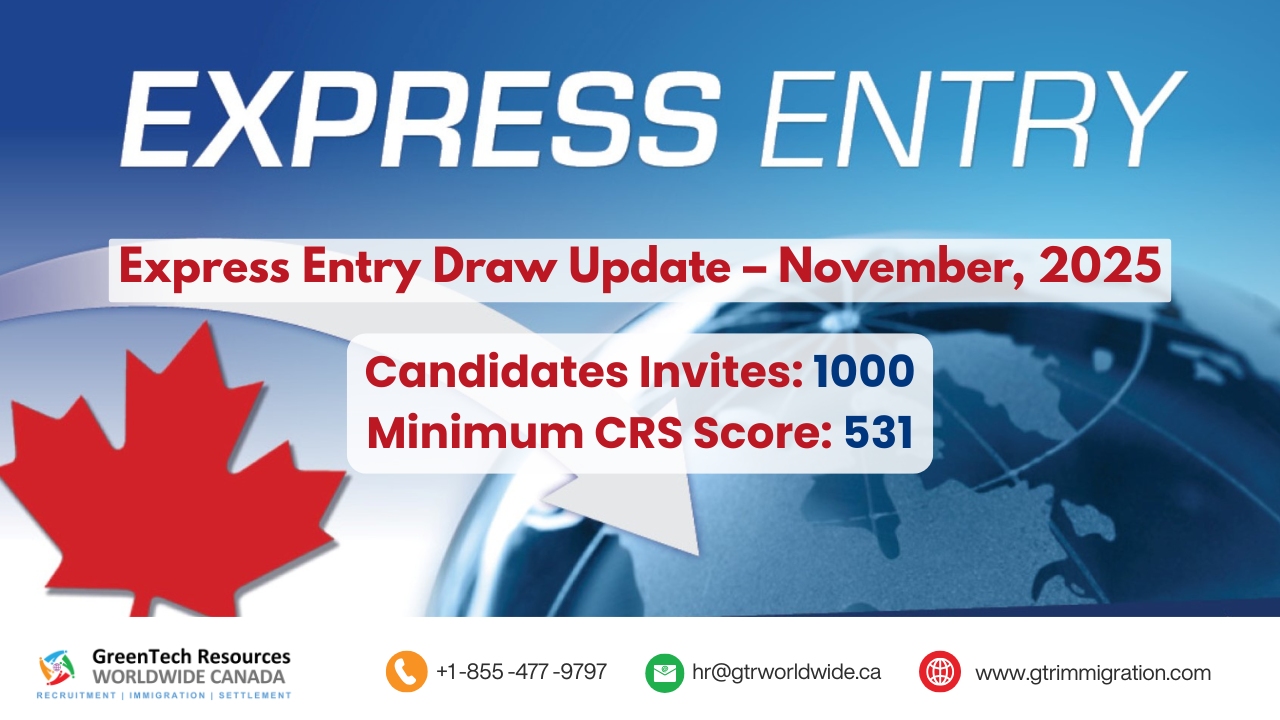
    Canada has issued another encouraging update for Canadian Experience Class (CEC) applicants after Immigration, Refugees and Citizenship Canada (IRCC) conducted the second CEC-specific Express Entry draw of November 2025. The latest draw invited 1,000 candidates and brought the Comprehensive Ranking System (CRS) cut-off down to 531, marking the lowest CEC cut-off score since July 2025.

    A Notable Drop After Months of Stability

    For several months, CEC draws maintained CRS thresholds within the 533–534 range. This consistent pattern, observed in multiple articles across industry sources, suggested a tightly competitive landscape.

    The new cut-off of 531—though only slightly lower—signals a shift and provides meaningful opportunities for applicants with CRS scores in the low 530s.

    Key Details of the November 26, 2025 Draw

    • Draw Date: November 26, 2025
    • Program: Canadian Experience Class (CEC)
    • Number of Invitations to Apply (ITAs): 1,000
    • Minimum CRS Score: 531
    • Lowest CEC Cut-Off Since: July 2025

    This is also the second CEC-only draw within the same month, indicating a possible renewed prioritization of candidates with Canadian work experience.

    2025 — Summary of Key Express Entry Draws & CRS Cut-off Trends

    Here’s a table summarizing major Express Entry draws in 2025 (selected draws across different categories):

    DateDraw TypeInvitations (ITAs)CRS Cut-off Score
    Nov 26, 2025Canadian Experience Class (CEC)1,000531
    Nov 25, 2025Provincial Nominee Program (PNP)777699
    Nov 14, 2025Healthcare & social services occupations3,500462
    Nov 12, 2025Canadian Experience Class (CEC)1,000533
    Nov 10, 2025PNP714738
    Oct 29, 2025French-language proficiency6,000416
    Oct 28, 2025Canadian Experience Class (CEC)1,000533
    Oct 1, 2025Canadian Experience Class (CEC)1,000534
    Sep 3, 2025Canadian Experience Class (CEC)1,000534
    Aug 7, 2025Canadian Experience Class (CEC)1,000534
    July 8, 2025Canadian Experience Class (CEC)3,000518
    June 26, 2025Canadian Experience Class (CEC)3,000521
    June 12, 2025Canadian Experience Class (CEC)3,000529
    May 13, 2025Express Entry general draw500547
    Feb 5, 2025Canadian Experience Class (CEC)4,000521
    Jan 23, 2025Canadian Experience Class (CEC)4,000527
    Jan 8, 2025Canadian Experience Class (CEC)1,350542

    Why This CRS Drop Matters

    The CRS decrease—though modest—carries significant implications:

    • More competitive candidates can now enter the invitation range
      Applicants hovering at 530–532 now have stronger chances in subsequent draws.
    • CEC remains a stable and reliable pathway
      In 2025, IRCC has balanced draw types, including PNP, category-based draws, and all-program rounds. Despite this, CEC continues to feature regularly, demonstrating Canada’s ongoing preference for experienced workers already integrated into the labour market.
    • Potential softening of competition
      If similar trends follow, Express Entry candidates with mid- to high-520s may find increased opportunities in coming months.
    • Category-Based & Non-CEC Draws Offer Alternative Pathways

    2025 has seen large draws under French-language proficiency (e.g. 6,000 ITAs, CRS ~416), healthcare & social services (e.g. 3,500 ITAs, CRS ~462), PNP, and others. These provide options beyond CEC, especially for those with skills or language proficiency matching the categories.

    What Candidates Should Do Now

    • Ensure Express Entry profiles are updated with the latest work experience, education, and language test results.
    • Consider boosting CRS through strategies such as improved language scores, additional work experience, or provincial nomination pathways.
    • Monitor future draws closely—especially if IRCC continues to prioritize CEC candidates.
  • Canada Express Entry Draw- 6,000 ITAs Issued with Record-Low 408 CRS in 2025

    Canada Express Entry Draw- 6,000 ITAs Issued with Record-Low 408 CRS in 2025

    Canada’s Express Entry system saw one of its most significant draws of 2025 as Immigration, Refugees and Citizenship Canada (IRCC) issued 6,000 Invitations to Apply (ITAs) in a French-language proficiency category-based round. The draw, held on November 28, 2025, recorded a CRS cut-off of just 408—the second-lowest CRS requirement of the entire year, marking a major opportunity for French-speaking skilled workers.

    Highlights of the November 28, 2025 Express Entry Draw

    • Category: French-language proficiency
    • ITA issued: 6,000
    • CRS cut-off: 408
    • Tie-breaking rule: Profiles submitted before 12:28 p.m. UTC, May 26, 2025
    • Rank: Second-lowest CRS cut-off among all 2025 draws

    This draw continues a year-long trend of large-scale category-based selections under the Express Entry system, particularly for French-speaking candidates. IRCC has repeatedly emphasized its intention to increase Francophone immigration outside Quebec, and 2025 data strongly reflects this commitment.

    2025 Express Entry — Notable Draws Overview

    Below is a table summarizing some of the most significant draws in 2025:

    DateDraw Type / CategoryITAs IssuedCRS Cut-off (Lowest)
    Nov 28, 2025French-language proficiency6,000408
    Nov 25, 2025Canadian Experience Class (CEC)1,000531
    Nov 25, 2025Provincial Nominee Program (PNP)777699
    Nov 14, 2025Healthcare & Social Services3,500462
    Oct 29, 2025French-language proficiency6,000416
    Oct 06, 2025French-language proficiency4,500432
    Sep 04, 2025French-language proficiency4,500446
    Mar 21, 2025French-language proficiency7,500379 — lowest CRS of the year
    Mar 06, 2025French-language proficiency4,500410
    Feb 19, 2025French-language proficiency6,500428

    As of the November 28 draw, IRCC has issued a total of 94,476 ITAs in 2025.

    Why the November 28 Draw Matters

    Historically Low CRS Threshold for French-speaking Candidates

    • A CRS of 408 is considerably lower than many rounds, especially compared to cuts for general draws or other categories.
    • The only 2025 draw with a lower CRS was on March 21 (379), which indicates IRCC’s willingness under certain circumstances to invite large volumes at lower CRS thresholds for French-language proficiency.

    Large Draw Size — Strong Demand for Francophone Immigrants

    • 6,000 invitations in a single draw is among the highest in 2025. French-language draws continue to dominate in terms of volume of ITAs issued this year.
    • According to IRCC’s 2025 draw statistics, French-speaking applicants have received the largest share of ITAs across all streams.

    Reflects Canada’s Strategic Immigration Goals

    • This draw reinforces Canada’s commitment to boost Francophone immigration outside of Québec, supporting bilingual communities and addressing labour market needs across provinces.
    • The strategy seems to integrate category-based draws (language, occupation, needs) rather than relying solely on general draws — giving more opportunities for specific applicant groups.

    What This Means for Express Entry Candidates

    • If you speak French (or are ready to invest in French proficiency): This remains one of the most promising pathways. CRS thresholds for French-language draws have repeatedly dipped lower than general draws — meaning that with moderate CRS (sometimes ~400+), you may still receive an ITA.
    • For other candidates (non-French / general CRS): Competition remains high, especially as many draws for other categories (CEC, PNP, Healthcare) maintain higher CRS thresholds. It may be helpful to consider alternate strategies — e.g. improving language skills, obtaining provincial nomination, or aiming for prioritized occupation draws.
    • Timing & Preparation Matter: French-language draws appear frequently and produce large numbers of ITAs. Having a ready profile, updated language exam results (e.g. TEF Canada / TCF Canada), and valid documentation can significantly increase eligibility when the next draw occurs.

    Outlook — What to Expect for Late 2025 & Early 2026

    Given the continuing demand for Francophone immigrants, plus shifting labour-market needs and demographic pressures, we can anticipate:

    • More large-scale French-language draws, possibly with CRS thresholds fluctuating depending on volume and IRCC’s targets.
    • Continued use of category-based draws (e.g. healthcare, education, trades, social services) to meet sectoral labour demands.
    • Opportunities for candidates with diverse profiles: not only high CRS but also language skills, occupation in demand, or provincial backing.

    For candidates — especially from non-Francophone countries — placing effort into French language proficiency could pay off significantly.

  • Ontario Introduces New PR Pathways for Skilled Workers and Francophones

    Ontario Introduces New PR Pathways for Skilled Workers and Francophones

    Ontario is entering one of its most significant immigration reform periods in the last decade. With ongoing labour shortages, an aging workforce, and rising demand in high-growth sectors, the province is preparing to launch new permanent residence (PR) pathways under the Ontario Immigrant Nominee Program (OINP). These changes include:

    • A new Talent Stream targeting high-skill professionals
    • Expansion of regional and rural immigration pilots
    • A new Francophone PR pathway
    • Stronger OINP rules and integrity measures
    • Suspension and redesign of certain older streams

    Why Ontario Is Launching New PR Pathways in 2025

    Ontario remains Canada’s top destination for newcomers, receiving:

    • Over 40% of total immigrants annually
    • The majority of international students
    • The highest number of temporary foreign workers

    However, Ontario faces serious challenges:

    • Acute labour shortages in health care, trades, technology & manufacturing
    • High urban concentration (GTA attracts over 75% of newcomers)
    • Declining French-speaking population outside Quebec
    • Growing regional disparities
    • Pressure on housing & public services

    As a result, the government is restructuring OINP to:

    ✔ Attract talent Ontario needs

    ✔ Distribute newcomers more evenly across the province

    ✔ Strengthen the workforce in critical sectors

    ✔ Support bilingual and francophone communities

    ✔ Make immigration more flexible and responsive

    This explains the introduction of multiple new PR pathways.

    New “Talent Stream” Under OINP: What We Know So Far

    Enabled by Bill 30, Ontario has gained new authority to create PR pathways through regulation—allowing rapid response to labour shortages.

    What is the Talent Stream?

    A new OINP category focusing on specialized, high-value professions, including:

    • Research & development professionals
    • Culinary arts experts & executive chefs
    • Creative arts & cultural professionals
    • Entrepreneurs & innovation specialists
    • Technical specialists in emerging industries

    Likely Selection Factors:

    While criteria are not officially published, based on OINP trends, selection may include:

    • Education in a high-skill field
    • Specialized certifications
    • Portfolio or experience evidence (for creative/culinary applicants)
    • Job offer from an Ontario employer
    • Language proficiency (likely CLB 6–9 depending on stream)

    Why this matters:

    Ontario is moving away from broad immigration categories toward occupation-specific targeted immigration, similar to federal Express Entry category-based draws.

    REDI Pilot: A Major Regional Immigration Pathway

    Launched January 2025, the Regional Economic Development through Immigration (REDI) Pilot is Ontario’s answer to ongoing workforce shortages in rural and northern communities.

    3.1. Goals of the REDI Pilot

    • Increase population in small & rural communities
    • Support regional industries with chronic labour shortages
    • Reduce dependence on Toronto & Ottawa labour markets
    • Attract skilled workers who are willing to settle long-term

    3.2. Eligible Sectors (Expected Priority Areas)

    • Health care (nurses, PSWs, lab technicians)
    • Industrial trades (welders, mechanics, electricians)
    • Manufacturing workers
    • Hospitality & food services
    • Logistics & transportation

    3.3. REDI Eligibility Overview

    RequirementDescription
    Job OfferMust be from an employer in a participating community
    NOC OccupationSkilled or semi-skilled depending on sector
    Work ExperienceLikely 6 months – 2 years
    LanguageCLB 4–6 depending on job
    Settlement PlanMust intend to live in the community

    REDI is expected to function similarly to RNIP but with Ontario-specific economic goals.

    New Francophone PR Pathway: Supporting French-Speaking Immigration

    Canada’s federal goal is 4.4% francophone immigration outside Quebec, but Ontario has consistently fallen below this target.

    The new Francophone Community Immigration Pilot (FCIP) aims to change that.

    Target Region:

    Superior East (Northern Ontario)

    Who Is Eligible:

    • French-speaking candidates
    • Valid job offer in designated communities
    • Priority sectors: healthcare, service, trades, logistics
    • Must demonstrate ability to integrate into francophone communities

    Benefits:

    • More PR opportunities for French-speaking applicants
    • Boosts bilingual workforce
    • Employers receive support for recruitment
    • Increased settlement services available

    Updated OINP Regulations: Stronger Integrity Measures

    Ontario has implemented new rules allowing the OINP to suspend or return applications under more conditions.

    5.1. Why the Rules Changed

    • Increase in fraudulent job offers seen nationally
    • Need to ensure employer compliance
    • Sudden labour market shifts require flexibility (e.g., layoffs)

    5.2. New Reasons OINP Can Suspend or Return Applications

    • Employer fails to meet business requirements
    • Job offer no longer valid
    • Change in applicant’s eligibility
    • Evidence of misrepresentation
    • Stream suspension or redesign

    This is why Ontario paused the Express Entry Skilled Trades Stream to update requirements.

    Ontario’s New PR Pathways & Updates (2025)

    Program / PathwayTarget GroupKey FeaturesStatus
    Talent Stream (New)Innovators, chefs, creative professionals, researchersTargeted high-skill PR pathwayLaunching soon
    REDI PilotSkilled workers with rural job offersPR for designated Ontario communitiesActive
    Francophone Pilot (FCIP)French-speaking workersSupports Franco-Ontarian regional growthActive
    Updated OINP RegulationsAll applicantsStronger integrity rulesIn effect
    Suspended Skilled Trades StreamExpress Entry trades candidatesBeing redesigned to match labour needsUnder review

    What These Changes Mean for Immigration Candidates

    More opportunities for specialized workers

    Talent-based selection gives an advantage to those with strong professional backgrounds.

    Greater access for rural & northern workers

    Candidates willing to move outside Toronto now have significantly better chances.

    French-speaking candidates benefit

    Ontario’s new pilot may make French-speaking applicants among the most competitive.

    Employers gain new hiring channels

    Ontario businesses can attract international specialists who may not qualify under standard streams.

    Applicants must prepare for stricter verification

    Accurate documentation and employer credibility will be critical.

    Who Should Apply Under Ontario’s New Pathways?

    Ideal candidates include:

    • Researchers with Canadian or international experience
    • Chefs, culinary managers & hospitality experts
    • Artists, musicians, digital creators, performers
    • Tradespeople open to relocating to rural communities
    • Healthcare assistants, nurses & technicians
    • French-speaking professionals
    • International graduates working in Ontario

    These changes reflect Ontario’s shift toward skills-based immigration, not just general economic immigration.

    Expert Tips for Applicants

    To increase your chances:

    • Secure a valid Ontario job offer (strongest advantage)
    • Target designated communities participating in REDI
    • Build a strong portfolio (creative, research, culinary fields)
    • Improve French-language proficiency if eligible
    • Maintain accurate records to avoid integrity flags
    • Follow OINP news as new criteria will be released throughout 2025
  • CEC Express Entry Draws – The Most Common Profiles Receiving ITAs in 2025

    CEC Express Entry Draws – The Most Common Profiles Receiving ITAs in 2025

    The Canadian Experience Class (CEC) continues to play a central role in Canada’s immigration strategy, with Immigration, Refugees and Citizenship Canada (IRCC) holding a series of competitive and increasingly frequent draws throughout 2025. Recent data from multiple trusted sources shows clear patterns in the CRS cut-off scores, candidate characteristics, and draw frequency, revealing exactly what types of applicants are being selected for permanent residency.

    Overview of Recent CEC Draws (Mid–Late 2025)

    Between June and November 2025, IRCC held several major CEC draws, with cut-off scores mostly in the 533–534 CRS range, indicating high competitiveness. Here is a summarized look:

    DateITAs IssuedCRS Cut-offKey Notes
    Nov 12, 20251,000533Tie-breaker: Oct 17, 2025. Second CEC draw within two weeks.
    Oct 28, 20251,000533Profile creation before Mar 21, 2025 required.
    Oct 1, 20251,000534Continued trend of 1,000-invite CEC draws.
    Sep 3, 20251,000534Stable competitiveness early fall.
    Aug 7, 20251,000534One of the highest CEC cut-offs of the year.
    Jul 8, 20253,000518A rare large draw with significantly lower cut-off.
    Jun 26, 20253,000521High-volume draw lowered the CRS threshold.
    Jun 12, 20253,000529Beginning of mid-year draw expansions.
    May 13, 2025500547Smallest and most selective draw of the year.

    These draw results show that while the CEC pathway remains one of the most reliable ways for temporary residents to obtain PR, the competition is sharper than ever.

    What Types of Candidates Are Being Invited?

    Based on the cut-off ranges, draw frequencies, and pool analysis, here are the candidate profiles most likely to receive an ITA (Invitation to Apply):

    1. Candidates With High CRS Scores (530+)

    Most CEC draws in late 2025 require CRS scores in the 533–534 range. This score level typically reflects:

    • Strong English or French language test results
    • Completion of Canadian post-secondary education
    • 1+ years of skilled Canadian work experience
    • Younger age brackets (20–32)
    • Additional CRS points from arranged employment, Canadian studies, or spouses

    2. Strong English/French Proficiency

    CLB 9–10 test scores remain a major differentiating factor among CEC candidates, elevating profiles into the 530+ range.

    3. Early Profile Creators

    The tie-breaker rule shows IRCC often selects candidates based on profile submission date when scores are identical.
    Example: The Nov 12 draw only invited candidates who created their profile before Oct 17, 2025.

    4. In-Canada Skilled Workers

    CEC is designed for candidates who already have:

    • One year of full-time skilled work experience in Canada
    • Temporary status (Post-Graduation Work Permit holders, skilled workers on LMIA-based or LMIA-exempt permits)

    IRCC continues to rely heavily on CEC draws to convert temporary residents into permanent residents.

    5. Candidates in High-Demand Sectors

    Although CEC is not occupation-based, many invited candidates typically work in:

    • Technology
    • Business and finance
    • Healthcare
    • Education
    • Skilled trades
    • Hospitality and service roles

    These sectors contribute significantly to Canada’s labor market, making candidates with Canadian experience highly attractive.

    Why Are CRS Cut-Offs So High?

    Several factors contributed to a competitive pool in 2025:

    • A growing number of international graduates and skilled workers in Canada
    • Reduced CEC draw sizes in late 2025 (1,000 ITAs vs. 3,000 earlier in the year)
    • More candidates in the 500+ CRS range compared with previous years
    • IRCC balancing CEC draws with category-based and PNP draws

    When IRCC reduced draw sizes, the CRS cut-offs rose accordingly.

    What This Means for Future Applicants

    If you are planning to apply through the Canadian Experience Class, you may benefit from:

    • Improving language test results (IELTS/CELPIP/TEF/TCF)
    • Completing a Canadian education program
    • Adding spousal CRS points
    • Obtaining Canadian work experience in skilled occupations
    • Submitting your profile early to benefit from future tie-breaker rules

    CEC remains one of the fastest and most consistent pathways to Canadian PR, but preparation and timing are now more important than ever.