Author: Admin

  • Working in Canada Without a Permit: Business Visitors, Remote Workers, and International Students

    Working in Canada Without a Permit: Business Visitors, Remote Workers, and International Students

    Work in Canada without a work permit: who qualifies and what to prepare

    Immediate update and why it matters

    Many foreign nationals assume a work permit is always required to take paid work while in Canada. That is not the case. There are clear, limited situations where a visitor, a remote worker for a foreign employer, or an international student with proper authorization can lawfully work in Canada without first securing a work permit from IRCC. Understanding these exemptions matters because eligibility affects the travel document you need to enter Canada, what paperwork you must carry at the border, your ability to work legally once inside the country, and the consequences of non-compliance.

    Three legitimate pathways to work without a Canadian work permit

    Business visitors
    A business visitor may carry out short-term business activities in Canada without entering the Canadian labour market. To qualify you must not be pursuing direct employment with a Canadian company; your remuneration and business profits must remain outside Canada and your employer’s principal place of business should be abroad. The activity should be international in scope—examples include attending meetings, trade conventions, procuring goods for a foreign company, or attending board meetings. Activities that compete with the Canadian market or engage the Canadian public (for example, sales to Canadian consumers) do not qualify. Typical qualifying activities also include after-sales warranty work on specialized equipment purchased abroad, and certain limited roles in advertising or film production where there is no employment relationship with a Canadian employer.

    Officers decide admissibility and duration at the border, and applicants bear the burden of proof. Business visitors should be ready with supporting documents such as a letter from their non-Canadian employer, an invitation from a Canadian host, and business papers or evidence of financing for the trip. A business visitor may generally stay for up to six months, subject to the officer’s discretion.

    Digital nomads working remotely for a foreign employer
    Remote work for an employer located entirely outside Canada can be done from Canada without a work permit, provided several strict conditions are met. The foreign employer must have no physical presence, no business operations, and no financial connections in Canada. The worker must not enter the Canadian labour market, must not provide services to Canadian clients, and must not receive payment from a Canadian entity while working from within Canada.

    Entry requires the appropriate travel document—either a visitor visa or an electronic Travel Authorization (eTA)—and allows stays up to six months. If you intend to stay longer, you must apply for a visitor record. Evidence that income is earned wholly outside Canada is critical. Acceptable documentation includes an employment contract or confirmation letter from a foreign employer, foreign pay slips, contracts or invoices for foreign clients (for self-employed individuals), business registration outside Canada, foreign tax filings, and bank statements showing income from abroad. Common remote roles that fit this framework include software development, digital marketing, consulting, and online tutoring.

    International students authorized to work
    International students may work on or off campus without a work permit only if their study permit includes conditions authorizing work. On-campus work is allowed for unlimited hours at any time. Off-campus work is permitted up to 24 hours per week during regular academic sessions and full-time during scheduled breaks that last at least seven consecutive days (scheduled by the school). You can remain enrolled part-time or full-time during a scheduled break and still benefit from unlimited work hours for that break.

    Eligibility requires that you be a full-time student at a designated learning institution (with an exception for part-time study in a final semester if you were full-time previously), be enrolled in at least a six-month post-secondary or vocational program leading to a degree, diploma, or certificate (or a secondary-level vocational program in Quebec), hold a valid study permit—or have applied to extend it before expiry—and possess a Social Insurance Number (SIN). You must obtain a SIN before beginning employment. Working more than 24 hours weekly while classes are in session breaches study permit conditions and can lead to loss of student status, refusal of future permit applications, and removal from Canada.

    Who is affected beyond these three categories

    Beyond business visitors, digital nomads and authorized students, the Immigration and Refugee Protection Regulations (under R186) list other scenarios where employment is allowed without a work permit. Examples include accredited diplomats and foreign representatives, foreign military personnel from Visiting Forces Act countries and their designated civilian staff, certain foreign government exchange officers placed with Canadian agencies, U.S. cross-border maritime law enforcement officers under a bilateral framework, in-flight security officers under aviation security arrangements, performing artists in time-limited non-broadcast engagements, sports participants, foreign journalists covering Canadian events for a foreign news company, guest speakers and short-term seminar leaders, academic examiners, religious workers in spiritual or counselling roles, emergency responders providing life- or property-protecting services, and individuals whose work permits have expired but whose renewal applications remain pending and who continue to comply with original permit conditions. Each of these categories has specific rules and limits; applicants should consult the relevant regulatory descriptions for details.

    Steps applicants should take before travelling and while in Canada

    • Confirm your status and paperwork: Identify whether you need a visitor visa or an eTA and confirm that your study permit, if relevant, explicitly authorizes work.
    • Gather supporting documents: Business visitors and digital nomads should carry employer letters, invitation letters from Canadian hosts, contracts, foreign pay slips, bank statements, and proof of business registration abroad as applicable.
    • Avoid entering the Canadian labour market: If relying on a business visitor or digital nomad exemption, do not provide services to Canadian clients, solicit Canadian customers, or receive payment from Canadian companies.
    • Apply for a visitor record if you plan to stay beyond six months.
    • Obtain a SIN before starting any employment in Canada, including for students working on or off campus.
    • Keep records for tax and compliance: Retain contracts, invoices, pay stubs, and foreign tax filings to demonstrate that income is earned outside Canada when required.
    • Be prepared for border discretion: An officer at the port of entry determines admissibility and length of stay; entry is never guaranteed even if you believe you qualify.

    What this means for applicants

    These exemptions provide legitimate, narrow pathways to work during a temporary stay in Canada without a formal work permit, but they come with clear limits and responsibilities. The common thread is that you must not be entering Canada’s labour market. For business visitors and digital nomads the emphasis is on where remuneration and clients are located; for students the focus is on whether their study permit authorizes work and on how many hours they may work during academic sessions.

    Failure to respect conditions—working more hours than allowed as a student, taking on work that competes with the Canadian market as a business visitor, or contracting with Canadian clients while claiming a foreign-only income stream—can have serious consequences, such as loss of status, refusal of future permits, or immigration enforcement. Because the burden of proof rests with the visitor, clear documentation and conservative compliance with the rules are essential.

    Key takeaways

    • Work without a Canadian work permit is possible in limited, well-defined situations: business visitors, remote workers for foreign employers, and international students with work conditions on their study permit.
    • Business visitor and digital nomad status requires that you do not enter the Canadian labour market and that payment and principal business operations remain outside Canada.
    • Digital nomads need a visitor visa or eTA and must show proof their income is earned wholly from abroad; stays are generally limited to six months without a visitor record.
    • International students can work without a work permit only if their study permit authorizes it; off-campus work is capped at 24 hours per week during academic sessions unless on a scheduled break.
    • Officers at the border have discretion; carry supporting documents and be ready to prove you qualify for the exemption you claim.
    • Working outside the rules risks serious immigration consequences; keep records and obtain a SIN before starting any employment.

    For personalized support with your Canadian immigration pathway, contact GTR Immigration.
    Call us: +1 855 477 9797

    #WorkPermit #StudyPermit #VisitorVisa #DigitalNomad #BusinessVisitor #InternationalStudents #IRCC

  • British Columbia Unveils Requirements for New Time-Limited Pathway to Permanent Residence

    British Columbia Unveils Requirements for New Time-Limited Pathway to Permanent Residence

    The Government of British Columbia has unveiled eligibility details for a new time-limited pathway to permanent residence through the British Columbia Provincial Nominee Program (BC PNP). The initiative is designed to address ongoing labour shortages in key sectors while providing eligible temporary residents with a streamlined route to Canadian permanent residency.

    The new pathway will focus on workers employed in occupations that are critical to British Columbia’s economic growth and public service needs, helping the province retain skilled talent already contributing to its workforce.

    New BC PNP Stream Prioritizes In-Demand Occupations

    Under the newly announced pathway, priority will be given to candidates working in sectors facing significant labour shortages, including:

    • Healthcare
    • Early Childhood Education
    • Construction and Skilled Trades
    • Veterinary Services
    • Other occupations identified as provincial priorities

    The pathway forms part of British Columbia’s broader strategy to attract and retain skilled workers who can support long-term labour market demands.

    Eligibility Requirements

    To qualify for the new time-limited permanent residence pathway, applicants will generally be required to:

    RequirementDetails
    EmploymentBe employed in an eligible priority occupation within British Columbia
    ResidenceBe legally residing and working in Canada
    Job OfferHold a valid full-time job offer from a British Columbia employer, where applicable
    Language ProficiencyMeet minimum language requirements based on the occupation and program stream
    Education & LicensingPossess the necessary education, certifications, or professional licensing
    Immigration StatusMaintain valid temporary resident status throughout the application process

    Specific requirements may vary depending on the occupation and BC PNP stream.

    Continued Focus on Healthcare and Community Services

    Healthcare remains a key priority within British Columbia’s immigration strategy. Recent BC PNP draws have consistently targeted professionals such as:

    • Physicians
    • Registered Nurses
    • Healthcare Assistants
    • Allied Health Professionals
    • Early Childhood Educators

    The province has reaffirmed that healthcare and community-focused occupations will continue to receive significant attention throughout 2026.

    Addressing Critical Labour Shortages

    British Columbia introduced this pathway in response to persistent workforce challenges driven by:

    • Population growth
    • Rising demand for healthcare services
    • Construction sector labour shortages
    • An aging workforce
    • Regional economic development

    By creating a dedicated immigration stream, the province aims to retain experienced workers already living and working in Canada while helping employers fill urgent labour market gaps.

    Application Process

    Eligible candidates will generally need to complete the following steps:

    1. Meet all BC PNP eligibility requirements.
    2. Submit an Expression of Interest (EOI), if required.
    3. Receive an invitation through a targeted BC PNP draw.
    4. Apply for a provincial nomination.
    5. Submit a permanent residence application to Immigration, Refugees and Citizenship Canada (IRCC).

    A provincial nomination can significantly enhance a candidate’s chances of obtaining Canadian permanent residence through economic immigration programs.

    Part of BC’s Evolving Immigration Strategy

    The announcement aligns with British Columbia’s ongoing efforts to modernize its Provincial Nominee Program in 2026. The province has increasingly shifted toward targeted, sector-based immigration selection rather than broader invitation rounds.

    Recent BC PNP draws have focused on the following sectors:

    SectorPriority Occupations
    HealthcareNurses, Physicians, Healthcare Workers
    EducationEarly Childhood Educators
    ConstructionSkilled Trades and Apprenticeship Workers
    Veterinary ServicesVeterinarians and Veterinary Technicians

    British Columbia has indicated that future immigration selections will continue to align closely with provincial workforce and economic priorities.

    Benefits for Applicants

    Successful applicants may gain access to several long-term advantages, including:

    • A pathway to Canadian permanent residence
    • Continued employment opportunities in British Columbia
    • Access to provincial healthcare and social benefits
    • Long-term settlement opportunities for accompanying family members
    • A potential pathway toward Canadian citizenship in the future

    The new stream is expected to particularly benefit temporary foreign workers and international graduates already employed in priority occupations across the province.

    Conclusion

    British Columbia’s new time-limited permanent residence pathway highlights the province’s commitment to addressing labour shortages through targeted immigration initiatives. By prioritizing workers in healthcare, education, construction, veterinary services, and other critical sectors, the province aims to strengthen its workforce while offering skilled individuals a clearer route to permanent residency.

    As the BC PNP continues to evolve in 2026, candidates employed in priority occupations may benefit from enhanced opportunities to secure permanent residence through sector-focused immigration pathways.

  • Newfoundland and Labrador invites over 100 candidates to submit an application for nomination or endorsement

    Newfoundland and Labrador invites over 100 candidates to submit an application for nomination or endorsement

    Newfoundland and Labrador immigration draw: May 28 invitations and what applicants should do next

    The Office of Immigration and Multiculturalism (OIM) for Newfoundland and Labrador held its sixth provincial immigration draw of 2026 on May 28, issuing 103 invitations through the Newfoundland and Labrador Provincial Nominee Program (NLPNP) and the Atlantic Immigration Program (AIP). This round matters because it continues a steady downtrend in invitation volumes after heavy activity earlier in the year, and it affects candidates who are in the province’s Expression of Interest (EOI) pool or planning to submit one.

    May 28 draw and the immediate context

    On May 28 the province invited 103 candidates: 84 through NLPNP and 19 through the AIP. That allocation means NLPNP received the lion’s share of invitations in this round (81.6%). The province did not disclose which NLPNP streams or which occupations were targeted in this selection. Candidates invited under NLPNP are asked to submit a provincial nomination application; AIP invitees are asked to submit an employer-led endorsement application. Invited applicants have 60 days to file a complete application.

    This was Newfoundland and Labrador’s smallest draw so far in 2026, closing a month (May) that nevertheless saw three separate rounds of invitations — the most draws held in a single month this year. The OIM has repeatedly run selection rounds since March, with invitation totals falling from the large March 6 round (445 invites) toward smaller, more selective draws in April and May.

    How the year’s draws compare and the trend to watch

    The OIM’s draws in 2026 have been front-loaded compared with 2025. From January 1 to May 28 the province issued 1,379 invitations in total. Of that total, 83.9% went to NLPNP candidates. Comparing year-over-year activity, the province has issued 795 more invitations so far in 2026 than it did in the same period in 2025; last year the province held just two draws accounting for 584 invitations in this timeframe.

    Monthly and per-draw totals for 2026 (to May 28) were:

    • March 6 — 445 (NLPNP: 362; AIP: 83)
    • March 30 — 245 (NLPNP: 209; AIP: 36)
    • April 13 — 210 (NLPNP: 177; AIP: 33)
    • May 1 — 190 (NLPNP: 157; AIP: 33)
    • May 11 — 186 (NLPNP: 168; AIP: 18)
    • May 28 — 103 (NLPNP: 84; AIP: 19)

    Those totals show an unmistakable narrowing of invitation counts across successive selection rounds. With the OIM not publishing stream- or occupation-level details for the May 28 draw, applicants should expect continued selectivity and plan accordingly.

    Why the decline in invitations matters

    Fewer invitations per draw can mean more competition for those in the EOI pool and a longer wait for candidates hoping to be selected. For prospective applicants, reduced invitation volumes raise the importance of ensuring EOIs are as competitive and up to date as possible. Administrative details that used to be relatively low risk — such as an incomplete job offer letter or missing proof of ties to the province — can have a bigger impact when selection margins tighten.

    A smaller draw size also further emphasizes the role of prioritization. The OIM has said it may prioritize candidates who work in healthcare occupations, who have employment outside major urban centres, who show strong prospects for long-term settlement, or who have ties to the province through local graduation. Candidates who meet those priorities may be relatively better positioned when invitation numbers fall.

    Who is most affected and who should act now

    The following applicant groups should pay close attention to the change in invitation volumes:

    • EOI registrants already in Newfoundland and Labrador’s pool — lower invitation counts increase competition and make updates to an existing EOI important.
    • AIP-eligible employers and their candidates — employers are responsible for submitting AIP endorsement applications within 60 days of invitation, so they must be ready to act quickly.
    • Skilled workers with job offers outside major urban centres, healthcare workers, and recent graduates with local ties — these profiles align with OIM stated prioritization factors and may have a relative advantage.
    • Entrepreneur-stream applicants — those streams do not require a job offer before EOI, but the same selectivity pressures apply to any stream the OIM chooses to prioritize.

    If you are not yet in the EOI pool, now is the moment to confirm whether you meet program requirements and prepare a strong submission. If you are already in the pool, consider whether new evidence (employment changes, language test results, additional education, or stronger settlement ties) can be added within the 12-month EOI validity window to improve your ranking.

    Practical steps to improve readiness

    The OIM’s process is straightforward on paper: submit an EOI, provide occupation, education, language proficiency and settlement plans, and wait to be invited. In practice, selectivity means details matter. Key actions applicants and employers can take include:

    • Confirm EOI completeness and accuracy — ensure occupation codes, language scores, and job offer details match supporting documents.
    • Keep documents current — language test results and job offers can change an EOI’s competitiveness; update the OIM as necessary within the 12-month validity window.
    • Prepare for the 60-day clock — if invited, have a full application package ready. For AIP, ensure the employer is prepared to submit the endorsement application.
    • Demonstrate settlement intent — evidence such as plans for housing, community ties, or local education can matter where long-term settlement is a stated prioritization factor.
    • Target prioritized profiles where possible — those working in healthcare, outside large urban centres, or with local graduation ties may be looked upon favourably.

    Remember that EOIs expire after 12 months. If your EOI lapses, you must submit a new one to remain under consideration.

    What this means for applicants

    The May 28 draw is a reminder that provincial selection patterns can shift within a single year. Applicants should treat the EOI as a living submission: update it when your situation improves, be prepared to act quickly if invited, and maintain realistic expectations about timing. Smaller draws increase the payoff for careful preparation and accurate documentation. For employer-supported AIP candidates, coordination with the employer is essential because the employer must file the endorsement application.

    The OIM’s non-disclosure of stream- and occupation-level targeting in the May 28 round reduces the ability to reverse-engineer selection criteria from a single draw. Instead, track the broader pattern: 2026 has had higher overall invitation totals than the same period in 2025, yet recent draws are trending smaller. That pattern suggests the OIM may be moving from larger mass selections earlier in the year toward more targeted, priority-driven rounds.

    Key takeaways

    • On May 28, 2026 Newfoundland and Labrador issued 103 invitations: 84 NLPNP and 19 AIP.
    • May has been the busiest month for draws in 2026 so far, but the May 28 round was the smallest draw of the year, signaling a downward trend in per-draw invitation volumes.
    • As of May 28 the province has invited 1,379 candidates in 2026, with 83.9% of invites going to NLPNP applicants.
    • Candidates must submit an EOI to be considered; EOIs remain valid for 12 months and an invited candidate has 60 days to submit a complete application.
    • The OIM may prioritize healthcare occupations, employment outside major urban centres, long-term settlement prospects, and local graduates — applicants meeting these criteria could be at an advantage.

    For personalized support with your Canadian immigration pathway, contact GTR Immigration.
    Call us: +1 855 477 9797

    #NLPNP #AIP #NewfoundlandAndLabrador #ProvincialNomineeProgram #CanadaImmigration #EOI #ImmigrationNews

  • May 30, 2026: Ontario Revokes All Nine OINP Nomination Streams in Historic Regulatory Overhaul

    May 30, 2026: Ontario Revokes All Nine OINP Nomination Streams in Historic Regulatory Overhaul

    Major overhaul of Ontario Immigrant Nominee Program: nine streams revoked May 30, 2026

    On May 30, 2026, Ontario will remove the legal basis for all nine of its current Ontario Immigrant Nominee Program (OINP) nomination categories, a sweeping regulatory change that directly affects provincial nomination pathways, employer-dependent applications, and candidates in existing Expression of Interest (EOI) systems. The revocations, together with newly codified targeted-draw powers and mandatory employer registration, represent the largest single change to the OINP since the program’s inception and create immediate uncertainty for many applicants and employers.

    What changed on May 30, 2026

    Ontario amended its immigration regulation through O. Reg. 47/26 on March 16, 2026, and set May 30, 2026 as the effective date for several major changes. The regulation revokes the following nine OINP categories (called streams in common usage): the foreign worker category; the international student with a job offer category; the in-demand skills category; the master’s graduate category; the Ph.D. graduate category; the human capital priorities category; the French‑speaking skilled worker category; the skilled trades category; and the entrepreneur category. After May 30, candidates who meet the existing eligibility rules for those categories will no longer qualify for nomination under those rules.

    Two operational changes also take effect on May 30. First, the OINP director now has explicit authority to issue both general and targeted invitations to apply (ITAs) across all new EOI streams. Targeted draws will rank only candidates who meet labour market or human capital attributes that the director specifies; only the highest‑ranking candidates who meet those targets will get ITAs. Second, employer verification is now written into regulation: candidates in categories that require an Ontario job offer cannot apply unless their employer is registered with the OINP director and has provided an eligible job offer. This employer-registration requirement had already been implemented operationally with the OINP’s employer portal, but it is now formally codified.

    Why this matters for candidates and employers

    This is a structural reboot of Ontario’s provincial nomination system. For candidates, the immediate consequence is legal: the pathways they were relying on will cease to exist in statute as of the May 30 date. For employers, regulation-backed registration and job-offer verification tighten the link between an employer’s participation and an applicant’s ability to file.

    Beyond the formal revocations, the expanded targeted-draw authority gives the OINP director greater discretion to shape which profiles receive invitations. That can speed selection of candidates who meet specific labour-market needs but also increases unpredictability for applicants who do not meet narrowly targeted attributes. For employers who wish to support hires through provincial nomination, registration is now non-negotiable and should be treated as part of recruitment planning.

    Which applicants are affected

    The change touches a broad spectrum of prospective nominees. Those most directly affected include:

    • Foreign workers who were counting on the foreign worker category for provincial nomination;
    • International students who had or were building profiles under the international student with a job offer stream;
    • Applicants in in-demand skills and skilled trades tracks;
    • Recent master’s and Ph.D. graduates targeting graduate-specific nomination streams;
    • Candidates in human capital and French-speaking skilled worker categories; and
    • Entrepreneur-stream applicants relying on the entrepreneur category rules.

    Anyone with active Expression of Interest profiles under the existing OINP streams should consider themselves affected, since Ontario has not confirmed whether current EOIs will transfer into whatever replaces the revoked categories.

    Immediate steps applicants and employers should take

    Given the uncertainty around transition mechanics, take practical steps now to protect eligibility and to prepare for the redesigned program:

    • Document and save your EOI profile details, application receipts, and correspondence with OINP. Copies of submitted documents and profile screenshots can be useful if Ontario requires re‑registration or review.
    • Confirm whether your application or EOI was submitted before May 30; applications submitted before a regulatory change are generally expected to be assessed under the rules in effect at submission, but Ontario’s regulation does not include explicit transitional provisions, so this expectation is not guaranteed in the text of the law.
    • If your nomination relies on a job offer, check that your employer is registered in the OINP system. Employers must be registered and provide an eligible job offer before a candidate can apply, and this is now a formal regulatory requirement.
    • Employers supporting potential nominees should review their registration status in the employer portal and be prepared to confirm the authenticity and compliance of job offers they issue.
    • Monitor official OINP communications closely for any transitional guidance. Ontario has not yet published a formal transition policy covering pending applications or the fate of existing EOI profiles.
    • Consider exploring provincial nomination options in other provinces’ PNPs if time is a factor; the broader PNP landscape may offer routes not affected by Ontario’s changes.
    • Seek immigration advice where needed. Given the scale of the regulatory change and the number of unanswered questions, professional guidance can help candidates interpret how their specific situation will be handled.

    Transition questions that remain unanswered

    Ontario has proposed a redesign but has not confirmed many operational details. In December 2025 the OINP consulted on a two‑phase redesign that would merge the three employer job-offer streams into one new stream with two TEER-based tracks (TEER 0–3 and TEER 4–5), and would replace the remaining streams with three new pathways: Priority Healthcare, Entrepreneur, and Exceptional Talent. These were consultation proposals; Ontario has not published eligibility rules, launch dates, or the mechanics of the new streams.

    Key unresolved issues include whether existing EOI profiles will carry over to any new streams, whether candidates will need to re-register, and whether profiles will be withdrawn. During the July 2025 employer portal transition, Ontario withdrew existing profiles, which provides one precedent, but the province has not said whether the same approach will be applied now. The regulation also lacks explicit transitional provisions that confirm how pending applications submitted before May 30 will be finalized; while they are generally expected to be assessed under the rules in effect at submission, that expectation is not codified in the regulation.

    What this means for applicants thinking ahead

    Applicants should plan for a period of uncertainty and a potential reset of eligibility criteria. With targeted draws likely to prioritize specific labour-market or human-capital attributes, success under a rebuilt OINP may depend on matching those attributes rather than relying on former category eligibility. Employer-supported applications will also depend on employer registration and verified job offers, so coordinated action between candidate and employer will be essential.

    If you are mid-application or have an active EOI, preserve evidence of your submission date and materials, and take proactive steps to communicate with any supporting employer. If you are building an EOI profile, consider diversifying your options: assess other provincial PNPs and evaluate whether your education, occupation, or language profile aligns with likely federal or other provincial pathways.

    Key takeaways

    • Ontario revoked the legal basis for all nine existing OINP categories effective May 30, 2026; these categories will no longer qualify candidates for nomination under the existing rules.
    • The OINP director gains authority to run both general and targeted draws; targeted draws will rank only candidates who meet specified attributes.
    • Employer registration and job-offer verification are now codified in regulation; employers must register and provide eligible job offers before candidates in job-offer streams can apply.
    • Ontario consulted in December 2025 on a proposed redesign (merging employer streams and introducing Priority Healthcare, Entrepreneur, and Exceptional Talent pathways), but those proposals are not finalized and lack published eligibility details.
    • Ontario has not clarified whether existing EOI profiles will transfer, whether candidates must re-register, or how pending applications will be transitioned; applicants should keep documentation and monitor OINP guidance.

    For personalized support with your Canadian immigration pathway, contact GTR Immigration.
    Call us: +1 855 477 9797

    #OINP #ProvincialNominee #PNP #OntarioImmigration #EmployerSponsored #InternationalStudents #SkilledTrades #ImmigrationUpdate

  • 93% of Express Entry Pool Growth Driven by Candidates Scoring in the 501–600 Range

    93% of Express Entry Pool Growth Driven by Candidates Scoring in the 501–600 Range

    Canada’s Express Entry system is becoming increasingly competitive, with new data revealing that 93% of recent growth in the candidate pool has come from individuals with Comprehensive Ranking System (CRS) scores between 501 and 600.

    The trend reflects the growing influence of provincial nominations, Canadian work experience, and category-based selection draws introduced by Immigration, Refugees and Citizenship Canada (IRCC). As more highly qualified candidates enter the system, competition for Invitations to Apply (ITAs) continues to intensify.

    Express Entry Pool Dominated by High-Scoring Candidates

    Recent Express Entry statistics indicate that the strongest growth is occurring among candidates with the highest CRS scores.

    Express Entry Pool Growth by CRS Score Range

    CRS Score RangeShare of Pool Growth
    501–60093%
    451–500Limited Growth
    401–450Minimal Growth
    Below 400Relatively Stable

    The surge in candidates within the 501–600 score range demonstrates that more applicants are entering the pool with highly competitive profiles and stronger qualifications.

    Key Factors Driving Higher CRS Scores

    Several developments are contributing to the increasing number of high-scoring candidates in the Express Entry system.

    Provincial Nominee Programs (PNPs)

    Provincial nominations remain one of the most effective ways to boost CRS scores. Candidates who receive a nomination from a province or territory are awarded an additional 600 CRS points, significantly increasing their chances of receiving an ITA.

    With provinces receiving larger immigration allocations in 2026, more nomination-backed candidates are entering the Express Entry pool.

    Canadian Work Experience

    Canada continues to prioritize applicants who already have experience living and working in the country. Candidates with Canadian work experience often benefit from additional CRS points through:

    • Skilled Canadian employment
    • Strong language proficiency
    • Educational credentials earned in Canada
    • Adaptability factors

    These advantages help many applicants achieve higher rankings within the pool.

    Category-Based Selection

    IRCC’s category-based selection system has also encouraged candidates to strengthen their profiles and align with occupations facing labour shortages.

    Priority categories currently include:

    • Healthcare occupations
    • Construction trades
    • STEM professions
    • French-language proficiency
    • Education occupations
    • Transportation occupations

    As a result, many candidates are strategically improving their qualifications to qualify for targeted draws.

    What This Means for Express Entry Candidates

    The rapid growth of candidates scoring above 500 CRS points is creating greater competition for those with lower rankings.

    Impact by CRS Score Range

    Candidate TypeImpact
    CRS Above 500Strong chances of receiving an ITA
    CRS 450–500Increased competition
    CRS Below 450May need alternative immigration pathways
    Provincial NomineesContinue to remain highly competitive

    Applicants with scores below 500 may need to consider additional strategies to strengthen their profiles and improve their ranking.

    Strategies to Increase CRS Scores

    Immigration experts recommend several ways for candidates to enhance their competitiveness:

    Improve Language Test Results

    Achieving higher scores in IELTS, CELPIP, or TEF can significantly increase CRS points and improve overall ranking.

    Secure a Provincial Nomination

    A provincial nomination remains one of the fastest and most effective methods of increasing CRS scores due to the 600-point bonus.

    Gain Additional Work Experience

    Accumulating more skilled work experience, whether in Canada or abroad, can positively impact CRS rankings.

    Pursue Further Education

    Additional educational qualifications may provide valuable CRS points and strengthen an applicant’s profile.

    Develop French Language Skills

    French proficiency continues to be heavily prioritized under Canada’s immigration strategy and can provide substantial advantages in both general and category-based draws.

    Canada’s Shift Toward Targeted Immigration

    The concentration of candidates in the highest CRS ranges reflects Canada’s broader shift toward targeted immigration selection.

    Rather than relying solely on large all-program draws, IRCC is increasingly focusing on candidates who meet specific economic and labour market needs, including:

    • Occupations facing labour shortages
    • Provincial workforce priorities
    • French-speaking immigration targets
    • Canadian work experience
    • Sector-specific economic demands

    This targeted approach helps Canada attract immigrants whose skills closely match current workforce requirements.

    Provincial Programs Continue to Fuel Growth

    Provincial Nominee Programs remain a major driver of growth within the Express Entry pool.

    Provinces such as Ontario, British Columbia, Alberta, Manitoba, and Saskatchewan received increased nomination allocations for 2026, creating more opportunities for skilled workers to obtain provincial nominations and significantly improve their CRS scores.

    As provincial immigration targets continue to expand, experts anticipate further growth in the number of candidates within the 501–600 CRS score range throughout 2026.

    Outlook for Future Express Entry Draws

    Recent draw trends suggest that CRS cut-off scores may remain high, particularly for Provincial Nominee Program and general invitation rounds.

    However, category-based draws targeting healthcare professionals, French-speaking candidates, skilled trades workers, and Canadian Experience Class applicants are expected to continue creating opportunities for candidates with lower CRS scores who meet specific eligibility criteria.

    Conclusion

    The fact that 93% of recent Express Entry pool growth comes from candidates with CRS scores between 501 and 600 underscores the increasingly competitive nature of Canada’s immigration system in 2026.

    Factors such as strong language proficiency, Canadian work experience, provincial nominations, and eligibility for category-based selection are becoming more important than ever for aspiring immigrants. As Canada continues to prioritize targeted immigration pathways and labour-market-focused selection, candidates who proactively strengthen their profiles and align with in-demand occupations will be best positioned for success in future Express Entry draws.

  • New IRCC Processing Times As Of May 2026

    New IRCC Processing Times As Of May 2026

    Canada’s immigration department, Immigration, Refugees and Citizenship Canada (IRCC), has released updated processing times for various immigration and visa categories for May 2026. The latest figures reveal mixed trends across permanent residence, citizenship, visitor visas, study permits, and work permits.

    While processing has improved in several temporary residence categories, some permanent residence and citizenship applications are experiencing longer wait times due to rising demand and increased application volumes.

    Latest IRCC Processing Times – May 2026

    Permanent Residence Processing Times

    Immigration ProgramCurrent Processing Time
    Canadian Experience Class (Express Entry)About 7 months
    Federal Skilled Worker ProgramAbout 7 months
    Provincial Nominee Program (Express Entry)About 7 months
    Provincial Nominee Program (Non-Express Entry)About 14 months
    Atlantic Immigration ProgramAbout 38 months
    Quebec Skilled Worker ProgramAbout 11 months

    Recent updates indicate that some permanent residence streams, particularly non-Express Entry provincial pathways, are processing slightly slower compared to earlier months.

    Citizenship Processing Times

    Citizenship Application TypeCurrent Processing Time
    Citizenship GrantAbout 13 months
    Citizenship Certificate (Proof of Citizenship)About 12 months
    Renunciation of CitizenshipAbout 7 months
    Search of Citizenship RecordsAbout 17 months

    Citizenship applications continue to face moderate delays as application inventories remain high across several categories.

    Visitor Visa Processing Times

    Applications Submitted Outside Canada

    CountryCurrent Processing Time
    India27–28 days
    Pakistan50 days
    Nigeria47–48 days
    Philippines20 days
    United States25 days

    Visitor visa timelines have increased slightly for some countries compared to April 2026.

    Work Permit Processing Times

    CountryCurrent Processing Time
    India9 weeks
    Pakistan6–8 weeks
    Nigeria6–12 weeks
    Philippines8 weeks
    United States5 weeks

    Work permit processing has improved in certain regions, especially Pakistan and the UAE, although wait times continue to fluctuate depending on application volumes.

    Study Permit Processing Times

    CountryCurrent Processing Time
    India4 weeks
    Pakistan7–8 weeks
    Nigeria6 weeks
    Philippines5 weeks
    United States5 weeks

    Study permit processing remains relatively stable, with some countries showing improvements compared to earlier months in 2026.

    Super Visa Processing Times

    CountryCurrent Processing Time
    India117–138 days
    Pakistan75–98 days
    Nigeria37–40 days
    Philippines32–33 days
    United States115 days

    IRCC data also shows noticeable improvements in Super Visa processing times for applicants from India and Pakistan.

    IRCC Backlog Continues to Decline

    Despite slower timelines in some immigration streams, IRCC recently confirmed that Canada’s overall immigration backlog continues to improve in 2026. Government data shows Express Entry application inventories are currently among the lowest levels seen in recent years.

    Immigration experts believe Canada’s increased reliance on targeted immigration selection and digital processing systems is helping reduce delays in several high-priority programs.

    Why Processing Times Change

    IRCC processing timelines vary depending on multiple factors, including:

    • Number of applications received
    • Program demand
    • Completeness of applications
    • Security and background checks
    • Staffing and operational capacity
    • Immigration targets under Canada’s Immigration Levels Plan

    Processing estimates are updated regularly based on real-time inventory and operational data.

    Conclusion

    The latest IRCC processing time update for May 2026 shows that Canada’s immigration system continues adjusting to growing demand and evolving immigration priorities. While some permanent residence and citizenship categories are moving more slowly, several work permit and study permit streams are seeing faster processing times.

    As Canada continues expanding immigration targets and Provincial Nominee Programs throughout 2026, applicants are encouraged to submit complete applications, monitor IRCC updates closely, and prepare documentation carefully to minimize delays.

  • IRCC Boosts French‑Language Express Entry Invitations with 4,500 ITAs and a 409 CRS Cut‑off

    IRCC Boosts French‑Language Express Entry Invitations with 4,500 ITAs and a 409 CRS Cut‑off

    Express Entry: IRCC issues 4,500 invitations to French-language candidates with CRS cut-off 409 (May 28, 2026)

    IRCC’s latest Express Entry draw — the numbers

    Immigration, Refugees and Citizenship Canada (IRCC) held a targeted Express Entry draw on May 28, 2026, issuing 4,500 invitations to apply (ITAs) to candidates selected for French-language proficiency. The minimum Comprehensive Ranking System (CRS) score required in this round was 409. To be eligible for consideration, profiles had to have been created before 10:20 p.m. Universal Coordinated Time (UTC) on April 29, 2026.

    This selection is the 30th Express Entry draw of 2026 and the fourth draw held in May. It follows a recent pattern of targeted draws for specific occupations and language skills, and continues IRCC’s focus on candidates already in Canada or with close ties to the domestic labour market.

    Recent draw patterns and what they reveal

    So far in 2026, IRCC has used a mix of targeted and category-specific draws. Between January and May, the department issued a total of 79,841 ITAs across several draw streams:

    • Canadian Experience Class: 37,250 ITAs
    • French-Language proficiency: 30,500 ITAs
    • Provincial Nominee Program (PNP): 4,450 ITAs
    • Healthcare and social services: 4,000 ITAs
    • Trades: 3,000 ITAs
    • Physicians with Canadian work experience: 391 ITAs
    • Senior Managers with Canadian work experience: 250 ITAs

    The distribution of draw types in 2026 (to date) shows a clear emphasis on Canadian Experience Class and French-language proficiency selections, along with a steady number of PNP draws. French-language draws have required CRS scores in a relatively narrow band this year, ranging from 393 to 419 before this latest 409 cut-off. Provincial Nominee Program draws show much higher CRS cut-offs, typically in the high 700s and 800s, reflecting the targeted nature of those selections.

    Why this matters for French-speaking candidates

    A 4,500-ITA round specifically for candidates with French proficiency is a substantial issuance and a meaningful opportunity for francophone applicants in the Express Entry pool. The 409 CRS cut-off places this draw near the upper end of the French-language thresholds used earlier in 2026, indicating competitive pressure among French-speaking candidates.

    For people who can demonstrate strong French language ability, targeted draws like this one create an alternative route to an ITA beyond the broader Canadian Experience Class or general draws. Even if a candidate’s CRS is below typical CEC thresholds seen this year, demonstrating French proficiency may put them within reach of selection when IRCC runs language-focused rounds.

    Who should pay attention now

    Candidates most directly affected by this draw include:

    • Express Entry candidates with verified French language test results who had profiles created before 10:20 p.m. UTC on April 29, 2026.
    • Internationally trained workers and recent arrivals already in Canada who meet the language requirement and are aiming for permanent residence through Express Entry.
    • Applicants tracking CRS trends to time registration, language testing, or provincial nomination strategies.

    Because IRCC has prioritized in-Canada candidates in many 2026 draws — particularly CEC and PNP selections — international applicants outside Canada should monitor their CRS and consider routes that increase competitiveness, such as provincial nomination streams or improving language scores.

    Steps applicants should consider now

    If you are in the Express Entry pool or preparing to enter it, the following practical actions reflect the current selection landscape:

    • Verify and update language test results: For candidates with French ability, confirm that your test results are valid and properly uploaded to your profile. Strong French results are the key attribute in these specialized draws.
    • Check profile date and eligibility: Ensure your Express Entry profile creation date met IRCC’s cut-off for relevant draws. For this May 28 draw, profiles had to be in the pool before 10:20 p.m. UTC on April 29, 2026.
    • Track CRS movement by draw type: CEC draws have tended to require mid-500s CRS scores; PNP draws have required scores in the high 700s to 800s; targeted streams such as trades, healthcare, physicians, and senior managers have shown variable cut-offs. Use these patterns to shape priorities.
    • Explore provincial nomination pathways: PNP draws have appeared frequently and yield high selection thresholds. If you have connections to a specific province or in-demand occupation, investigate PNP options that match your profile.
    • Consider Canadian work experience: IRCC’s emphasis on in-Canada candidates suggests that obtaining or documenting Canadian work experience remains a strong path to competitiveness in the pool.

    These steps do not guarantee an ITA but align with the selection trends IRCC has used so far this year.

    How this fits into 2026 selection trends

    The May 28 French-language draw is consistent with a broader IRCC strategy observed in 2026: frequent targeted selections for candidates who fill specific policy priorities or labour market needs. The department has held multiple draws aimed at francophone applicants, healthcare workers, trades, and those with Canadian experience or provincial nominations. This approach allows IRCC to address both demographic objectives and provincial labour demands while maintaining overall admissions targets.

    Quantitatively, French-language and Canadian Experience Class invitations make up the bulk of 2026 ITAs to date. That emphasis suggests IRCC is balancing the desire to welcome francophone newcomers with the practical goal of selecting candidates who are more likely to integrate quickly into the Canadian labour market because of language skills or Canadian work experience.

    Key takeaways

    • IRCC issued 4,500 ITAs on May 28, 2026, to candidates selected for French-language proficiency; the CRS cut-off was 409.
    • Profiles considered for this draw had to be created before 10:20 p.m. UTC on April 29, 2026.
    • Express Entry selections in 2026 have prioritized candidates already in Canada, especially through Canadian Experience Class and Provincial Nominee Program draws.
    • French-language draw cut-offs in 2026 have ranged from 393 to 419 prior to this selection, placing the recent 409 cut-off near the higher end of that range.
    • IRCC has issued 79,841 ITAs in 2026 so far, with 37,250 for Canadian Experience Class and 30,500 for French-language proficiency.

    For applicants, the practical implications are clear: strong, verifiable French language results continue to open distinct pathways within Express Entry, and staying current with profile details and eligibility criteria is essential. Provincial nomination and Canadian work experience remain strategic levers for increasing competitiveness in the pool.

    For personalized support with your Canadian immigration pathway, contact GTR Immigration.
    Call us: +1 855 477 9797

    #ExpressEntry #IRCC #FrenchLanguage #CRS #CanadianExperience #PNP #ImmigrationNews #PermanentResidence

  • Alberta Allows WEOI Edits Without Cancellation, Ending Duplicate Fee Requirement

    Alberta Allows WEOI Edits Without Cancellation, Ending Duplicate Fee Requirement

    Alberta WEOI Update: Edit Submissions Without Cancelling, Limited Refunds for Recent Filers

    Introduction — what changed and why it matters

    On May 26, 2026, the Government of Alberta made two operational changes to the Alberta Advantage Immigration Program (AAIP) Worker Expression of Interest (WEOI) system that directly affect anyone seeking provincial nomination through Alberta’s worker streams. Candidates who have already submitted a WEOI can now edit their profiles without cancelling and resubmitting. Alberta also clarified that some candidates may decline invitations under certain streams and return to the WEOI pool before the 15-day invitation window closes to be considered for other streams. Finally, Alberta announced a limited refund program for people who submitted and then cancelled a WEOI between April 7 and May 26, 2026, to allow those affected by the prior rules to recover the $135 submission fee in specific circumstances. These changes reduce administrative friction and offer more flexibility for many applicants, but refunds are not automatic and updates do not extend a WEOI’s one-year validity.

    Background: how WEOI works and recent policy steps

    The WEOI is the AAIP’s pre-application profile used to screen foreign nationals for Alberta’s worker streams and pathways. To enter the Worker Stream pool, candidates submit information about work experience, education (level and where completed), language ability, family connections in Alberta, and other details. Since April 7, 2026, the WEOI submission has required a $135 fee. Each submitted WEOI is scored and ranked using the AAIP points grid, which allots up to 100 points across Human Capital and Economic factors.

    The province conducts periodic draws from the Worker Stream pool and issues invitations to apply for provincial nomination based on WEOI scores, provincial labour market needs and priorities, the number of available nomination spaces, and application volumes. A candidate who receives an invitation can file a full provincial nomination application to the AAIP; that application requires a $1,500 application fee. Successful applicants receive a provincial nomination and then apply to Immigration, Refugees and Citizenship Canada (IRCC) for permanent residence.

    The current WEOI model in use by the AAIP was introduced on September 30, 2024. Since then the province has adjusted the WEOI form and processes: on February 25, 2026, Alberta added new fields to collect wages and hours of work information for candidates with an in-province job offer, noting that WEOIs missing these details would not be considered in future draws. On April 7, 2026 the government introduced the $135 WEOI fee for candidates seeking immigration under multiple worker streams and pathways.

    What Alberta announced on May 26, 2026

    The AAIP – Updates webpage published the following operational changes, effective immediately as of May 26, 2026:

    – Candidates can edit an existing WEOI without cancelling it. Under the previous rule, edits required cancelling and submitting a new WEOI, which meant paying the $135 fee again.
    – Candidates who receive invitations under certain streams may decline those invitations and return to the WEOI pool before the 15-day invitation period expires so they can be considered for other eligible streams.
    – Alberta is offering limited refunds for WEOI fees paid by candidates who submitted and then cancelled a WEOI between April 7 and May 26, 2026. Refunds are not automatic; candidates must request a refund through the Opportunity Alberta contact form. Some cancelled submissions are not eligible for refunds, including those cancelled because of Express Entry profile updates or where the candidate resubmitted a WEOI while an invitation period was active.
    – Editing a WEOI does not extend its validity: all WEOIs remain valid for one year from the original date of submission, regardless of any subsequent edits.

    Which streams and candidates are covered

    The WEOI fee and the WEOI process apply to candidates seeking immigration under the AAIP worker streams and pathways listed below, and these streams are directly affected by the May 26 operational changes:

    • Alberta Opportunity Stream
    • Alberta Express Entry Stream — including the Accelerated Tech Pathway, Law Enforcement Pathway, and priority sector draws
    • Dedicated Health Care Pathways (Express Entry and non-Express Entry)
    • Rural Renewal Stream
    • Tourism and Hospitality Stream

    Any foreign national who has a WEOI in the Worker Stream pool for these pathways is potentially affected by the ability to edit without cancelling, the option to decline and return to the pool within the invitation window, and the limited retroactive refund offer.

    Analysis — what the changes mean in practice

    Allowing edits without cancellation removes a previously costly and inefficient step. Under the former process, even a small profile correction required cancellation and full resubmission, forcing candidates to pay the $135 fee multiple times if they needed to change their WEOI shortly after submission. The new editing capability reduces financial waste and administrative churn for candidates and for AAIP staff reviewing submissions.

    The option to decline an invitation and re-enter the WEOI pool prior to the expiry of a 15-day invitation window introduces tactical flexibility. Previously, declining an invitation might have meant losing consideration entirely or waiting to re-enter according to the program’s rules. Under the May 26 clarification, candidates invited under certain streams can instead elect to be reconsidered for other streams during that same invitation window. This could help candidates align themselves with a stream that better matches their qualifications or current labour market needs without immediately forfeiting their position in the Worker Stream pool.

    The limited refund initiative is a pragmatic response to a timing issue created by the April 7 introduction of the WEOI fee. Alberta acknowledged that some candidates submitted WEOIs under the old editing rule and then, because edits required cancelling, incurred additional fees when trying to correct or update their profiles. By offering refunds to those who cancelled between April 7 and May 26, Alberta is retroactively addressing that burden for eligible applicants. However, because the refund is not automatic and has stated exclusions, not all affected candidates will receive reimbursement.

    It is also important to note that updating a WEOI does not change the one-year validity period. Candidates who update their profile should not assume that an edit resets or extends the WEOI clock. This preserves the AAIP’s original submission date policy and prevents repeated strategic updates from extending a candidate’s time in the pool.

    Who is affected — a closer look

    Primary groups affected by these changes include:

    – Foreign nationals with an active WEOI in the Alberta Worker Stream pool. This includes candidates in the Alberta Opportunity Stream and those targeting Express Entry pathways managed by Alberta.
    – Candidates with in-province job offers who were asked to provide wage and hours information after the February 25 changes. Missing wage/hours information may exclude a WEOI from draws, so these candidates must ensure that new fields are completed.
    – Candidates who submitted and cancelled WEOIs between April 7 and May 26, 2026. These people may be eligible for a refund of the $135 fee if their circumstances match Alberta’s stated eligibility criteria.
    – Candidates who receive an AAIP invitation but would prefer to be considered for a different stream. The ability to decline and re-enter the pool within the invitation window gives these applicants another option.
    – Employers or representatives who advise or sponsor provincial nomination candidates, since changes to editing and invitation handling alter timelines and fee exposure for their employees or clients.

    Less directly affected but still relevant groups include potential applicants considering a WEOI submission now that editing without resubmission is allowed, and applicants monitoring AAIP draws and priorities for 2026.

    Practical impact for readers and next steps

    Here are the practical implications and actions candidates should consider based on Alberta’s May 26 changes:

    – Edit without cancelling: If you already have a WEOI and need to correct or update details, you can now do so without cancelling and paying another $135 fee. Use the AAIP portal’s editing function rather than cancelling and resubmitting.
    – Refunds are not automatic: If you submitted and cancelled a WEOI between April 7 and May 26, 2026, you may be eligible for a refund of the $135 submission fee. You must request the refund through the Opportunity Alberta contact form. Alberta specifies exclusions—for example, cancellations related to Express Entry profile updates or where the candidate resubmitted during an active invitation period are not eligible.
    – Do not rely on edits to extend validity: Any edits made to a WEOI do not change the original one-year validity period. If your WEOI’s submission date is approaching one year, editing it will not extend that clock.
    – Consider your options if you receive an invitation: If you receive an invitation under a stream and prefer consideration in another stream, you can decline and return to the pool before the 15-day invitation expiry to be considered for other eligible streams. Confirm whether the specific stream issuing the invitation is among those covered by this change when you receive an invitation.
    – Complete new required fields: If your WEOI is based on an in-province job offer, ensure you have provided the wage and hours of work information added to the WEOI on February 25. Alberta stated WEOIs missing that information would not be considered in future draws.
    – Track inventory and quotas: The federal government granted Alberta 6,403 nomination spaces for 2026. As of May 14, Alberta had issued 2,191 nominations and had 1,289 provincial nomination applications awaiting processing. There were 40,161 WEOIs in the pool on that date, with 63.7 percent under the Alberta Opportunity Stream. Those figures show a competitive candidate pool and limited nomination capacity.
    – Align with Alberta’s priorities: Alberta’s stated 2026 draw and nomination priorities include occupations in healthcare, technology, construction, manufacturing, aviation, agriculture, and communities designated under the Rural Renewal Stream. If your profile and experience align with those areas, maintain accurate and current supporting information in your WEOI.

    Refund eligibility and limitations

    Alberta’s refund approach is narrowly scoped. Key points drawn from the government’s May 26 publication:

    • Refunds are available only for candidates who created and submitted a WEOI and paid the $135 fee between April 7 and May 26, 2026, and then cancelled the submission to make edits.
    • Refunds are not automatic; an individual must submit a request using the Opportunity Alberta contact form.
    • Certain cancellations are excluded from refund eligibility, specifically cancellations made due to Express Entry profile updates and cancellations followed by a resubmission of a WEOI profile during an active invitation period.

    If you believe you qualify, use the Opportunity Alberta contact form as instructed in the AAIP update to request refund consideration. Keep documentation of your original submission date, cancellation, and evidence that the cancellation occurred within the eligible window.

    Numbers to keep in mind

    These figures, as published by Alberta and reported on the AAIP updates page, provide context for competitiveness and capacity:

    • Federal nomination spaces granted to Alberta for 2026: 6,403
    • Provincial nominations issued as of May 14, 2026: 2,191
    • WEOIs in the Worker Stream pool as of May 14, 2026: 40,161
    • Share of WEOIs under the Alberta Opportunity Stream as of that date: 63.7 percent
    • Provincial nomination applications awaiting processing in the AAIP inventory as of the last update: 1,289
    • WEOI submission fee introduced: April 7, 2026 — $135
    • Full AAIP provincial nomination application fee: $1,500
    • WEOI model in use since: September 30, 2024

    These numbers highlight a large candidate pool relative to the total nomination allocation for 2026 and the ongoing inventory of applications with the AAIP.

    What to watch next

    Monitor AAIP communications for any clarifications about which invitations allow a return to the pool and any operational details related to the editing function in the WEOI portal. If you submitted a WEOI during the April 7–May 26 window and cancelled it, prepare a refund request and review the exclusion criteria stated by Alberta.

    Keep an eye on draw announcements and Alberta’s stated priority sectors to understand how your WEOI score and profile fit current needs. Because WEOIs are scored on Human Capital and Economic factors up to 100 points total, ensure your profile accurately reflects qualifications, language ability, work experience, and Alberta connections to maximize your ranking.

    What This Means for Applicants

    – Greater flexibility and lower financial risk. Candidates can now adjust WEOI details without triggering a new submission fee. That reduces repeated costs for minor corrections and allows profiles to be refined without extra expense.
    – Tactical decision-making during invitation windows. If you receive an invitation but prefer consideration under another stream, you may decline and return to the pool before the 15-day period ends to seek other opportunities. Confirm whether the invitation you receive is among the streams covered by this option.
    – Limited recourse for those who already paid extra. Alberta’s refund program addresses a narrow group of candidates who paid multiple fees due to the timing of the April 7 fee introduction. Eligible candidates must request a refund; it is not automatic. Certain scenarios are excluded from refunds.
    – No extension of WEOI validity through edits. Candidates should not rely on profile edits to extend the one-year validity window. Plan WEOI updates and application timing with that limit in mind.
    – Importance of completing new WEOI fields. Candidates with in-province job offers must provide wage and hours of work details required since February 25. WEOIs missing this data may not be considered in upcoming draws.

    Key Takeaways

    • As of May 26, 2026, Alberta allows candidates to edit WEOIs without cancelling and resubmitting, removing the need to pay the $135 fee for each edit.
    • Candidates invited under certain streams may decline and return to the WEOI pool before the 15-day invitation window expires to be considered for other streams.
    • Alberta is offering limited, non-automatic refunds for WEOI submission fees paid between April 7 and May 26, 2026, when candidates cancelled to make edits; eligibility exclusions apply.
    • Editing a WEOI does not extend its one-year validity period; all WEOIs remain valid for one year from the original submission date.
    • The WEOI fee applies to several worker streams and pathways, including the Alberta Opportunity Stream, Alberta Express Entry Stream (and related pathways), Dedicated Health Care Pathways, Rural Renewal Stream, and Tourism and Hospitality Stream.
    • Alberta’s 2026 priorities include healthcare, technology, construction, manufacturing, aviation, agriculture, and Rural Renewal Stream communities; the province had 6,403 nomination spaces for 2026 and had issued 2,191 nominations by May 14.

    For personalized support with your Canadian immigration pathway, contact GTR Immigration.
    Call us: +1 855 477 9797

    #AlbertaImmigration #AAIP #WEOI #ProvincialNomination #PNP #ExpressEntry #PermanentResidence

  • 93% of Express Entry pool growth driven by candidates scoring in the 501–600 range

    93% of Express Entry pool growth driven by candidates scoring in the 501–600 range

    Express Entry competitiveness surges as 501–600 CRS band dominates pool growth

    Introduction — what just changed and why you should care

    Between April 26 and May 24, Canada’s Express Entry candidate pool grew by 4,395 profiles. Almost all of that net expansion — 4,085 profiles, or 93% — came from candidates with Comprehensive Ranking System (CRS) scores in the 501–600 range. That concentration is significant because it shows the pool is getting denser at the upper-mid score levels where many Canadian Experience Class (CEC) and other targeted draws draw their winners. This update matters to anyone tracking invitation cut-offs, assessing their odds in upcoming draws, or planning next steps to improve a profile: when one score band accumulates faster than draws remove candidates, cut-offs can remain high even when draw sizes increase.

    Background: how the pool changed and what drove the shift

    IRCC’s published data for May 24 shows the Express Entry pool contained 238,847 profiles, up from 234,452 on April 26 — a net increase of 4,395. The most striking change is the 29% jump in the 501–600 CRS range, which grew from 13,860 to 17,945 profiles and now makes up 7.51% of the total pool.

    Several draw behaviours and timing patterns help explain why this happened:

    • IRCC paused Canadian Experience Class (CEC) draws for 29 days — the longest CEC pause so far in 2026. During that pause, high-scoring candidates continued to enter the pool but were not being removed by CEC invitations, allowing accumulation in the 501–600 band.
    • IRCC resumed CEC invitations on May 27 and issued 3,000 Invitations to Apply (ITAs) with a CRS cut-off of 518 and a tie-breaking date of April 30, 2025. That higher cut-off reflects the accumulated volume in the 501–600 range.
    • Between April 26 and May 24, IRCC held four draws issuing 6,853 ITAs in total. Despite those invitations, intake outpaced removal: approximately 11,248 new profiles entered the pool over that period, producing the net growth of 4,395.

    The numbers: where candidates moved within the pool

    The April 26 to May 24 comparison shows eight score ranges gained candidates while seven lost profiles. Key movements include:

    • 501–600: +4,085 profiles (13,860 → 17,945)
    • 471–480: +553 profiles
    • 481–490: +508 profiles
    • 461–470: +289 profiles
    • 421–430 and 441–450: modest gains (302 and 158 respectively)
    • 401–420 overall contracted by 957 profiles (the 411–420 band fell by 554)
    • 351–400: −293 profiles
    • 301–350: −358 profiles
    • 601–1200: −140 profiles (472 → 332)

    The data also include a percentile breakdown showing how crowded each bracket is relative to the whole pool. For example, candidates in the 501–600 range fall between the 92.35th and 99.86th percentiles of the pool, while 601–1200 is only 0.14% of the pool.

    Uncounted draws and their immediate implications

    IRCC’s May 24 pool snapshot does not include three draws that occurred between May 25 and May 28, where 7,834 ITAs were issued:

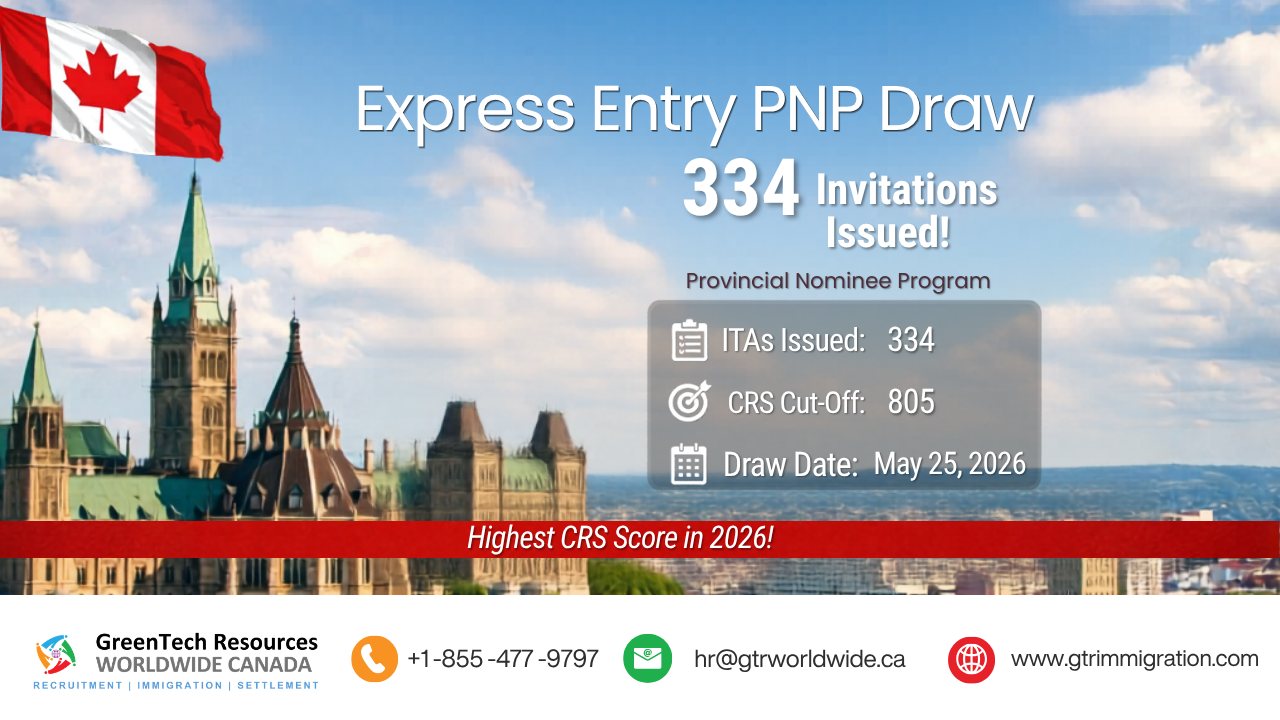
    • May 25 — Provincial Nominee Program: 334 ITAs, lowest CRS 805
    • May 27 — Canadian Experience Class: 3,000 ITAs, lowest CRS 518 (tie-break April 30, 2025)
    • May 28 — French-Language proficiency: 4,500 ITAs, lowest CRS 409

    Based on those invitations, the uncounted draws would minimally remove:

    • 4,500 profiles from the 401–410 range and above (French-language draw at CRS 409)
    • 3,000 profiles from the 501–600 range and above (CEC draw at CRS 518)
    • 334 profiles from the 601–1200 range (PNP draw at CRS 805)

    These removals confirm the accumulation pattern: even substantial draws (for example, a 3,000-ITA CEC draw) were not enough to push the CEC cut-off lower because of the accumulated volume within the 501–600 band.

    What this means in plain terms

    The Express Entry pool is more competitive in the upper-mid score ranges than the raw draw history alone would indicate. Candidates with CRS scores in the high 400s and especially within 501–600 are competing in a denser field. Because IRCC can target specific program draws that remove candidates from narrow score windows (for example, French-language proficiency draws around CRS 400, PNP draws at 800+), the pool reshuffles depending on which draw types IRCC runs and when.

    A notable dynamic in this reporting period:

    • While IRCC continued to run sizeable French-language proficiency and PNP rounds, the extended CEC pause allowed candidates who otherwise would have been invited by CEC to remain in the pool and accumulate in the 501–600 bracket.
    • When CEC invitations resumed on May 27 with a cut-off of 518, the existence of many profiles above that score meant IRCC needed a large draw to make a meaningful dent in the band — and even then, the tie-break date (April 30, 2025) limited how many profiles below 518 would be invited.

    Who is affected

    The pool composition and recent draws affect different groups in different ways. Based strictly on the source content:

    • Express Entry candidates with CRS scores of 501–600: most directly impacted. Their band has expanded rapidly; competition inside the band is higher because many more candidates now share similar or higher scores.
    • Candidates in the 461–500 upper-mid bands: also seeing growth and thus facing increased competition for draws that target these scores.
    • Candidates in lower bands (301–420): the pool contracted in parts of this range during the reporting period, partly because French-language proficiency draws removed candidates from around CRS 400–410.
    • PNP-ready candidates with very high scores (601–1200): the 601–1200 range is small (332 candidates, 0.14% of the pool as of May 24), and a PNP draw at CRS 805 on May 25 removed profiles at that very top end. Those with provincial nominations remain in a distinct position because PNP invitations operate differently from program-specific CEC or French-language draws.
    • Employers, international students, families, and visitors: while not directly measured by CRS bands, any applicant tracking their pathway to permanent residence should be aware that heightened competition can slow the pace at which typical CRS cut-offs fall even after large draws occur.

    Practical impact for readers

    If you are tracking your Express Entry chances, the data imply several practical realities you need to factor into plans and expectations:

    • High score accumulation can keep program-specific cut-offs elevated. The 501–600 band collected many profiles during the CEC pause; when CEC draws resumed, IRCC issued a large 3,000‑ITA round at a cut-off of 518. That suggests draw sizes need to be substantial to materially lower cut-offs when accumulation is this pronounced.
    • Tie-breaking dates matter. The May 27 CEC draw included a tie-break date of April 30, 2025. If many profiles share the same CRS score at the cut-off, tie-break dates determine who is invited. Pay attention to tie-break dates in draw results as they influence which profile submission dates will be considered.
    • Program-specific draws reshape the pool unevenly. French-language proficiency draws pulled candidates from the 401–420 ranges, while PNP draws remove very high-score profiles. Expect shifts based on which draw types IRCC runs and their timing.
    • Reporting snapshots lag live changes. The May 24 composition did not include three draws between May 25 and 28 that issued 7,834 ITAs. Always compare pool snapshots against the latest draw history to understand current competitiveness.

    What to watch next

    Based on the pattern registered in the source content, readers should monitor the following moving parts:

    • IRCC draw frequency and the mix of round types (CEC, French-language proficiency, PNP). Different draw types remove different score segments and can rapidly alter competitiveness in specific bands.
    • CSR accumulation in the 501–600 band. If accumulation continues faster than draws remove profiles, cut-offs are likely to stay elevated for program-specific rounds targeting that range.
    • Next tie-break dates and the date on which you submitted your Express Entry profile. Tie-break rules can be decisive when many candidates cluster at the same CRS score.
    • Published pool snapshots versus subsequent draws. Recent May 24 data omitted three later draws; keep both sources in view when estimating competition.

    What This Means for Applicants

    For applicants, the core message is that the field is getting thicker at the scores where invitations are often issued. Practical implications:

    • If your CRS falls into the 501–600 band, you are in a crowded segment. Competition inside this range is stronger than it was a month earlier. Higher draw sizes may be required to secure an ITA at the same cut-off.
    • If your CRS is in the high 400s or low 500s, remain realistic about short-term draw outcomes. Even when IRCC increases invitation counts, accumulated profiles in adjacent bands can blunt the effect on cut-off scores.
    • Lower-scoring candidates (around 350–420) may see fluctuating opportunities when IRCC runs French-language or targeted draws; those rounds can temporarily reduce competition in those bands but also move candidates through the system quickly.
    • Provincial nomination remains a pathway that operates at very high CRS thresholds in some rounds. A PNP invitation at CRS 805 on May 25 removed high-score candidates and altered the distribution at the very top end.
    • Keep your profile current and pay attention to the tie-break date. Administrative details like the date a profile was entered can determine whether an applicant at a given CRS is included in an ITA when scores are tight.

    Key Takeaways

    • The Express Entry pool grew by 4,395 profiles between April 26 and May 24; the 501–600 CRS band accounted for 4,085 of those profiles (93% of net growth).
    • The 501–600 range expanded by 29% during that period and now represents 7.51% of the pool; candidates in this band fall between the 92.35th and 99.86th percentiles of the pool.
    • IRCC’s 29-day pause in CEC draws contributed to the accumulation of high-scoring profiles in the 501–600 band; when CEC draws resumed on May 27, IRCC issued 3,000 ITAs at CRS 518 (tie-break April 30, 2025).
    • Between May 25 and 28, IRCC held three draws not reflected in the May 24 pool snapshot that together issued 7,834 ITAs: a PNP draw at CRS 805 (334 ITAs), a CEC draw at CRS 518 (3,000 ITAs), and a French-language proficiency draw at CRS 409 (4,500 ITAs). These draws would have removed a meaningful number of profiles across affected bands.
    • Despite 6,853 ITAs issued during April 26–May 24, inbound profile submissions outpaced removals by roughly 11,248 new entries, producing the net pool growth reported.

    For personalized support with your Canadian immigration pathway, contact GTR Immigration.
    Call us: +1 855 477 9797

    #ExpressEntry #IRCC #CRS #CanadianImmigration #CEC #PNP #PermanentResidence #ImmigrationNews

  • Canada Conducts New Express Entry PNP Draw

    Canada Conducts New Express Entry PNP Draw

    Canada has conducted a new Express Entry draw targeting Provincial Nominee Program (PNP) candidates, issuing 334 Invitations to Apply (ITAs) on May 25, 2026. The draw required a minimum Comprehensive Ranking System (CRS) score of 805 — the highest PNP cut-off recorded so far in 2026.

    Latest Express Entry Draw Results

    Draw TypeITAs IssuedCRS Cut-OffDraw Date
    Provincial Nominee Program (PNP)334805May 25, 2026

    This marks Canada’s second consecutive PNP-specific Express Entry draw in May 2026, further highlighting the increasing importance of provincial immigration pathways in the country’s long-term immigration strategy.

    Provincial Immigration Taking a Larger Role

    Canada continues to place greater emphasis on province-led immigration selection. Candidates who receive a provincial nomination are awarded an additional 600 CRS points, significantly improving their chances of securing permanent residence.

    The federal government has already confirmed expanded Provincial Nominee Program targets for 2026 and 2027, with provinces receiving larger nomination allocations to help address labour shortages in sectors such as:

    • Healthcare
    • Construction
    • Skilled trades
    • Regional and rural communities

    IRCC Backlog Drops to Lowest Levels in Years

    Immigration, Refugees and Citizenship Canada (IRCC) recently reported a major reduction in its immigration application backlog. As of March 31, 2026, the backlog had declined to approximately 935,000 applications — one of the lowest levels seen in recent years.

    The reduction is expected to improve processing efficiency across several economic immigration categories, including Express Entry and Provincial Nominee Programs.

    Prince Edward Island Holds New PNP Draw

    In a separate provincial update, Prince Edward Island conducted a new Labour and Express Entry draw this week, issuing 114 invitations to skilled workers and international graduates through the PEI Provincial Nominee Program.

    Key Immigration Trends in Canada for 2026

    Canada’s immigration system continues evolving toward a more targeted and labour market-focused model. Current priorities include:

    • Provincial Nominee Programs (PNPs)
    • Healthcare workers
    • Skilled trades professionals
    • Regional immigration pathways
    • Employer-driven immigration
    • Faster PR pathways for workers already in Canada

    Recent Express Entry draws also demonstrate continued reliance on category-based selection and occupation-focused invitations aligned with economic needs.

    Conclusion

    The latest Express Entry and provincial immigration updates confirm Canada’s ongoing transition toward a more targeted and province-driven immigration system in 2026. With rising CRS cut-offs, expanded provincial allocations, and more PNP-focused draws, candidates with provincial nominations remain among the strongest contenders for Canadian permanent residence.

    As provinces continue taking a larger role in immigration selection, skilled workers in healthcare, construction, trades, education, and other high-demand sectors are expected to benefit the most from Canada’s evolving immigration policies.