Category: Canada

  • Ontario Introduces New PR Pathways for Skilled Workers and Francophones

    Ontario Introduces New PR Pathways for Skilled Workers and Francophones

    Ontario is entering one of its most significant immigration reform periods in the last decade. With ongoing labour shortages, an aging workforce, and rising demand in high-growth sectors, the province is preparing to launch new permanent residence (PR) pathways under the Ontario Immigrant Nominee Program (OINP). These changes include:

    • A new Talent Stream targeting high-skill professionals
    • Expansion of regional and rural immigration pilots
    • A new Francophone PR pathway
    • Stronger OINP rules and integrity measures
    • Suspension and redesign of certain older streams

    Why Ontario Is Launching New PR Pathways in 2025

    Ontario remains Canada’s top destination for newcomers, receiving:

    • Over 40% of total immigrants annually
    • The majority of international students
    • The highest number of temporary foreign workers

    However, Ontario faces serious challenges:

    • Acute labour shortages in health care, trades, technology & manufacturing
    • High urban concentration (GTA attracts over 75% of newcomers)
    • Declining French-speaking population outside Quebec
    • Growing regional disparities
    • Pressure on housing & public services

    As a result, the government is restructuring OINP to:

    ✔ Attract talent Ontario needs

    ✔ Distribute newcomers more evenly across the province

    ✔ Strengthen the workforce in critical sectors

    ✔ Support bilingual and francophone communities

    ✔ Make immigration more flexible and responsive

    This explains the introduction of multiple new PR pathways.

    New “Talent Stream” Under OINP: What We Know So Far

    Enabled by Bill 30, Ontario has gained new authority to create PR pathways through regulation—allowing rapid response to labour shortages.

    What is the Talent Stream?

    A new OINP category focusing on specialized, high-value professions, including:

    • Research & development professionals
    • Culinary arts experts & executive chefs
    • Creative arts & cultural professionals
    • Entrepreneurs & innovation specialists
    • Technical specialists in emerging industries

    Likely Selection Factors:

    While criteria are not officially published, based on OINP trends, selection may include:

    • Education in a high-skill field
    • Specialized certifications
    • Portfolio or experience evidence (for creative/culinary applicants)
    • Job offer from an Ontario employer
    • Language proficiency (likely CLB 6–9 depending on stream)

    Why this matters:

    Ontario is moving away from broad immigration categories toward occupation-specific targeted immigration, similar to federal Express Entry category-based draws.

    REDI Pilot: A Major Regional Immigration Pathway

    Launched January 2025, the Regional Economic Development through Immigration (REDI) Pilot is Ontario’s answer to ongoing workforce shortages in rural and northern communities.

    3.1. Goals of the REDI Pilot

    • Increase population in small & rural communities
    • Support regional industries with chronic labour shortages
    • Reduce dependence on Toronto & Ottawa labour markets
    • Attract skilled workers who are willing to settle long-term

    3.2. Eligible Sectors (Expected Priority Areas)

    • Health care (nurses, PSWs, lab technicians)
    • Industrial trades (welders, mechanics, electricians)
    • Manufacturing workers
    • Hospitality & food services
    • Logistics & transportation

    3.3. REDI Eligibility Overview

    RequirementDescription
    Job OfferMust be from an employer in a participating community
    NOC OccupationSkilled or semi-skilled depending on sector
    Work ExperienceLikely 6 months – 2 years
    LanguageCLB 4–6 depending on job
    Settlement PlanMust intend to live in the community

    REDI is expected to function similarly to RNIP but with Ontario-specific economic goals.

    New Francophone PR Pathway: Supporting French-Speaking Immigration

    Canada’s federal goal is 4.4% francophone immigration outside Quebec, but Ontario has consistently fallen below this target.

    The new Francophone Community Immigration Pilot (FCIP) aims to change that.

    Target Region:

    Superior East (Northern Ontario)

    Who Is Eligible:

    • French-speaking candidates
    • Valid job offer in designated communities
    • Priority sectors: healthcare, service, trades, logistics
    • Must demonstrate ability to integrate into francophone communities

    Benefits:

    • More PR opportunities for French-speaking applicants
    • Boosts bilingual workforce
    • Employers receive support for recruitment
    • Increased settlement services available

    Updated OINP Regulations: Stronger Integrity Measures

    Ontario has implemented new rules allowing the OINP to suspend or return applications under more conditions.

    5.1. Why the Rules Changed

    • Increase in fraudulent job offers seen nationally
    • Need to ensure employer compliance
    • Sudden labour market shifts require flexibility (e.g., layoffs)

    5.2. New Reasons OINP Can Suspend or Return Applications

    • Employer fails to meet business requirements
    • Job offer no longer valid
    • Change in applicant’s eligibility
    • Evidence of misrepresentation
    • Stream suspension or redesign

    This is why Ontario paused the Express Entry Skilled Trades Stream to update requirements.

    Ontario’s New PR Pathways & Updates (2025)

    Program / PathwayTarget GroupKey FeaturesStatus
    Talent Stream (New)Innovators, chefs, creative professionals, researchersTargeted high-skill PR pathwayLaunching soon
    REDI PilotSkilled workers with rural job offersPR for designated Ontario communitiesActive
    Francophone Pilot (FCIP)French-speaking workersSupports Franco-Ontarian regional growthActive
    Updated OINP RegulationsAll applicantsStronger integrity rulesIn effect
    Suspended Skilled Trades StreamExpress Entry trades candidatesBeing redesigned to match labour needsUnder review

    What These Changes Mean for Immigration Candidates

    More opportunities for specialized workers

    Talent-based selection gives an advantage to those with strong professional backgrounds.

    Greater access for rural & northern workers

    Candidates willing to move outside Toronto now have significantly better chances.

    French-speaking candidates benefit

    Ontario’s new pilot may make French-speaking applicants among the most competitive.

    Employers gain new hiring channels

    Ontario businesses can attract international specialists who may not qualify under standard streams.

    Applicants must prepare for stricter verification

    Accurate documentation and employer credibility will be critical.

    Who Should Apply Under Ontario’s New Pathways?

    Ideal candidates include:

    • Researchers with Canadian or international experience
    • Chefs, culinary managers & hospitality experts
    • Artists, musicians, digital creators, performers
    • Tradespeople open to relocating to rural communities
    • Healthcare assistants, nurses & technicians
    • French-speaking professionals
    • International graduates working in Ontario

    These changes reflect Ontario’s shift toward skills-based immigration, not just general economic immigration.

    Expert Tips for Applicants

    To increase your chances:

    • Secure a valid Ontario job offer (strongest advantage)
    • Target designated communities participating in REDI
    • Build a strong portfolio (creative, research, culinary fields)
    • Improve French-language proficiency if eligible
    • Maintain accurate records to avoid integrity flags
    • Follow OINP news as new criteria will be released throughout 2025
  • Canada Announces New Immigration Levels Plan 2026–2028

    Canada Announces New Immigration Levels Plan 2026–2028

    Canada’s federal government has officially revealed the 2026–2028 Immigration Levels Plan, confirming a consistent intake of 380,000 new permanent residents (PRs) annually for the next three years.
    This plan highlights a shift toward stability and sustainability, while at the same time opening new pathways for temporary residents — including foreign workers, international graduates, and protected persons — to transition to permanent residency (PR) in Canada.

    According to Immigration, Refugees and Citizenship Canada (IRCC), the plan is designed to balance economic growth with population management and address national challenges such as housing shortages, infrastructure pressure, and service demand.

    A Balanced Immigration Approach for Long-Term Growth

    The 2026–2028 plan focuses on selecting immigrants already living and working in Canada, ensuring a smoother integration into the economy and communities.
    Canada aims to maintain strong immigration outcomes while reducing temporary resident (TR) admissions — a major policy shift from the previous years.

    Canada’s Immigration Targets 2025–2028

    YearPermanent Residents (PR)Temporary Residents (TR)Key Highlights
    2025485,000673,650Record TR admissions
    2026380,000385,000Launch of new PR pathways
    2027380,000370,000TR-to-PR transition phase
    2028380,000370,000Immigration levels stabilize

    This adjustment aims to bring the temporary resident population down to below 5% of Canada’s total population by the end of 2027.

    New Measures: Pathways from Temporary to Permanent Residence

    One of the key features of the new plan is the launch of special PR transition programs for temporary residents. The government will introduce a one-time or limited-duration initiative to grant permanent residency to up to 33,000 work permit holders between 2026 and 2027.

    Additionally, IRCC announced a two-year measure to recognize and grant PR to eligible Protected Persons currently residing in Canada.

    These changes reflect the government’s focus on an “in-Canada selection model, where preference is given to candidates who already contribute to the economy, speak English or French, and have local experience.

    Overview of New PR Transition Programs (2026–2028)

    CategoryDurationExpected BeneficiariesDescription
    Work Permit Holders2026–2027Up to 33,000Temporary foreign workers with Canadian experience may qualify for PR through a one-time pathway
    Protected Persons2026–2028ThousandsHumanitarian initiative granting PR to eligible residents already in Canada
    International GraduatesOngoingContinuousExpanded PR options through Express Entry and PNP systems

    Economic Immigration Remains Canada’s Priority

    Under the 2026–2028 Immigration Levels Plan, economic immigration will account for up to 64% of total admissions — an increase from the previous 59%.
    Programs like Express Entry and Provincial Nominee Programs (PNPs) will continue to be the main channels for skilled workers to settle in Canada permanently.

    Provinces and territories will also gain greater flexibility to align their immigration nominations with regional labour market needs, especially in healthcare, construction, and technology sectors.

    What to Expect in 2026 and Beyond

    • Mid-2026: Expected launch of TR-to-PR transition stream.
    • Ongoing: Focus on permanent over temporary pathways.
    • 2027–2028: Gradual stabilization of immigration growth.
    • After 2028: More emphasis on integration, housing, and community development.

    Conclusion

    The 2026–2028 Immigration Levels Plan reflects Canada’s continued commitment to inclusive, sustainable immigration.
    By maintaining steady PR targets while introducing new Temporary to Permanent Residence (TR to PR) pathways, the government is ensuring that people already contributing to the country’s success can make Canada their permanent home.

    For foreign workers, graduates, and temporary residents, 2026 marks the beginning of a new era of opportunity.

  • Canada PR Invitations October 2025: Over 21,000 Candidates Invited to Apply

    Canada PR Invitations October 2025: Over 21,000 Candidates Invited to Apply

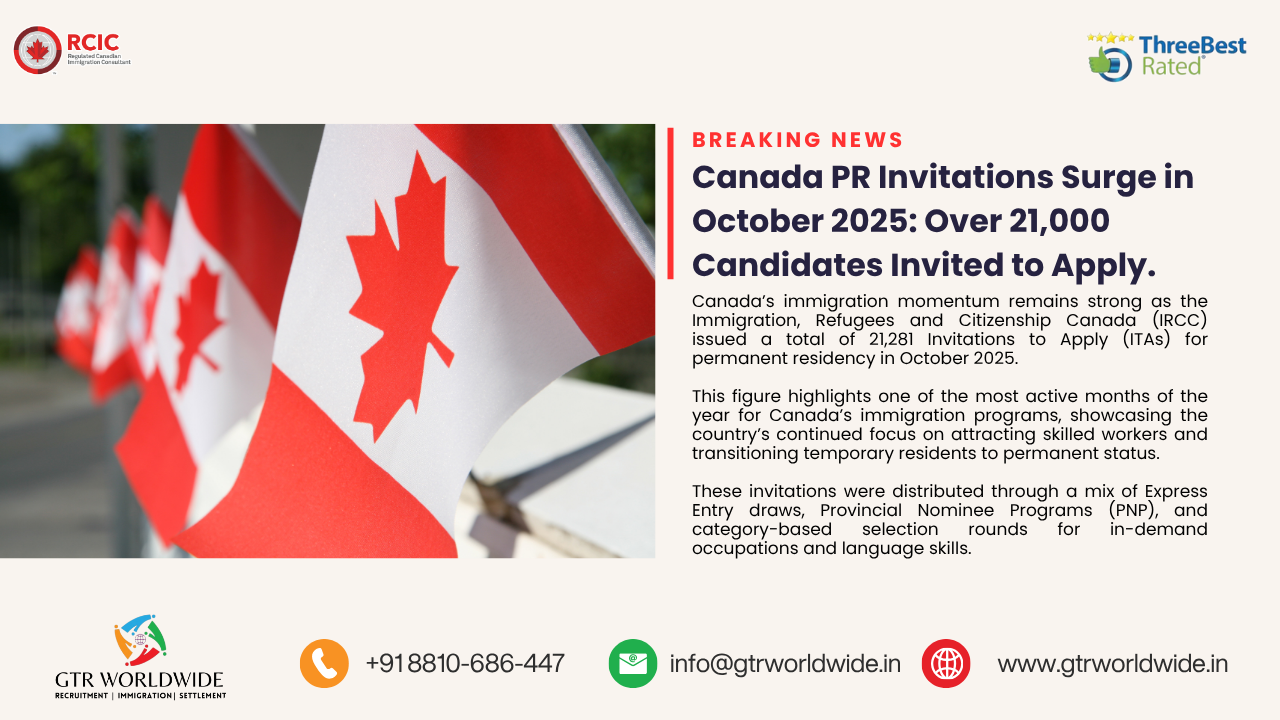
    Canada’s immigration momentum remains strong as the Immigration, Refugees and Citizenship Canada (IRCC) issued a total of 21,281 Invitations to Apply (ITAs) for permanent residency in October 2025.
    This figure highlights one of the most active months of the year for Canada’s immigration programs, showcasing the country’s continued focus on attracting skilled workers and transitioning temporary residents to permanent status.

    These invitations were distributed through a mix of Express Entry draws, Provincial Nominee Programs (PNP), and category-based selection rounds for in-demand occupations and language skills.

    Breakdown of Permanent Residency Invitations – October 2025

    DateDraw TypeNumber of InvitationsCRS Cut-offRemarks / Category
    Oct 29, 2025French Language Proficiency6,000416Category-based draw for French speakers
    Oct 28, 2025Canadian Experience Class (CEC)1,000533Targeted toward temporary residents in Canada
    Oct 27, 2025Provincial Nominee Program (PNP)302761For candidates nominated by provinces
    Oct 15, 2025Healthcare & Social Services2,500472Category-based draw for healthcare occupations
    Oct 14, 2025Provincial Nominee Program (PNP)345778PNP stream supporting regional labor needs
    Oct 8, 2025Trade Occupations650441Skilled trade professionals
    Oct 3, 2025General Express Entry10,484495Open draw for all categories

    Total Invitations (October 2025): 21,281

    This data shows that October was not only diverse in draw types but also balanced between targeted and general rounds — an indication of Canada’s ongoing efforts to fill both national and provincial labor shortages.

    Express Entry Draw Highlights – October 2025

    Stream / CategoryKey FocusApproximate Share of Total ITAsTrend
    French Language ProficiencyBoosting bilingual workforce~28%Increasing focus
    Healthcare & Social ServicesAddressing health sector shortages~12%Consistent priority
    Canadian Experience Class (CEC)Transitioning temporary workers~5%Stable
    Skilled Trades & PNPsFilling regional gaps~15%Steady demand
    General DrawsOpen to all eligible candidates~40%Strong ongoing intake

    This diversified strategy allows IRCC to balance targeted economic immigration with general skilled migration, ensuring Canada remains responsive to both immediate and long-term labor demands.

    IRCC’s 2025–2027 Immigration Plan

    Under the 2025–2027 Immigration Levels Plan, Canada aims to welcome approximately 395,000 new permanent residents in 2025.
    More than 40% of these admissions are expected to come from temporary residents already in Canada, such as foreign workers and international students.

    The IRCC also announced plans to modernize the Express Entry system with smarter, data-driven selection methods and to enhance collaboration with provinces and territories for regional PNP quotas.

    What To Expect in Late 2025 and 2026

    PeriodExpected Focus AreasPotential Policy Direction
    Late 2025Continuation of category-based draws (French, healthcare, tech)Sustained high ITA volumes
    Early 2026More pathways for in-Canada temporary workersSimplified transition from study/work to PR
    Mid–Late 2026Increased PNP allocations to smaller provincesStronger regionalization of immigration
    2026 overallPotential adjustment of CRS thresholdsBroader inclusion of skilled trades and STEM roles

    Experts predict that Canada will maintain — or even increase — monthly ITA volumes through 2026 as the country continues addressing labor shortages and population growth goals.

    Key Takeaways for Applicants

    • Keep your Express Entry profile active and up to date.
    • Improve your language scores — French proficiency is becoming a major advantage.
    • Explore Provincial Nominee Programs (PNPs) that align with your profession.
    • If you’re already in Canada, ensure you qualify under CEC or in-Canada transition programs.

    While receiving an ITA is a strong step forward, remember it is not automatic approval — successful applicants must still meet all medical, security, and documentation requirements.

    Conclusion

    With over 21,000 invitations issued in October 2025, Canada’s immigration landscape continues to show strength and stability.
    For international applicants and temporary residents alike, now is an excellent time to position yourself for permanent residency in Canada as the country heads toward another high-intake year in 2026.

  • IEC 2025 Full Guide – Eligibility, Countries, and Application Process

    IEC 2025 Full Guide – Eligibility, Countries, and Application Process

    Canada has long been one of the world’s most desirable destinations for young travelers and professionals seeking international experience. Through the International Experience Canada (IEC) program, young citizens from partner countries can live, work, and travel in Canada temporarily — gaining valuable professional and cultural experience.

    Managed by Immigration, Refugees and Citizenship Canada (IRCC), the IEC 2025 season welcomes thousands of youth to Canada every year under three categories: Working Holiday, Young Professionals, and International Co-op (Internship).

    1. What Is the International Experience Canada Program?

    The International Experience Canada (IEC) initiative is a youth mobility agreement between Canada and 36 countries and territories.
    It aims to help young people:

    • Gain international work experience in Canada
    • Explore Canadian culture and improve English or French language skills
    • Build connections that can support future immigration goals

    IEC participants receive temporary work permits, typically valid for 12 to 24 months, depending on their country’s agreement.

    2. Who Can Apply for IEC 2025?

    To apply for IEC 2025, you must meet the following eligibility criteria:

    Basic Requirements

    • Be a citizen of one of the countries that have a Youth Mobility Agreement with Canada.
    • Be between 18 and 35 years old (some countries limit eligibility to 30).
    • Hold a valid passport for the entire duration of your stay.
    • Have health insurance that covers your stay in Canada.
    • Show proof of sufficient funds (minimum CAD $2,500).
    • Be admissible to Canada (no criminal or medical ineligibility).
    • Have a return ticket or enough funds to buy one.
    • Not be accompanied by dependents (IEC does not include family sponsorship).

    Who Cannot Apply

    • Refugee travel document holders, even if issued by an IEC partner country.
    • Citizens of countries without a Youth Mobility Agreement (unless applying through a Recognized Organization).

    3. Full List of Eligible Countries (as of 2025)

    According to IRCC, citizens of the following 36 countries and territories can apply under at least one IEC category:

    Andorra, Australia, Austria, Belgium, Chile, Costa Rica, Croatia, Czech Republic, Denmark, Estonia, Finland, France, Germany, Greece, Hong Kong, Iceland, Ireland, Italy, Japan, Latvia, Lithuania, Luxembourg, Netherlands, New Zealand, Norway, Poland, Portugal, San Marino, Slovakia, Slovenia, South Korea, Spain, Sweden, Switzerland, Taiwan, and the United Kingdom.

    Each bilateral agreement specifies:

    • Eligible age range
    • Duration of stay (typically 12–24 months)
    • Number of participations allowed (one or two)
    • Available categories (Working Holiday, Young Professionals, or Co-op)

    4. IEC Categories Explained

    1️⃣ Working Holiday

    • Best for travelers who don’t have a job offer.
    • Receive an open work permit, allowing them to work for any employer across Canada.
    • Perfect for exploring Canada while working short-term or seasonal jobs.

    2️⃣ Young Professionals

    • For those with a valid job offer in Canada related to their career path.
    • Provides an employer-specific work permit.
    • Helps participants gain career-building experience in their professional field.

    3️⃣ International Co-op (Internship)

    • Designed for students who need a work placement or internship as part of their academic program.
    • Work permit is tied to a single employer.
    • Ideal for university or college students looking for global industry experience.

    5. How to Apply for IEC 2025

    Step 1: Check Eligibility

    Use the IRCC eligibility tool to confirm if your country participates and which category applies.

    https://www.canada.ca/en/immigration-refugees-citizenship/services/work-canada/iec.html

    Step 2: Create an IEC Profile

    Create an account on IRCC’s website and submit your IEC profile to the appropriate “pool.”

    Step 3: Wait for an Invitation to Apply (ITA)

    IRCC conducts regular rounds of invitations. If selected, you’ll receive an Invitation to Apply (ITA) through your IRCC account.

    Step 4: Submit Application for Work Permit

    Once invited, you have 10 days to accept the invitation and 20 days to submit your completed application with:

    • Biometric data
    • Passport copy
    • Police certificates
    • Proof of funds and insurance

    Step 5: Receive Work Permit

    If approved, you’ll receive a Port of Entry Letter of Introduction, which you present when you arrive in Canada to obtain your work permit.

    6. Why Apply for IEC?

    Participating in IEC offers numerous benefits:

    • Gain international work experience to enhance your resume.
    • Improve language and intercultural skills.
    • Experience Canadian lifestyle and diversity.
    • Build networks that may help with future immigration pathways such as Express Entry or Provincial Nominee Programs.

    7. Conclusion

    The International Experience Canada (IEC) 2025 program remains a remarkable opportunity for young people worldwide to work, travel, and grow in one of the world’s most dynamic countries.

    If you’re from a participating country, this is your chance to embark on a unique adventure that combines career growth, cultural exploration, and global networking — all while experiencing life in Canada.

  • Henley Passport Index 2025: Canada Stays in Top 10, U.S. Falls to 12th Place

    Henley Passport Index 2025: Canada Stays in Top 10, U.S. Falls to 12th Place

    According to the Henley Passport Index (October 2025), Canada continues to hold one of the world’s most powerful passports, granting its citizens visa-free or visa-on-arrival access to 183 destinations.
    This puts Canada in 9th place globally, ahead of the United States, which fell out of the top 10 for the first time in two decades.

    Although Canada slipped slightly from 7th earlier this year, experts note that this still reflects strong international partnerships and widespread visa agreements that support Canada’s global mobility.

    The Henley Index—based on data from the International Air Transport Association (IATA)—ranks 199 passports by the number of countries their holders can visit without a prior visa.

    U.S. Passport Drops to Its Lowest Ranking in 20 Years

    The United States now ranks 12th with visa-free access to 180 destinations, sharing its position with Malaysia.
    This marks the lowest point for the U.S. in the 20-year history of the Henley Passport Index.

    The decline has been linked to:

    • Countries such as Brazil reinstating visa requirements for U.S. travelers.
    • The U.S. offering visa-free access to only 46 nations, affecting its “openness” score.
    • Rising passport strength in European and Asian countries, reflecting evolving global diplomacy.

    Analysts say the U.S. drop highlights a broader shift in soft power and international influence, as global travel freedom becomes more evenly distributed.

    Top 10 Most Powerful Passports in the World (October 2025)

    RankCountryVisa-Free / Visa-on-Arrival Destinations
    1Singapore193
    2South Korea190
    3Japan189
    4Germany, Italy, Luxembourg, Spain, Switzerland188
    5Austria, Belgium, Denmark, Finland, France, Ireland, Netherlands187
    6Greece, Hungary, New Zealand, Norway, Portugal, Sweden186
    7Australia, Czech Republic, Malta, Poland185
    8Croatia, Estonia, Slovakia, Slovenia, United Arab Emirates, United Kingdom184
    9Canada183
    10Latvia, Liechtenstein182

    Why These Rankings Matter

    For Canadians, the strong ranking confirms that Canadian citizenship remains one of the most globally mobile.
    For Americans, it’s a reminder that maintaining reciprocal visa agreements and international diplomacy plays a crucial role in global movement.

    Post-pandemic policy shifts and strengthening alliances among European and Asian countries have created a more competitive passport landscape—where smaller, highly connected nations now lead.

    Conclusion

    While Canada maintains its reputation as a global mobility leader, the U.S. experiences its sharpest drop in two decades.
    These results from the Henley Passport Index 2025 underscore how international cooperation, diplomacy, and visa reciprocity directly shape global travel freedom.

  • IRCC Updates – Canada plan to reduce Temporarily Residents

    IRCC updates – Canada plan to reduce temporarily residents

    The update on temporary resident levels in Canada has been provided by Marc Miller, the Minister of Immigration, Refugees, and Citizenship Canada (IRCC). He has directed the immigration department to review IRCC programs facilitating temporary foreign workers, aligning them with the country’s labor market needs. For the first time, Canada will establish annual targets for temporary residents, starting in the fall of 2023, mirroring the existing practice for permanent residents.

    Minister Miller will convene a meeting with provincial counterparts to establish these annual targets for the influx of temporary residents into Canada. IRCC aims to decrease the temporary resident population to 5% over the next three years. This target will be finalized in the fall, following consultations with provincial and territorial counterparts, as part of the annual level planning process.

    It’s encouraging news that there will be more domestic immigration draws, and the Minister encourages provincial counterparts to adopt similar measures to facilitate the transition of temporary residents into permanent residents.

    Act now. If you have plans to visit or are looking for job opportunities to work and live in Canada, contact Green Tech Resource for advice. We will support you throughout your immigration journey and provide detailed information on immigration opportunities and requirements.


    Book a consultation

  • Canada Extends Ban On Foreign Ownership of Housing Until 2027

    Canada Extends Ban On Foreign Ownership of Housing Until 2027

    The Canadian government, represented by Deputy Prime Minister and Finance Minister Chrystia Freeland, has announced its intention to extend the ban on foreign ownership of Canadian housing for an additional two years. This decision comes in response to concerns over foreign investment driving up housing prices and exacerbating affordability issues, particularly in major urban areas. The ban, which is currently set to expire on January 1, 2025, will now be extended until January 1, 2027. Foreign commercial enterprises and individuals who are not Canadian citizens or permanent residents will remain prohibited from purchasing residential property in Canada.

    This extension is part of the government’s broader efforts to improve housing affordability for Canadians. The government has significantly increased its investment in housing since 2015, with the current annual federal housing investment more than double what it was in 2013-14. Various measures have been implemented to address housing affordability, including the passage of the Prohibition on the Purchase of Residential Property by Non-Canadians Act in 2022. Additionally, the government’s economic plan includes initiatives such as the Affordable Housing and Groceries Act, the Apartment Construction Loan Program, the Affordable Housing Fund, the Housing Accelerator Fund, the Rapid Housing Initiative, the Federal Lands Initiative, and others aimed at increasing housing supply and supporting Canadians in achieving homeownership.

  • Settlement in Saskatchewan – Things to Do As a Newcomer

    Settlement in Saskatchewan – Things to Do As a Newcomer

    Settlement in Saskatchewan – Things to Do As a Newcomer

    Coming to a new country, learning the culture and settling into a new community can be daunting and slightly nerve-wracking. Those coming to settle in Saskatchewan as newcomers are often put to task if coming during winters and may initially seem lost. It’s best to know what to expect when you land because that will help create a smoother experience to settle in Saskatchewan.

    Here is a guide we put together to help you transition into your new community in Saskatchewan. When you land in Canada, one of the first few people you will meet after your arrival in Canada will be a Canadian customs agent. You should be ready with all your landing certificates, passports, and visas. You’ll also meet other officials from immigration Services who may ask you to validate your arrival and show your passport and visa papers.


    As you start your journey there are a few very important documents and papers that you will need handy for all your ongoing applications for banking, etc.

    Permanent Resident (PR) Card & Landing paper
    Social Insurance Number (SIN) card
    Health care card
    Driver’s license and or Government-issued photo ID

    It’s very important that you start the process to obtain these documents as soon as you land as it may take several weeks/months to receive the cards after you apply.

    Before you leave the airport, you should check out the newcomer welcome center. Toronto and Vancouver being the main airports, you’ll find their welcome kiosks at airports. At Toronto Pearson International Airport, look for the Immigrant Reception and Information Services (IRIS) kiosks. At Vancouver International Airport, go to Community Airport Newcomers Network (CANN) kiosk. These kiosks will have all the resources to help you in your first days in Canada. They will further share information on your onwards journey to Saskatchewan.

    Accommodation

    It’s always best to find temporary accommodation for your first few nights after landing and then start looking for a long-term rental in the city and the area you like as per your research. It’s good to do some research on where you want to live for the long term before committing to a lease. There are some big property companies like Mainstreet, Broadway, Remai, Elite Property Management, etc. and you should check the vacancy as soon as you start your home search.

    Navigation and Direction

    These days, almost every one of us carries our data-enabled smartphone. However, during your early days, you may not have access to mobile data plans and will need a good old paper map. Most of the local grocery and convenience stores will have an elaborate map of your city. You can also get the maps from the local library. It’s good to have a detailed street map pointing all local amenities, a telephone book, and the Yellow Pages. During your initial days, theses resources will be very important and helpful to do the research about the place and settling in.

    Settlement Services

    There are many settlement service agencies available in the cities and you must take some time to visit a local immigrant settlement agency. These agencies are usually non-profit organizations and receive government funding to offer newcomers services, such as free language training, settlement counseling, employment workshops, etc. They help newcomers to settle into the Canadian society and provide numerous free services including printing to help you adjust to life in Canada.

    PR Card for settlement in Saskatchewan

    Permanent resident identification or PR card, in short, is an identification and travel document. Wallet-sized, this card replaces your paper IMM 1000 Record of Landing document. It’s proof of your permanent resident status and you will need this card whenever you re-enter Canada and for other identification purposes.

    SIN Card for settlement in Saskatchewan

    It’s a 9-digit private and secure number that you’ll need to work in Canada. You should apply for your Social Insurance Number (SIN) card as soon as you land. If you don’t have a SIN card you cannot work or apply for any government assistance or credit. Applications for a SIN card can be made through the local Services Canada office.

    Health Card

    One of the other important things is health card which you should apply as soon as you start living in Saskatchewan. Application forms for these cards are available online on the e-health Saskatchewan website, doctor’s offices, hospitals, and most pharmacies, or by calling the provincial medical services authorities. It’s best to apply right after landing since there is an approx. three-month waiting period for coverage and you should not delay your application. It’s also good to have temporary private health coverage to cover your family during the waiting period.

    Bank account for settlement in Saskatchewan

    Check out local banks and their offers for new Canadians. Once you’ve researched and identified the best offer, set up a bank account and get a credit card. In Canada, you will need to start building your credit score for future financial needs such as mortgages or loans. It’s important to start a relationship with a bank so you can manage your money, pay your bills and begin building a credit history. Open an account at a bank or credit union near your home that is accessible and provides the best service to you.

    Cell Phone for settlement in Saskatchewan

    Communication is an important part of our living and you will need a cell phone plan to talk to your family and friends back home. Sign up for a Canadian cell phone, even just a pay-as-a-you-go plan so you will be accessible for potential employers and landlords. As with any other bills, paying your phone bills (if you have monthly contracts) is another way of building your credit score.

    Driver License for settlement in Saskatchewan

    An international license is only valid for a few months (the rules differ by province) so it’s better to get a Canadian driver’s license. If you are in cities with limited public transit facilities, you will need to have access to a car to drive from your place of work or to run any chores. Learn about the driving rules, practice your driving and take the exam as soon as you can.

    School 

    One of the main reasons you and most immigrants come to Canada is a better future and it all starts with a good education. The Canadian education system guarantees an education to everyone, every child between the ages of five and 16 is required to attend school. Ask schools in your area or contact the local school board for guidance to register and enroll your kids at school.

    For more information and how Greentech Resources can help you with jobs and recruitment, get in touch with our expert immigration consultant at our service locations in Saskatoon, Regina, Prince Albert, North Battleford and Moose Jaw.

  • 10 Tips to Prepare Your Move to Canada

    Canada tip: 10 Tips to Prepare Your Move to Canada


    When you move to Canada, there are a number of things you’ll need to do in order to make sure your new home is set up for success. Whether you’re moving here from another country or relocating within Canada, there’s a lot to take care of when you arrive. The good news is that getting everything done won’t take too long, and you’ll soon be officially settled in.

    Here are some things to do while preparing for your transition to Canada.

    Use this list as a checklist to make sure everything gets done on time, or if there’s something that has to get done right away, don’t put it off!
    #1

    Know what you’re bringing with you

    Before you go, note what appliances and other household items you’ll need to buy once you’re here.

    You may want to buy some things before your move, or, take them with you when you travel.

    For example, if you don’t have access at home to a clothes washer/dryer, consider packing a few loads of laundry to take with you on the plane.

    It’s also important to know what documents you’ll need for crossing the border.

    This includes your passport, proof of Canadian residency (e.g. utility bills, bank statements), and if you’re moving with children, their birth certificates, and other important paperwork.
    #2

    Gather the necessary paperwork for crossing the border

    If you’re coming into Canada from a foreign country, you’ll need a valid passport to cross the border.

    In some cases, you may also need a visa or other special documents.

    You may be able to get these from your local Canadian consulate or embassy in your home country.

    You’ll also need proof of Canadian residency, which you can show with bank statements, utility bills, or other documents.
    #3

    Find out about Canadian health insurance and other benefits

    Find out if your health insurance plan is valid in Canada, and what’s covered by it when you’re living abroad.

    Learn about the other benefits you may be entitled to as a newcomer to Canada, such as the Child Tax Benefit and the GST/HST Credit.

    You can find more information on government websites, or by contacting Service Canada.
    #4

    Learn about immigration requirements, including visas and work permits

    There are a number of different visas and work permits that may be applicable to your situation.

    Make sure you know which one is right for you, and start the application process well in advance of your move.

    You can find more information on the Citizenship and Immigration Canada website, or by consulting with a qualified immigration lawyer.
    #5

    Get your children enrolled in school as soon as possible

    If you have school-aged children, it’s important to find out about the school system in your new city.

    Find out when children can start attending school, and what paperwork you need to send to the local school board or district office. You may also have to provide proof of immunization or other records before your child can attend school here in Canada.
    #6

    Tips on settling into life as a Canadian citizen or permanent resident of this country

    As a newcomer to Canada, learn about taxes, driving licenses, bank accounts, and setting up utilities at home, which you’ll want to do as soon as possible after arriving in your new locale.

    Take advantage of community programs designed for newcomers such as Welcome Wagon and newcomer information centers, where experts will be able to help answer any questions you may have, or point you in the right direction.
    #7

    Things to do when you first arrive in Canada

    The first few days are crucial for settling into your new home so take this time to get organized.

    Visit the local library or bookstore to find out about local newspapers and magazines, check out a map of your city so you know where everything is located, shop around for health insurance.

    Go online to check if there are any clubs or organizations that might interest you, especially if they’re related to work or hobbies that you enjoy.

    Also, make sure to visit the government websites for your new province or territory, and Canada.ca, so you can find out more about living in this country.
    #8

    Settling down after arriving in your new city

    The first month is crucial for settling into life as a newcomer to Canada.

    Spend time getting to know your neighbors, signing up for local newsletters at work or school, and getting involved with clubs that interest you.

    Take advantage of newcomer services such as Welcome Wagon where possible. These programs are designed to help new arrivals adjust to life in their new homes faster than they would otherwise be able to do on their own. You can also take advantage of other free or low-cost services available in your area, such as language classes or help to find a job.
    #9

    Making friends while living abroad

    One of the biggest challenges for newcomers to Canada is making friends.

    There are a few things you can do to make the process a little easier.

    Start by attending social events at work, school, or in your local community.

    Look for activities that interest you and try out new things – you might be surprised at how many people share your hobbies and interests.

    Be open to meeting new people and don’t be afraid to ask for help when you need it. Most people are more than happy to lend a helping hand to someone who’s just starting out in their new home.
    #10

    How does culture shock affect newcomers to Canada

    Culture shock is a major adjustment that can affect immigrants and refugees, no matter how well they know the language or the culture.

    The first few days of settling into life as a newcomer to Canada can be an overwhelming experience, and it’s important not to feel pressure to adjust too quickly.

    Give yourself time every day – even just 10 minutes of quiet time alone – so you can readjust at your own pace.

    If you’re feeling overwhelmed by the differences in language, culture, or place of living here in Canada, don’t hesitate to ask for more information from friends or family members who have come before you; they’ll be able to help you feel more comfortable sooner than if you try and go it alone.

    The process of immigration can be challenging, but with the right preparation, you can make the move to Canada a smooth one. By gathering the necessary paperwork, learning about Canadian health insurance and other benefits, and getting your children enrolled in school, you’ll be well on your way to starting a new life in this country. With a little effort, you’ll be feeling at home in no time.

  • Canada – best country in the world 2021

    Canada best country in the world 2021

    The overall ranking of Best Countries measure global performance on a variety of metrics. Canada is the best country in the world for 2021.

    Overview of Canada

    Capital: Ottawa
    Region: North America
    GDP Per Capita, PPP: $50,661
    GDP: $1.74 trillion
    Population: 37,593,384
    Area: 9,984,670 SQ.KM

    anada takes up about two-fifths of the North American continent, making it the second-largest country in the world after Russia. The country is sparsely populated, with most of its residents living within 125 miles of its border with the United States. Canada’s expansive wilderness to the north plays a large role in Canadian identity, as does the country’s reputation of welcoming immigrants.

    Although the Norse briefly settled in Canada during the 10th century, European exploration accelerated in the 1500s. France and Britain angled for control over the region, with the British cementing their dominance in the year 1763. The country was a collection of British colonies until it became a self-governing dominion in 1867.

    Canadians pride themselves in encouraging all of their citizens to honor their own cultures. In 1971, Canada adopted a national policy of multiculturalism, which celebrates the country’s diversity. At the same time, Canada faces national challenges related to the concerns of indigenous people and those in the predominantly French-speaking province of Quebec. While constitutional guarantees allow the province wide-ranging cultural and linguistic autonomy, movements for complete independence come in waves.

    The list of accomplished and eclectic Canadian writers and artists is long. Joni Mitchell, Avril Lavigne and Drake are just a few of the Canadians who have made an impression on modern music.

    Technically, Canada is a constitutional monarchy with the U.K. monarch as the head of state. The royal leader is represented locally by a largely ceremonial governor-general appointed by the Canadian prime minister. The government follows the British style of parliamentary democracy. The capital, Ottawa, is located in the province of Ontario.

    Canada is a high-tech industrial society with a high standard of living. Trade agreements in the 1980s and 1990s dramatically bolstered trade with the U.S., and now the two counties are each other’s largest trading partner. While the service sector is Canada’s biggest economic driver, the country is a significant exporter of energy, food and minerals. Canada ranks third in the world in proven oil reserves and is the world’s fourth-largest oil producer.

    Canada is a member of the United Nations, through which it has participated in many peacekeeping missions. It is also a member of NATO and the Commonwealth of Nations.

    Source: usnews.com