Author: Admin

  • IRCC Boosts French‑Language Express Entry Invitations with 4,500 ITAs and a 409 CRS Cut‑off

    IRCC Boosts French‑Language Express Entry Invitations with 4,500 ITAs and a 409 CRS Cut‑off

    Express Entry: IRCC issues 4,500 invitations to French-language candidates with CRS cut-off 409 (May 28, 2026)

    IRCC’s latest Express Entry draw — the numbers

    Immigration, Refugees and Citizenship Canada (IRCC) held a targeted Express Entry draw on May 28, 2026, issuing 4,500 invitations to apply (ITAs) to candidates selected for French-language proficiency. The minimum Comprehensive Ranking System (CRS) score required in this round was 409. To be eligible for consideration, profiles had to have been created before 10:20 p.m. Universal Coordinated Time (UTC) on April 29, 2026.

    This selection is the 30th Express Entry draw of 2026 and the fourth draw held in May. It follows a recent pattern of targeted draws for specific occupations and language skills, and continues IRCC’s focus on candidates already in Canada or with close ties to the domestic labour market.

    Recent draw patterns and what they reveal

    So far in 2026, IRCC has used a mix of targeted and category-specific draws. Between January and May, the department issued a total of 79,841 ITAs across several draw streams:

    • Canadian Experience Class: 37,250 ITAs
    • French-Language proficiency: 30,500 ITAs
    • Provincial Nominee Program (PNP): 4,450 ITAs
    • Healthcare and social services: 4,000 ITAs
    • Trades: 3,000 ITAs
    • Physicians with Canadian work experience: 391 ITAs
    • Senior Managers with Canadian work experience: 250 ITAs

    The distribution of draw types in 2026 (to date) shows a clear emphasis on Canadian Experience Class and French-language proficiency selections, along with a steady number of PNP draws. French-language draws have required CRS scores in a relatively narrow band this year, ranging from 393 to 419 before this latest 409 cut-off. Provincial Nominee Program draws show much higher CRS cut-offs, typically in the high 700s and 800s, reflecting the targeted nature of those selections.

    Why this matters for French-speaking candidates

    A 4,500-ITA round specifically for candidates with French proficiency is a substantial issuance and a meaningful opportunity for francophone applicants in the Express Entry pool. The 409 CRS cut-off places this draw near the upper end of the French-language thresholds used earlier in 2026, indicating competitive pressure among French-speaking candidates.

    For people who can demonstrate strong French language ability, targeted draws like this one create an alternative route to an ITA beyond the broader Canadian Experience Class or general draws. Even if a candidate’s CRS is below typical CEC thresholds seen this year, demonstrating French proficiency may put them within reach of selection when IRCC runs language-focused rounds.

    Who should pay attention now

    Candidates most directly affected by this draw include:

    • Express Entry candidates with verified French language test results who had profiles created before 10:20 p.m. UTC on April 29, 2026.
    • Internationally trained workers and recent arrivals already in Canada who meet the language requirement and are aiming for permanent residence through Express Entry.
    • Applicants tracking CRS trends to time registration, language testing, or provincial nomination strategies.

    Because IRCC has prioritized in-Canada candidates in many 2026 draws — particularly CEC and PNP selections — international applicants outside Canada should monitor their CRS and consider routes that increase competitiveness, such as provincial nomination streams or improving language scores.

    Steps applicants should consider now

    If you are in the Express Entry pool or preparing to enter it, the following practical actions reflect the current selection landscape:

    • Verify and update language test results: For candidates with French ability, confirm that your test results are valid and properly uploaded to your profile. Strong French results are the key attribute in these specialized draws.
    • Check profile date and eligibility: Ensure your Express Entry profile creation date met IRCC’s cut-off for relevant draws. For this May 28 draw, profiles had to be in the pool before 10:20 p.m. UTC on April 29, 2026.
    • Track CRS movement by draw type: CEC draws have tended to require mid-500s CRS scores; PNP draws have required scores in the high 700s to 800s; targeted streams such as trades, healthcare, physicians, and senior managers have shown variable cut-offs. Use these patterns to shape priorities.
    • Explore provincial nomination pathways: PNP draws have appeared frequently and yield high selection thresholds. If you have connections to a specific province or in-demand occupation, investigate PNP options that match your profile.
    • Consider Canadian work experience: IRCC’s emphasis on in-Canada candidates suggests that obtaining or documenting Canadian work experience remains a strong path to competitiveness in the pool.

    These steps do not guarantee an ITA but align with the selection trends IRCC has used so far this year.

    How this fits into 2026 selection trends

    The May 28 French-language draw is consistent with a broader IRCC strategy observed in 2026: frequent targeted selections for candidates who fill specific policy priorities or labour market needs. The department has held multiple draws aimed at francophone applicants, healthcare workers, trades, and those with Canadian experience or provincial nominations. This approach allows IRCC to address both demographic objectives and provincial labour demands while maintaining overall admissions targets.

    Quantitatively, French-language and Canadian Experience Class invitations make up the bulk of 2026 ITAs to date. That emphasis suggests IRCC is balancing the desire to welcome francophone newcomers with the practical goal of selecting candidates who are more likely to integrate quickly into the Canadian labour market because of language skills or Canadian work experience.

    Key takeaways

    • IRCC issued 4,500 ITAs on May 28, 2026, to candidates selected for French-language proficiency; the CRS cut-off was 409.
    • Profiles considered for this draw had to be created before 10:20 p.m. UTC on April 29, 2026.
    • Express Entry selections in 2026 have prioritized candidates already in Canada, especially through Canadian Experience Class and Provincial Nominee Program draws.
    • French-language draw cut-offs in 2026 have ranged from 393 to 419 prior to this selection, placing the recent 409 cut-off near the higher end of that range.
    • IRCC has issued 79,841 ITAs in 2026 so far, with 37,250 for Canadian Experience Class and 30,500 for French-language proficiency.

    For applicants, the practical implications are clear: strong, verifiable French language results continue to open distinct pathways within Express Entry, and staying current with profile details and eligibility criteria is essential. Provincial nomination and Canadian work experience remain strategic levers for increasing competitiveness in the pool.

    For personalized support with your Canadian immigration pathway, contact GTR Immigration.
    Call us: +1 855 477 9797

    #ExpressEntry #IRCC #FrenchLanguage #CRS #CanadianExperience #PNP #ImmigrationNews #PermanentResidence

  • Alberta Allows WEOI Edits Without Cancellation, Ending Duplicate Fee Requirement

    Alberta Allows WEOI Edits Without Cancellation, Ending Duplicate Fee Requirement

    Alberta WEOI Update: Edit Submissions Without Cancelling, Limited Refunds for Recent Filers

    Introduction — what changed and why it matters

    On May 26, 2026, the Government of Alberta made two operational changes to the Alberta Advantage Immigration Program (AAIP) Worker Expression of Interest (WEOI) system that directly affect anyone seeking provincial nomination through Alberta’s worker streams. Candidates who have already submitted a WEOI can now edit their profiles without cancelling and resubmitting. Alberta also clarified that some candidates may decline invitations under certain streams and return to the WEOI pool before the 15-day invitation window closes to be considered for other streams. Finally, Alberta announced a limited refund program for people who submitted and then cancelled a WEOI between April 7 and May 26, 2026, to allow those affected by the prior rules to recover the $135 submission fee in specific circumstances. These changes reduce administrative friction and offer more flexibility for many applicants, but refunds are not automatic and updates do not extend a WEOI’s one-year validity.

    Background: how WEOI works and recent policy steps

    The WEOI is the AAIP’s pre-application profile used to screen foreign nationals for Alberta’s worker streams and pathways. To enter the Worker Stream pool, candidates submit information about work experience, education (level and where completed), language ability, family connections in Alberta, and other details. Since April 7, 2026, the WEOI submission has required a $135 fee. Each submitted WEOI is scored and ranked using the AAIP points grid, which allots up to 100 points across Human Capital and Economic factors.

    The province conducts periodic draws from the Worker Stream pool and issues invitations to apply for provincial nomination based on WEOI scores, provincial labour market needs and priorities, the number of available nomination spaces, and application volumes. A candidate who receives an invitation can file a full provincial nomination application to the AAIP; that application requires a $1,500 application fee. Successful applicants receive a provincial nomination and then apply to Immigration, Refugees and Citizenship Canada (IRCC) for permanent residence.

    The current WEOI model in use by the AAIP was introduced on September 30, 2024. Since then the province has adjusted the WEOI form and processes: on February 25, 2026, Alberta added new fields to collect wages and hours of work information for candidates with an in-province job offer, noting that WEOIs missing these details would not be considered in future draws. On April 7, 2026 the government introduced the $135 WEOI fee for candidates seeking immigration under multiple worker streams and pathways.

    What Alberta announced on May 26, 2026

    The AAIP – Updates webpage published the following operational changes, effective immediately as of May 26, 2026:

    – Candidates can edit an existing WEOI without cancelling it. Under the previous rule, edits required cancelling and submitting a new WEOI, which meant paying the $135 fee again.
    – Candidates who receive invitations under certain streams may decline those invitations and return to the WEOI pool before the 15-day invitation period expires so they can be considered for other eligible streams.
    – Alberta is offering limited refunds for WEOI fees paid by candidates who submitted and then cancelled a WEOI between April 7 and May 26, 2026. Refunds are not automatic; candidates must request a refund through the Opportunity Alberta contact form. Some cancelled submissions are not eligible for refunds, including those cancelled because of Express Entry profile updates or where the candidate resubmitted a WEOI while an invitation period was active.
    – Editing a WEOI does not extend its validity: all WEOIs remain valid for one year from the original date of submission, regardless of any subsequent edits.

    Which streams and candidates are covered

    The WEOI fee and the WEOI process apply to candidates seeking immigration under the AAIP worker streams and pathways listed below, and these streams are directly affected by the May 26 operational changes:

    • Alberta Opportunity Stream
    • Alberta Express Entry Stream — including the Accelerated Tech Pathway, Law Enforcement Pathway, and priority sector draws
    • Dedicated Health Care Pathways (Express Entry and non-Express Entry)
    • Rural Renewal Stream
    • Tourism and Hospitality Stream

    Any foreign national who has a WEOI in the Worker Stream pool for these pathways is potentially affected by the ability to edit without cancelling, the option to decline and return to the pool within the invitation window, and the limited retroactive refund offer.

    Analysis — what the changes mean in practice

    Allowing edits without cancellation removes a previously costly and inefficient step. Under the former process, even a small profile correction required cancellation and full resubmission, forcing candidates to pay the $135 fee multiple times if they needed to change their WEOI shortly after submission. The new editing capability reduces financial waste and administrative churn for candidates and for AAIP staff reviewing submissions.

    The option to decline an invitation and re-enter the WEOI pool prior to the expiry of a 15-day invitation window introduces tactical flexibility. Previously, declining an invitation might have meant losing consideration entirely or waiting to re-enter according to the program’s rules. Under the May 26 clarification, candidates invited under certain streams can instead elect to be reconsidered for other streams during that same invitation window. This could help candidates align themselves with a stream that better matches their qualifications or current labour market needs without immediately forfeiting their position in the Worker Stream pool.

    The limited refund initiative is a pragmatic response to a timing issue created by the April 7 introduction of the WEOI fee. Alberta acknowledged that some candidates submitted WEOIs under the old editing rule and then, because edits required cancelling, incurred additional fees when trying to correct or update their profiles. By offering refunds to those who cancelled between April 7 and May 26, Alberta is retroactively addressing that burden for eligible applicants. However, because the refund is not automatic and has stated exclusions, not all affected candidates will receive reimbursement.

    It is also important to note that updating a WEOI does not change the one-year validity period. Candidates who update their profile should not assume that an edit resets or extends the WEOI clock. This preserves the AAIP’s original submission date policy and prevents repeated strategic updates from extending a candidate’s time in the pool.

    Who is affected — a closer look

    Primary groups affected by these changes include:

    – Foreign nationals with an active WEOI in the Alberta Worker Stream pool. This includes candidates in the Alberta Opportunity Stream and those targeting Express Entry pathways managed by Alberta.
    – Candidates with in-province job offers who were asked to provide wage and hours information after the February 25 changes. Missing wage/hours information may exclude a WEOI from draws, so these candidates must ensure that new fields are completed.
    – Candidates who submitted and cancelled WEOIs between April 7 and May 26, 2026. These people may be eligible for a refund of the $135 fee if their circumstances match Alberta’s stated eligibility criteria.
    – Candidates who receive an AAIP invitation but would prefer to be considered for a different stream. The ability to decline and re-enter the pool within the invitation window gives these applicants another option.
    – Employers or representatives who advise or sponsor provincial nomination candidates, since changes to editing and invitation handling alter timelines and fee exposure for their employees or clients.

    Less directly affected but still relevant groups include potential applicants considering a WEOI submission now that editing without resubmission is allowed, and applicants monitoring AAIP draws and priorities for 2026.

    Practical impact for readers and next steps

    Here are the practical implications and actions candidates should consider based on Alberta’s May 26 changes:

    – Edit without cancelling: If you already have a WEOI and need to correct or update details, you can now do so without cancelling and paying another $135 fee. Use the AAIP portal’s editing function rather than cancelling and resubmitting.
    – Refunds are not automatic: If you submitted and cancelled a WEOI between April 7 and May 26, 2026, you may be eligible for a refund of the $135 submission fee. You must request the refund through the Opportunity Alberta contact form. Alberta specifies exclusions—for example, cancellations related to Express Entry profile updates or where the candidate resubmitted during an active invitation period are not eligible.
    – Do not rely on edits to extend validity: Any edits made to a WEOI do not change the original one-year validity period. If your WEOI’s submission date is approaching one year, editing it will not extend that clock.
    – Consider your options if you receive an invitation: If you receive an invitation under a stream and prefer consideration in another stream, you can decline and return to the pool before the 15-day invitation expiry to be considered for other eligible streams. Confirm whether the specific stream issuing the invitation is among those covered by this change when you receive an invitation.
    – Complete new required fields: If your WEOI is based on an in-province job offer, ensure you have provided the wage and hours of work information added to the WEOI on February 25. Alberta stated WEOIs missing that information would not be considered in future draws.
    – Track inventory and quotas: The federal government granted Alberta 6,403 nomination spaces for 2026. As of May 14, Alberta had issued 2,191 nominations and had 1,289 provincial nomination applications awaiting processing. There were 40,161 WEOIs in the pool on that date, with 63.7 percent under the Alberta Opportunity Stream. Those figures show a competitive candidate pool and limited nomination capacity.
    – Align with Alberta’s priorities: Alberta’s stated 2026 draw and nomination priorities include occupations in healthcare, technology, construction, manufacturing, aviation, agriculture, and communities designated under the Rural Renewal Stream. If your profile and experience align with those areas, maintain accurate and current supporting information in your WEOI.

    Refund eligibility and limitations

    Alberta’s refund approach is narrowly scoped. Key points drawn from the government’s May 26 publication:

    • Refunds are available only for candidates who created and submitted a WEOI and paid the $135 fee between April 7 and May 26, 2026, and then cancelled the submission to make edits.
    • Refunds are not automatic; an individual must submit a request using the Opportunity Alberta contact form.
    • Certain cancellations are excluded from refund eligibility, specifically cancellations made due to Express Entry profile updates and cancellations followed by a resubmission of a WEOI profile during an active invitation period.

    If you believe you qualify, use the Opportunity Alberta contact form as instructed in the AAIP update to request refund consideration. Keep documentation of your original submission date, cancellation, and evidence that the cancellation occurred within the eligible window.

    Numbers to keep in mind

    These figures, as published by Alberta and reported on the AAIP updates page, provide context for competitiveness and capacity:

    • Federal nomination spaces granted to Alberta for 2026: 6,403
    • Provincial nominations issued as of May 14, 2026: 2,191
    • WEOIs in the Worker Stream pool as of May 14, 2026: 40,161
    • Share of WEOIs under the Alberta Opportunity Stream as of that date: 63.7 percent
    • Provincial nomination applications awaiting processing in the AAIP inventory as of the last update: 1,289
    • WEOI submission fee introduced: April 7, 2026 — $135
    • Full AAIP provincial nomination application fee: $1,500
    • WEOI model in use since: September 30, 2024

    These numbers highlight a large candidate pool relative to the total nomination allocation for 2026 and the ongoing inventory of applications with the AAIP.

    What to watch next

    Monitor AAIP communications for any clarifications about which invitations allow a return to the pool and any operational details related to the editing function in the WEOI portal. If you submitted a WEOI during the April 7–May 26 window and cancelled it, prepare a refund request and review the exclusion criteria stated by Alberta.

    Keep an eye on draw announcements and Alberta’s stated priority sectors to understand how your WEOI score and profile fit current needs. Because WEOIs are scored on Human Capital and Economic factors up to 100 points total, ensure your profile accurately reflects qualifications, language ability, work experience, and Alberta connections to maximize your ranking.

    What This Means for Applicants

    – Greater flexibility and lower financial risk. Candidates can now adjust WEOI details without triggering a new submission fee. That reduces repeated costs for minor corrections and allows profiles to be refined without extra expense.
    – Tactical decision-making during invitation windows. If you receive an invitation but prefer consideration under another stream, you may decline and return to the pool before the 15-day period ends to seek other opportunities. Confirm whether the invitation you receive is among the streams covered by this option.
    – Limited recourse for those who already paid extra. Alberta’s refund program addresses a narrow group of candidates who paid multiple fees due to the timing of the April 7 fee introduction. Eligible candidates must request a refund; it is not automatic. Certain scenarios are excluded from refunds.
    – No extension of WEOI validity through edits. Candidates should not rely on profile edits to extend the one-year validity window. Plan WEOI updates and application timing with that limit in mind.
    – Importance of completing new WEOI fields. Candidates with in-province job offers must provide wage and hours of work details required since February 25. WEOIs missing this data may not be considered in upcoming draws.

    Key Takeaways

    • As of May 26, 2026, Alberta allows candidates to edit WEOIs without cancelling and resubmitting, removing the need to pay the $135 fee for each edit.
    • Candidates invited under certain streams may decline and return to the WEOI pool before the 15-day invitation window expires to be considered for other streams.
    • Alberta is offering limited, non-automatic refunds for WEOI submission fees paid between April 7 and May 26, 2026, when candidates cancelled to make edits; eligibility exclusions apply.
    • Editing a WEOI does not extend its one-year validity period; all WEOIs remain valid for one year from the original submission date.
    • The WEOI fee applies to several worker streams and pathways, including the Alberta Opportunity Stream, Alberta Express Entry Stream (and related pathways), Dedicated Health Care Pathways, Rural Renewal Stream, and Tourism and Hospitality Stream.
    • Alberta’s 2026 priorities include healthcare, technology, construction, manufacturing, aviation, agriculture, and Rural Renewal Stream communities; the province had 6,403 nomination spaces for 2026 and had issued 2,191 nominations by May 14.

    For personalized support with your Canadian immigration pathway, contact GTR Immigration.
    Call us: +1 855 477 9797

    #AlbertaImmigration #AAIP #WEOI #ProvincialNomination #PNP #ExpressEntry #PermanentResidence

  • 93% of Express Entry pool growth driven by candidates scoring in the 501–600 range

    93% of Express Entry pool growth driven by candidates scoring in the 501–600 range

    Express Entry competitiveness surges as 501–600 CRS band dominates pool growth

    Introduction — what just changed and why you should care

    Between April 26 and May 24, Canada’s Express Entry candidate pool grew by 4,395 profiles. Almost all of that net expansion — 4,085 profiles, or 93% — came from candidates with Comprehensive Ranking System (CRS) scores in the 501–600 range. That concentration is significant because it shows the pool is getting denser at the upper-mid score levels where many Canadian Experience Class (CEC) and other targeted draws draw their winners. This update matters to anyone tracking invitation cut-offs, assessing their odds in upcoming draws, or planning next steps to improve a profile: when one score band accumulates faster than draws remove candidates, cut-offs can remain high even when draw sizes increase.

    Background: how the pool changed and what drove the shift

    IRCC’s published data for May 24 shows the Express Entry pool contained 238,847 profiles, up from 234,452 on April 26 — a net increase of 4,395. The most striking change is the 29% jump in the 501–600 CRS range, which grew from 13,860 to 17,945 profiles and now makes up 7.51% of the total pool.

    Several draw behaviours and timing patterns help explain why this happened:

    • IRCC paused Canadian Experience Class (CEC) draws for 29 days — the longest CEC pause so far in 2026. During that pause, high-scoring candidates continued to enter the pool but were not being removed by CEC invitations, allowing accumulation in the 501–600 band.
    • IRCC resumed CEC invitations on May 27 and issued 3,000 Invitations to Apply (ITAs) with a CRS cut-off of 518 and a tie-breaking date of April 30, 2025. That higher cut-off reflects the accumulated volume in the 501–600 range.
    • Between April 26 and May 24, IRCC held four draws issuing 6,853 ITAs in total. Despite those invitations, intake outpaced removal: approximately 11,248 new profiles entered the pool over that period, producing the net growth of 4,395.

    The numbers: where candidates moved within the pool

    The April 26 to May 24 comparison shows eight score ranges gained candidates while seven lost profiles. Key movements include:

    • 501–600: +4,085 profiles (13,860 → 17,945)
    • 471–480: +553 profiles
    • 481–490: +508 profiles
    • 461–470: +289 profiles
    • 421–430 and 441–450: modest gains (302 and 158 respectively)
    • 401–420 overall contracted by 957 profiles (the 411–420 band fell by 554)
    • 351–400: −293 profiles
    • 301–350: −358 profiles
    • 601–1200: −140 profiles (472 → 332)

    The data also include a percentile breakdown showing how crowded each bracket is relative to the whole pool. For example, candidates in the 501–600 range fall between the 92.35th and 99.86th percentiles of the pool, while 601–1200 is only 0.14% of the pool.

    Uncounted draws and their immediate implications

    IRCC’s May 24 pool snapshot does not include three draws that occurred between May 25 and May 28, where 7,834 ITAs were issued:

    • May 25 — Provincial Nominee Program: 334 ITAs, lowest CRS 805
    • May 27 — Canadian Experience Class: 3,000 ITAs, lowest CRS 518 (tie-break April 30, 2025)
    • May 28 — French-Language proficiency: 4,500 ITAs, lowest CRS 409

    Based on those invitations, the uncounted draws would minimally remove:

    • 4,500 profiles from the 401–410 range and above (French-language draw at CRS 409)
    • 3,000 profiles from the 501–600 range and above (CEC draw at CRS 518)
    • 334 profiles from the 601–1200 range (PNP draw at CRS 805)

    These removals confirm the accumulation pattern: even substantial draws (for example, a 3,000-ITA CEC draw) were not enough to push the CEC cut-off lower because of the accumulated volume within the 501–600 band.

    What this means in plain terms

    The Express Entry pool is more competitive in the upper-mid score ranges than the raw draw history alone would indicate. Candidates with CRS scores in the high 400s and especially within 501–600 are competing in a denser field. Because IRCC can target specific program draws that remove candidates from narrow score windows (for example, French-language proficiency draws around CRS 400, PNP draws at 800+), the pool reshuffles depending on which draw types IRCC runs and when.

    A notable dynamic in this reporting period:

    • While IRCC continued to run sizeable French-language proficiency and PNP rounds, the extended CEC pause allowed candidates who otherwise would have been invited by CEC to remain in the pool and accumulate in the 501–600 bracket.
    • When CEC invitations resumed on May 27 with a cut-off of 518, the existence of many profiles above that score meant IRCC needed a large draw to make a meaningful dent in the band — and even then, the tie-break date (April 30, 2025) limited how many profiles below 518 would be invited.

    Who is affected

    The pool composition and recent draws affect different groups in different ways. Based strictly on the source content:

    • Express Entry candidates with CRS scores of 501–600: most directly impacted. Their band has expanded rapidly; competition inside the band is higher because many more candidates now share similar or higher scores.
    • Candidates in the 461–500 upper-mid bands: also seeing growth and thus facing increased competition for draws that target these scores.
    • Candidates in lower bands (301–420): the pool contracted in parts of this range during the reporting period, partly because French-language proficiency draws removed candidates from around CRS 400–410.
    • PNP-ready candidates with very high scores (601–1200): the 601–1200 range is small (332 candidates, 0.14% of the pool as of May 24), and a PNP draw at CRS 805 on May 25 removed profiles at that very top end. Those with provincial nominations remain in a distinct position because PNP invitations operate differently from program-specific CEC or French-language draws.
    • Employers, international students, families, and visitors: while not directly measured by CRS bands, any applicant tracking their pathway to permanent residence should be aware that heightened competition can slow the pace at which typical CRS cut-offs fall even after large draws occur.

    Practical impact for readers

    If you are tracking your Express Entry chances, the data imply several practical realities you need to factor into plans and expectations:

    • High score accumulation can keep program-specific cut-offs elevated. The 501–600 band collected many profiles during the CEC pause; when CEC draws resumed, IRCC issued a large 3,000‑ITA round at a cut-off of 518. That suggests draw sizes need to be substantial to materially lower cut-offs when accumulation is this pronounced.
    • Tie-breaking dates matter. The May 27 CEC draw included a tie-break date of April 30, 2025. If many profiles share the same CRS score at the cut-off, tie-break dates determine who is invited. Pay attention to tie-break dates in draw results as they influence which profile submission dates will be considered.
    • Program-specific draws reshape the pool unevenly. French-language proficiency draws pulled candidates from the 401–420 ranges, while PNP draws remove very high-score profiles. Expect shifts based on which draw types IRCC runs and their timing.
    • Reporting snapshots lag live changes. The May 24 composition did not include three draws between May 25 and 28 that issued 7,834 ITAs. Always compare pool snapshots against the latest draw history to understand current competitiveness.

    What to watch next

    Based on the pattern registered in the source content, readers should monitor the following moving parts:

    • IRCC draw frequency and the mix of round types (CEC, French-language proficiency, PNP). Different draw types remove different score segments and can rapidly alter competitiveness in specific bands.
    • CSR accumulation in the 501–600 band. If accumulation continues faster than draws remove profiles, cut-offs are likely to stay elevated for program-specific rounds targeting that range.
    • Next tie-break dates and the date on which you submitted your Express Entry profile. Tie-break rules can be decisive when many candidates cluster at the same CRS score.
    • Published pool snapshots versus subsequent draws. Recent May 24 data omitted three later draws; keep both sources in view when estimating competition.

    What This Means for Applicants

    For applicants, the core message is that the field is getting thicker at the scores where invitations are often issued. Practical implications:

    • If your CRS falls into the 501–600 band, you are in a crowded segment. Competition inside this range is stronger than it was a month earlier. Higher draw sizes may be required to secure an ITA at the same cut-off.
    • If your CRS is in the high 400s or low 500s, remain realistic about short-term draw outcomes. Even when IRCC increases invitation counts, accumulated profiles in adjacent bands can blunt the effect on cut-off scores.
    • Lower-scoring candidates (around 350–420) may see fluctuating opportunities when IRCC runs French-language or targeted draws; those rounds can temporarily reduce competition in those bands but also move candidates through the system quickly.
    • Provincial nomination remains a pathway that operates at very high CRS thresholds in some rounds. A PNP invitation at CRS 805 on May 25 removed high-score candidates and altered the distribution at the very top end.
    • Keep your profile current and pay attention to the tie-break date. Administrative details like the date a profile was entered can determine whether an applicant at a given CRS is included in an ITA when scores are tight.

    Key Takeaways

    • The Express Entry pool grew by 4,395 profiles between April 26 and May 24; the 501–600 CRS band accounted for 4,085 of those profiles (93% of net growth).
    • The 501–600 range expanded by 29% during that period and now represents 7.51% of the pool; candidates in this band fall between the 92.35th and 99.86th percentiles of the pool.
    • IRCC’s 29-day pause in CEC draws contributed to the accumulation of high-scoring profiles in the 501–600 band; when CEC draws resumed on May 27, IRCC issued 3,000 ITAs at CRS 518 (tie-break April 30, 2025).
    • Between May 25 and 28, IRCC held three draws not reflected in the May 24 pool snapshot that together issued 7,834 ITAs: a PNP draw at CRS 805 (334 ITAs), a CEC draw at CRS 518 (3,000 ITAs), and a French-language proficiency draw at CRS 409 (4,500 ITAs). These draws would have removed a meaningful number of profiles across affected bands.
    • Despite 6,853 ITAs issued during April 26–May 24, inbound profile submissions outpaced removals by roughly 11,248 new entries, producing the net pool growth reported.

    For personalized support with your Canadian immigration pathway, contact GTR Immigration.
    Call us: +1 855 477 9797

    #ExpressEntry #IRCC #CRS #CanadianImmigration #CEC #PNP #PermanentResidence #ImmigrationNews

  • Canada Conducts New Express Entry PNP Draw

    Canada Conducts New Express Entry PNP Draw

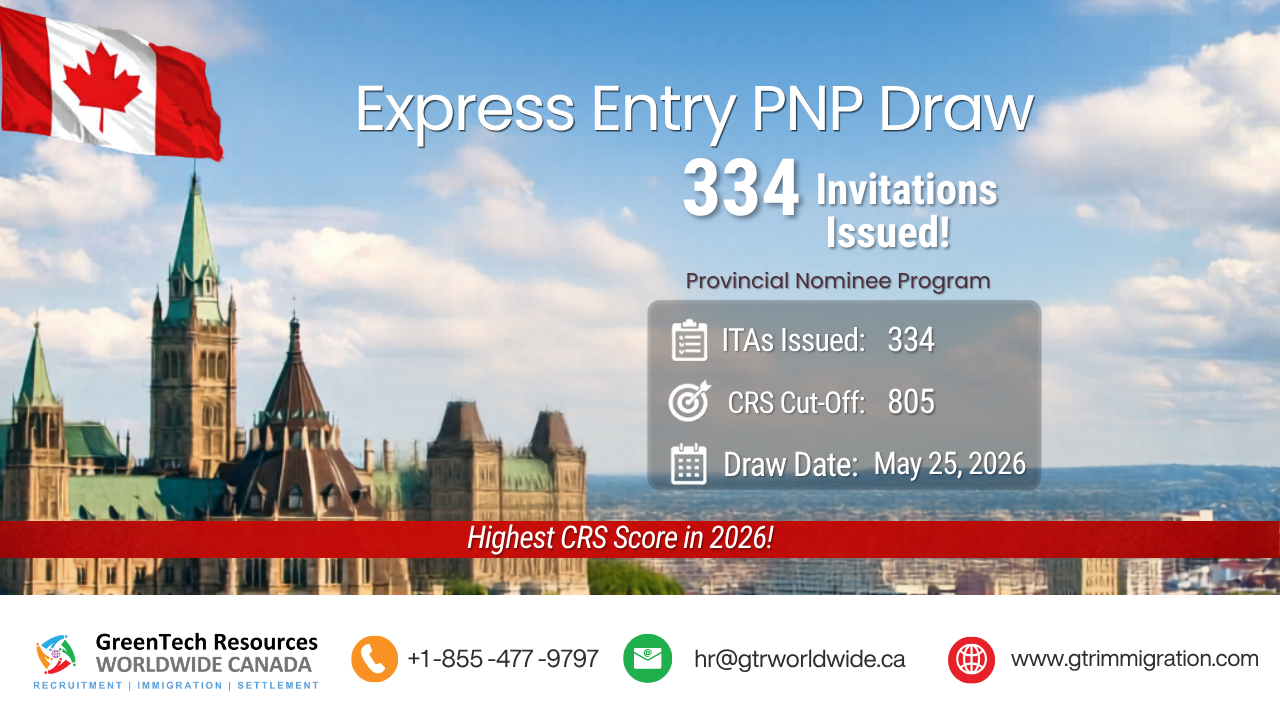
    Canada has conducted a new Express Entry draw targeting Provincial Nominee Program (PNP) candidates, issuing 334 Invitations to Apply (ITAs) on May 25, 2026. The draw required a minimum Comprehensive Ranking System (CRS) score of 805 — the highest PNP cut-off recorded so far in 2026.

    Latest Express Entry Draw Results

    Draw TypeITAs IssuedCRS Cut-OffDraw Date
    Provincial Nominee Program (PNP)334805May 25, 2026

    This marks Canada’s second consecutive PNP-specific Express Entry draw in May 2026, further highlighting the increasing importance of provincial immigration pathways in the country’s long-term immigration strategy.

    Provincial Immigration Taking a Larger Role

    Canada continues to place greater emphasis on province-led immigration selection. Candidates who receive a provincial nomination are awarded an additional 600 CRS points, significantly improving their chances of securing permanent residence.

    The federal government has already confirmed expanded Provincial Nominee Program targets for 2026 and 2027, with provinces receiving larger nomination allocations to help address labour shortages in sectors such as:

    • Healthcare
    • Construction
    • Skilled trades
    • Regional and rural communities

    IRCC Backlog Drops to Lowest Levels in Years

    Immigration, Refugees and Citizenship Canada (IRCC) recently reported a major reduction in its immigration application backlog. As of March 31, 2026, the backlog had declined to approximately 935,000 applications — one of the lowest levels seen in recent years.

    The reduction is expected to improve processing efficiency across several economic immigration categories, including Express Entry and Provincial Nominee Programs.

    Prince Edward Island Holds New PNP Draw

    In a separate provincial update, Prince Edward Island conducted a new Labour and Express Entry draw this week, issuing 114 invitations to skilled workers and international graduates through the PEI Provincial Nominee Program.

    Key Immigration Trends in Canada for 2026

    Canada’s immigration system continues evolving toward a more targeted and labour market-focused model. Current priorities include:

    • Provincial Nominee Programs (PNPs)
    • Healthcare workers
    • Skilled trades professionals
    • Regional immigration pathways
    • Employer-driven immigration
    • Faster PR pathways for workers already in Canada

    Recent Express Entry draws also demonstrate continued reliance on category-based selection and occupation-focused invitations aligned with economic needs.

    Conclusion

    The latest Express Entry and provincial immigration updates confirm Canada’s ongoing transition toward a more targeted and province-driven immigration system in 2026. With rising CRS cut-offs, expanded provincial allocations, and more PNP-focused draws, candidates with provincial nominations remain among the strongest contenders for Canadian permanent residence.

    As provinces continue taking a larger role in immigration selection, skilled workers in healthcare, construction, trades, education, and other high-demand sectors are expected to benefit the most from Canada’s evolving immigration policies.

  • Canada Increasing Provincial Immigration Targets for 2026 and 2027

    Canada Increasing Provincial Immigration Targets for 2026 and 2027

    Canada is significantly increasing its Provincial Nominee Program (PNP) targets for 2026 and 2027, highlighting the growing importance of provincial and territorial governments in selecting skilled immigrants to meet regional labour market needs.

    According to Canada’s latest Immigration Levels Plan, the federal government has raised the PNP admissions target to 91,500 permanent residents in 2026, compared to the earlier target of 55,000. This represents one of the most substantial increases ever made to provincial immigration allocations.

    Provincial Immigration Targets Rising Sharply

    The revised immigration strategy reflects a clear shift toward strengthening provincial pathways as a key driver of economic immigration, rather than relying primarily on federal Express Entry programs.

    YearPNP Admissions Target
    202555,000
    202691,500
    202792,500

    This increase reflects an approximate 66% rise in provincial immigration admissions for 2026 compared to previous planning levels.

    Why Canada Is Expanding Provincial Immigration

    The expansion is designed to address several ongoing challenges, including:

    • Labour shortages across multiple provinces
    • Healthcare workforce gaps
    • Skilled trades and construction demand
    • Regional and rural economic development
    • Population growth outside major cities
    • Northern and remote labour needs

    Provincial governments are seen as better positioned to identify local workforce requirements and nominate candidates whose skills align with regional priorities.

    Provinces Receiving Higher Allocations

    Several provinces have already reported increased nomination allocations for 2026:

    Province2026 AllocationIncrease vs 2025
    Ontario14,11931.3%
    Alberta6,40331.3%
    Manitoba6,23931.3%
    British Columbia5,25431.3%
    Saskatchewan4,76131.3%

    Other provinces and territories are also expected to benefit from expanded quotas as Canada continues shifting immigration responsibilities toward regional programs.

    Greater Focus on Targeted Selection

    The higher PNP targets reflect Canada’s increasing focus on selecting immigrants in specific, high-demand categories such as:

    • Healthcare professionals
    • Construction and skilled trades workers
    • Early childhood educators
    • Engineers and IT professionals
    • Rural and regional workers
    • Candidates already working in Canada

    Many provinces are now conducting occupation-specific and employer-driven draws to directly address urgent labour shortages.

    Impact on Express Entry Applicants

    The expansion of provincial allocations is expected to strengthen the role of PNPs as one of the most effective pathways to permanent residence in 2026 and 2027.

    Candidates who receive a provincial nomination are awarded an additional 600 CRS points under Express Entry, significantly increasing their chances of receiving an Invitation to Apply (ITA). As a result, PNP-specific draws continue to dominate Express Entry selections in 2026, often with high CRS cut-offs due to strong demand.

    Immigration experts suggest this trend signals Canada’s shift toward a more regionally driven and targeted immigration system.

    Conclusion

    Canada’s decision to substantially increase Provincial Nominee Program targets for 2026 and 2027 underscores the growing role of provinces in shaping immigration outcomes. With annual admissions rising to over 91,000, provinces will have greater capacity to select skilled workers aligned with their local economic needs.

    For applicants, this expansion creates stronger opportunities through provincial immigration streams, especially in healthcare, skilled trades, construction, education, and other in-demand sectors. As Canada continues moving toward targeted and regional selection models, Provincial Nominee Programs are set to remain one of the most important pathways to permanent residence in the coming years.

  • Ontario Receives Higher Immigration Allocation for 2026

    Ontario Receives Higher Immigration Allocation for 2026

    Ontario has officially received a larger immigration nomination allocation for 2026 under the Ontario Immigrant Nominee Program (OINP), creating expanded opportunities for skilled workers, healthcare professionals, international graduates, and trades people seeking permanent residence in Canada.

    According to Ontario’s latest update, the province has been allocated 14,119 nomination spaces for 2026 by the federal government. This marks a significant increase compared to the 10,750 nominations Ontario received in 2025.

    Ontario’s OINP Nomination Allocation

    YearOINP Nomination Allocation
    202421,500
    202510,750
    202614,119

    The 2026 allocation represents an increase of approximately 31% compared to 2025, highlighting renewed federal support for Provincial Nominee Programs across Canada.

    What This Means for Immigration Applicants

    The expanded allocation is expected to create more opportunities across several major OINP streams, including:

    • Employer Job Offer streams
    • Express Entry-linked streams
    • Skilled Trades pathways
    • Healthcare-targeted draws
    • International Student streams

    Ontario continues to focus heavily on sectors experiencing critical labour shortages, particularly:

    • Healthcare
    • Education
    • Skilled trades and construction
    • Regional economic development

    The province has already begun conducting targeted draws throughout 2026, prioritizing candidates such as physicians, healthcare workers, early childhood educators, and other professionals in high-demand occupations.

    Why Ontario’s Allocation Increased

    The larger allocation is tied to Canada’s broader Immigration Levels Plan 2026–2028, which includes increased targets for Provincial Nominee Programs nationwide.

    By expanding PNP admissions, the federal government aims to help provinces attract more skilled immigrants to address workforce shortages and support long-term economic growth.

    Ontario remains one of Canada’s most attractive immigration destinations due to its strong labour market, diverse economy, and large immigrant population.

    Competition Is Still Expected to Remain High

    Despite the increase in nomination spaces, competition across OINP streams is expected to remain strong due to continued high demand.

    Immigration experts believe Ontario will likely continue using targeted draws instead of broad invitation rounds, focusing on occupations and sectors facing the most urgent labour shortages.

    Reports also suggest Ontario may introduce regulatory updates and redesign certain immigration streams to better align with labour market priorities and employer needs.

    Conclusion

    Ontario’s increased OINP allocation for 2026 is encouraging news for skilled workers and international graduates planning to immigrate to Canada. With 14,119 nomination spaces available, the province is expected to continue expanding opportunities for candidates in healthcare, education, skilled trades, and employer-driven pathways.

    Although competition remains intense, the larger allocation reinforces Ontario’s commitment to attracting global talent and addressing key workforce shortages through targeted immigration programs.

  • Ontario Targets Greater Toronto Area in Latest OINP Draws, Issuing 997 ITAs

    Ontario Targets Greater Toronto Area in Latest OINP Draws, Issuing 997 ITAs

    Ontario has conducted a major targeted immigration draw under the Ontario Immigrant Nominee Program (OINP), issuing 997 Invitations to Apply (ITAs) to candidates with valid job offers in the Greater Toronto Area (GTA).

    The latest draw, held on April 30, 2026, focused on the Employer Job Offer streams, specifically the Foreign Worker Stream and the International Student Stream. The move highlights Ontario’s ongoing efforts to address labour shortages and support economic growth across the GTA region.

    Latest OINP Draw Results

    StreamInvitations IssuedMinimum ScoreProfile Selection Window
    Employer Job Offer: Foreign Worker Stream78657July 2, 2025 – April 28, 2026
    Employer Job Offer: International Student Stream27781July 2, 2025 – April 28, 2026
    Total997

    To qualify, candidates needed to be living in Canada with a valid work or study permit and possess a job offer from an employer located in the Greater Toronto Area, including Durham, Halton, Peel, Toronto, and York regions.

    Ontario Continues to Target High-Demand Sectors

    The draw primarily focused on candidates working in occupations facing ongoing labour shortages, including:

    • Healthcare
    • Construction
    • Technology
    • Administration
    • Skilled trades

    Ontario continues to prioritize workers who can quickly integrate into the labour market and contribute to the province’s economic development.

    This GTA-focused round follows several regional OINP draws earlier in 2026 that targeted communities in Northern, Eastern, Southwestern, and Central Ontario. The latest invitations signal renewed focus on workforce demands in Canada’s largest metropolitan region.

    Important Next Steps for Invited Candidates

    Candidates who received an invitation must meet strict OINP deadlines:

    • Employers must submit employment position approval forms within 14 calendar days
    • Candidates must submit their full provincial nomination application within 17 calendar days of receiving the ITA

    Missing these deadlines could impact eligibility under the program.

    Why This Draw Is Significant

    Ontario’s latest draw demonstrates the province’s increasingly targeted immigration strategy based on regional and sector-specific labour needs.

    The relatively low score requirement under the Foreign Worker Stream suggests Ontario is actively expanding opportunities for skilled workers already contributing to the provincial economy.

    With thousands of invitations already issued across multiple streams in 2026, Ontario remains one of Canada’s most active provinces for provincial nomination opportunities.

    Conclusion

    Ontario’s latest OINP draw highlights the province’s continued commitment to attracting skilled workers and international graduates to the Greater Toronto Area. By issuing 997 invitations through the Foreign Worker and International Student streams, Ontario aims to strengthen key sectors experiencing labour shortages while supporting long-term economic growth.

    As the province continues using targeted and regional immigration draws throughout 2026, candidates with valid job offers in high-demand occupations may find strong opportunities to secure Canadian permanent residence through Ontario’s provincial nominee pathways.

  • Canada’s Fee Waiver for Reclaiming Indigenous Names on Identity Documents Ending Soon

    Canada’s Fee Waiver for Reclaiming Indigenous Names on Identity Documents Ending Soon

    Canada has announced that its temporary fee waiver program for Indigenous peoples reclaiming traditional names on official identity documents will officially end on May 30, 2026.

    The initiative, introduced in 2021 by Immigration, Refugees and Citizenship Canada (IRCC), was created in response to the Truth and Reconciliation Commission’s Call to Action 17. It allowed Indigenous individuals, residential school survivors, and their descendants to update official documents using reclaimed Indigenous names without paying government processing fees.

    What Documents Are Covered Under the Fee Waiver?

    Eligible applicants have been able to replace or update several important Canadian identity documents free of charge, including:

    • Passports
    • Travel documents
    • Citizenship certificates
    • Permanent Resident (PR) cards

    The waiver remains available until May 30, 2026. Beginning May 31, 2026, standard processing fees will once again apply to all name-change and replacement requests.

    Why the Program Was Created

    The program was introduced to help address the lasting impact of historical government policies that forced many Indigenous peoples to abandon or alter their traditional names, particularly during the residential school era.

    As part of reconciliation efforts, the Truth and Reconciliation Commission recommended removing financial and administrative barriers for Indigenous individuals seeking to restore their original names on official documents. IRCC responded by launching the five-year fee waiver initiative in 2021.

    Who Is Eligible?

    To qualify for the fee waiver before the deadline, applicants generally must:

    • Be an Indigenous person, residential school survivor, or descendant
    • Possess valid identification documents
    • Provide supporting documentation or proof of legal name change for the reclaimed Indigenous name

    Certain documents, including passports and PR cards, must also meet specific validity requirements at the time of application.

    Important Deadline to Remember

    Individuals wishing to reclaim Indigenous names without paying government fees are encouraged to submit their applications before May 30, 2026.

    After this date, applicants will still be able to update their names through regular procedures, but standard IRCC processing fees will apply.

    Conclusion

    The conclusion of Canada’s temporary fee waiver program marks the end of an important reconciliation initiative aimed at helping Indigenous peoples restore traditional names on official identity documents. Since its launch in 2021, the program has helped reduce financial barriers for thousands seeking to reconnect with their cultural identity and heritage.

    With the May 30, 2026 deadline approaching, eligible individuals still have time to take advantage of the fee-free process before regular fees are reinstated.

  • Manitoba Issues 906 Letters of Advice to Apply in Largest MPNP Draw of 2026

    Manitoba Issues 906 Letters of Advice to Apply in Largest MPNP Draw of 2026

    In a major boost for Canadian immigration, the Manitoba Provincial Nominee Program (MPNP) has held its largest draw of 2026, issuing 906 Letters of Advice to Apply (LAAs) to skilled workers and international graduates pursuing permanent residence in Canada.

    The latest draw highlights Manitoba’s ongoing commitment to addressing labour shortages and supporting economic growth by attracting qualified talent across multiple industries. Invitations were issued under several immigration streams, including:

    • Skilled Workers in Manitoba
    • Skilled Workers Overseas
    • International Education Stream

    According to the official update, Manitoba prioritized candidates with strong ties to the province, relevant work experience, language proficiency, and the ability to contribute effectively to the local labour market.

    A significant number of invitations were also issued to candidates working in high-demand sectors such as:

    • Healthcare
    • Skilled trades
    • Transportation
    • Manufacturing
    • Other essential industries

    Manitoba Continues to Prioritize Skilled Immigration

    The Manitoba Provincial Nominee Program remains one of Canada’s most accessible immigration pathways for individuals looking to settle outside major metropolitan areas.

    In recent years, Manitoba has increasingly focused on retaining:

    • International graduates
    • Temporary foreign workers
    • Skilled professionals already contributing to the provincial economy

    Immigration experts suggest that this record-breaking draw reflects Manitoba’s growing demand for skilled workers in 2026. As Canada continues expanding economic immigration, provincial nominee programs are expected to play an even larger role in meeting workforce demands across the country.

    Why This Draw Matters

    Candidates selected through the MPNP may receive a provincial nomination, which can significantly improve their chances of obtaining Canadian permanent residence through the federal immigration system.

    The draw also supports Canada’s broader immigration strategy focused on:

    • Regional economic development
    • Addressing labour shortages
    • Population growth outside major cities

    Provincial governments across Canada are increasingly relying on nominee programs to attract talent tailored to local labour market needs.

    Advice for Future Applicants

    Individuals interested in Manitoba immigration opportunities are encouraged to:

    • Keep their profiles updated
    • Improve language test scores where possible
    • Gain experience in occupations facing labour shortages
    • Explore provincial pathways aligned with Manitoba’s economic priorities

    Conclusion

    Manitoba’s issuance of 906 Letters of Advice to Apply marks a major milestone in the province’s 2026 immigration efforts. The record-setting draw demonstrates Manitoba’s urgent need for skilled workers and its strong commitment to economic growth through immigration.

    As Canada continues expanding regional immigration initiatives, Manitoba remains one of the most attractive destinations for skilled workers, international graduates, and temporary foreign workers seeking long-term career opportunities and permanent residence in Canada.

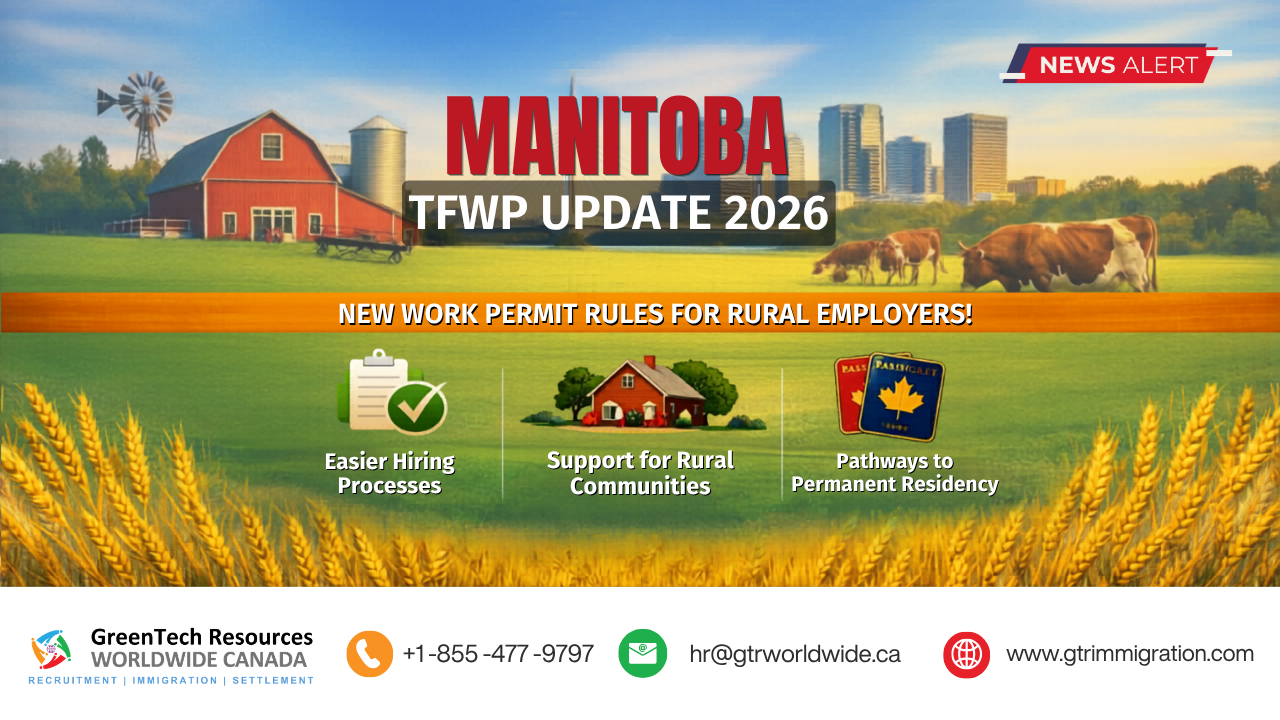
  • Manitoba TFWP Update 2026: New Work Permit Rules for Rural Employers

    Manitoba TFWP Update 2026: New Work Permit Rules for Rural Employers

    Manitoba Expands Work Permit Access for Rural Employers and Foreign Workers in 2026

    In a significant step to tackle ongoing labour shortages, Manitoba has officially expanded work permit opportunities for rural employers and temporary foreign workers through new measures under Canada’s Temporary Foreign Worker Program (TFWP).

    Effective April 14, 2026, Manitoba adopted special federal temporary measures that provide rural employers with greater flexibility to hire low-wage temporary foreign workers. These measures will remain active until March 31, 2027.

    The update is expected to benefit both employers facing staffing shortages in rural and northern Manitoba and foreign workers seeking employment opportunities and potential pathways to permanent residence in Canada.

    What Has Changed Under Manitoba’s New TFWP Rules?

    Under the standard low-wage TFWP rules, employers are generally limited to hiring temporary foreign workers for up to 10% of their workforce.

    With the new temporary measures, eligible rural employers in Manitoba can now benefit from two major changes:

    1. Employers Can Retain Existing Workers Above the 10% Cap

    Businesses can now maintain their current proportion of low-wage temporary foreign workers at a worksite, even if it already exceeds the usual 10% limit.

    This flexibility helps employers avoid operational disruptions and retain essential workers needed to keep businesses running smoothly.

    2. Hiring Limit Increased from 10% to 15%

    Eligible employers are now permitted to hire temporary foreign workers for up to 15% of their workforce under the low-wage stream.

    This increase applies across all industries, giving employers additional flexibility to respond to labour shortages.

    Who Is Eligible?

    These temporary measures apply to:

    • Employers located outside the Winnipeg Census Metropolitan Area (CMA)
    • Rural and northern Manitoba businesses
    • All employment sectors
    • Low-wage positions under the TFWP

    The Winnipeg CMA is not included under these special measures.

    Employers must still comply with all standard TFWP requirements, including demonstrating efforts to recruit Canadian citizens and permanent residents before hiring foreign workers.

    Why Manitoba Introduced These Measures

    Manitoba continues to face serious labour shortages, particularly in smaller communities where finding local workers remains challenging.

    The province introduced these changes to help employers address staffing gaps, maintain operations, and support economic growth across rural regions.

    Industries expected to benefit the most include:

    • Agriculture
    • Food processing
    • Manufacturing
    • Hospitality
    • Health support services
    • Transportation
    • Rural construction
    • Seasonal industries

    What This Means for Foreign Workers

    The expanded TFWP measures create several advantages for temporary foreign workers in Manitoba.

    More Employment Opportunities

    With higher hiring limits, more employers can recruit workers through the low-wage TFWP stream.

    Greater Job Stability

    Workers already employed under the program may benefit from improved job security as employers can now retain staffing levels above previous limits.

    Stronger Pathways to Permanent Residence

    Canada’s new 2026 TR-to-PR initiatives are placing greater focus on rural workers and smaller communities.

    As a result, temporary foreign workers employed in rural Manitoba may have stronger long-term opportunities to transition to permanent residence.

    This makes rural Manitoba an increasingly attractive destination for workers planning to build their future in Canada.

    Important Dates

    Program Start Date:
    April 14, 2026

    Program Expiry Date:
    March 31, 2027

    Only new LMIA applications submitted during this period may qualify under these temporary measures. Applications submitted before the implementation date are not eligible.

    Final Thoughts

    Manitoba’s decision to expand TFWP access represents an important development for both employers and foreign workers in rural Canada.

    With increased hiring flexibility, stronger workforce retention, and growing connections to future permanent residence opportunities, the province is positioning itself as one of Canada’s leading destinations for rural immigration and employment growth.

    For employers, the policy offers faster and more flexible hiring solutions.
    For foreign workers, it creates new employment opportunities and a stronger potential pathway toward permanent residence in Canada.